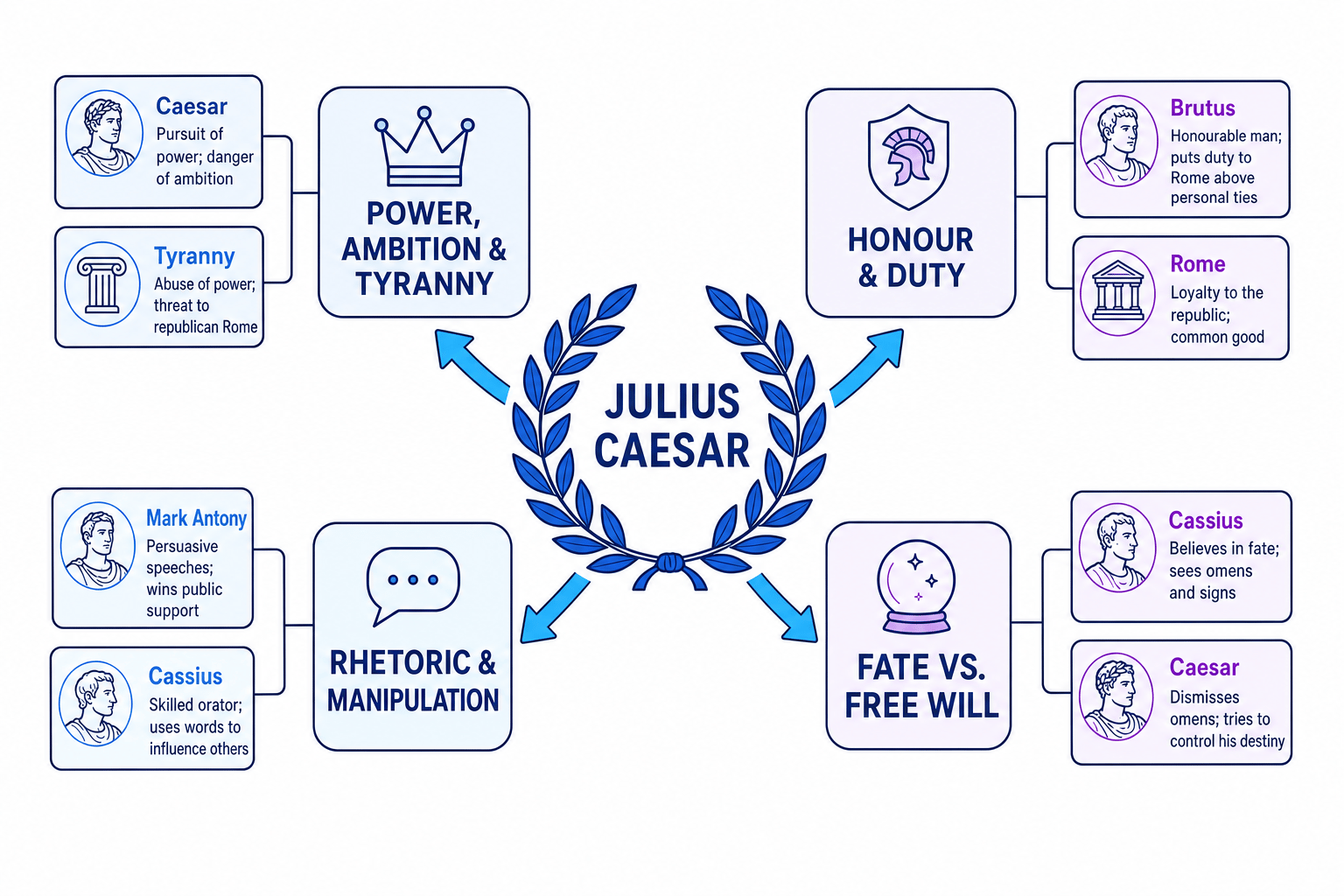
In Julius Caesar, Shakespeare explores the volatile world of Roman politics to ask timeless questions about power, ethics, and human nature. Written in 1599, during the final years of Queen Elizabeth I's reign, the play reflects Elizabethan anxieties about government succession, rebellion, and civil war. By analyzing the play's themes, you will discover that Shakespeare rarely offers simple moral answers; instead, he presents a complex world of conflicting values.
What you'll learn
- How the tension between republican duty and personal ambition drives the tragedy.
- The dangerous power of rhetoric and language to manipulate political outcomes.
- How the conflict between fate and free will shapes the characters' tragic downfalls.
- Strategies to link language analysis directly to Shakespeare's broader thematic messages.
1. Power, Ambition, and Tyranny
At the heart of the play is a political struggle over the future of the Roman state. The conflict arises from a clash between Julius Caesar's growing power and the conspirators' fear of authoritarian rule.
Tyranny
Tyranny is a cruel, unreasonable, or arbitrary use of power or control, typically exercised by a single ruler (a tyrant) who has seized absolute authority.
The Threat of Caesar's Ambition
While Caesar is a brilliant military commander, his ambition threatens the Roman Republic. Rome was founded on the principle that no single man should rule as a king.
Shakespeare shows Caesar's growing self-deification (treating himself like a god). Caesar frequently speaks of himself in the third person, stating, "danger knows full well / That Caesar is more dangerous than he." This detachment from his own humanity signals to the audience that Caesar is beginning to see himself as an unstoppable force, justifying the conspirators' fears of impending dictatorship.
The Paradox of Pre-emptive Violence
The conspirators, led by Brutus, justify assassination as a necessary act of protection. However, Shakespeare presents a profound moral paradox: is it right to kill a leader for what they might do in the future?
In Act 2, Scene 1, Brutus struggles with this exact dilemma in his soliloquy:
"He would be crown'd: / How that might change his nature, there's the question."
Brutus admits that Caesar has not yet abused his power, but he fears the crown will give him the capacity to do so. The tragedy of the play is that by trying to prevent tyranny through violence, the conspirators plunge Rome into a brutal civil war, ultimately resulting in another dictatorship under Octavius and Mark Antony.
The Cycle of Power
Shakespeare suggests that power is inherently corrupting and cyclical. The assassination of one ruler (Caesar) does not save the Republic; it simply creates a power vacuum filled by new, even more ruthless leaders (the Triumvirate of Antony, Octavius, and Lepidus).
2. Honour and Duty
For a Roman noble, honour (virtus) was the most important personal quality, representing moral integrity, bravery, and selfless service to the state. However, the play demonstrates how easily "honour" can be manipulated or used to justify terrible acts.
Brutus: The Tragic Idealist
Brutus is defined by his commitment to honour. Cassius recognizes this and exploits it, knowing that Brutus will only join the conspiracy if he believes it is for the "general good" of Rome. Brutus prioritizes his civic duty over his personal love for Caesar:
"Not that I loved Caesar less, but that I loved Rome more." (Act 3, Scene 2)
By framing the murder of his friend as a noble sacrificial rite rather than a bloody assassination, Brutus maintains his self-image of honour. He tells the conspirators to be "sacrificers, but not butchers."
The Irony of "Honourable Men"
Shakespeare exposes the fragility of honour through Mark Antony's devastatingly ironic funeral speech. By repeatedly referring to Brutus and the conspirators as "honourable men", Antony systematically deconstructs their reputation in the eyes of the public. The repetition strips the word of its dignity, exposing the conspirators' actions as treasonous and self-serving.
Confusing Brutus's motives with Cassius's
Do not write that all the conspirators had the same motivations. While Brutus is driven by genuine honour and patriotism, Cassius is largely motivated by personal envy of Caesar's authority (e.g., complaining that Caesar is treated like a "Colossus" while they are "underlings"). Differentiating these motives is crucial for securing higher-tier marks.
3. Rhetoric, Persuasion, and Manipulation
Language in Julius Caesar is not merely a tool for communication; it is a weapon. The play demonstrates that in a political arena, public perception and emotional manipulation are far more powerful than objective truth.
Rhetoric
Rhetoric is the art of persuasive speaking or writing, especially the use of figures of speech and other compositional techniques to influence an audience.
Cassius's Seduction of Brutus
In Act 1, Scene 2, Cassius uses sophisticated rhetorical techniques to recruit Brutus. Instead of appealing to logic, he targets Brutus's pride and sense of honour. He uses a mirror metaphor, offering to be Brutus's "glass" to show him the hidden greatness that he cannot see in himself. Cassius uses flattering language and appeals to ancestral duty, reminding Brutus of his ancestor who expelled the last king of Rome.
The Battle of the Speeches (Act 3, Scene 2)
The pivotal scene of the play features two contrasting rhetorical styles:
- Brutus's Speech: Written in prose (the language of reason and intellect). He appeals to the crowd’s logic, asking them to respect his honour and calmly weigh his arguments. It is rigid, formal, and ultimately fails to capture the crowd's long-term loyalty because it lacks emotional warmth.
- Antony's Speech: Written in blank verse (unrhymed iambic pentameter, the language of emotion and passion). Antony uses masterful theatricality, holding Caesar's blood-stained cloak, showing the physical wounds, and using verbal irony. He leverages pathos (emotional appeal) to incite the plebeians to a state of collective rage and mutiny.
Look closely at form
When analyzing the funeral speeches, always note that Brutus speaks in prose while Antony speaks in poetry. This structural contrast perfectly mirrors their characters: Brutus is academic and emotionally detached; Antony is passionate, theatrical, and deeply understands human psychology.
4. Fate versus Free Will
Throughout the play, Rome is filled with supernatural signs, storms, and omens. Shakespeare uses these elements to explore whether the characters' lives are pre-determined by fate, or if they have the agency (free will) to shape their own destinies.
The Rejection and Acceptance of Omens
Characters constantly misinterpret or ignore signs depending on their political desires:
- Cassius initially represents a philosophical stance of free will, arguing:
"The fault, dear Brutus, is not in our stars, / But in ourselves, that we are underlings." (Act 1, Scene 2) He believes that human action, not celestial fate, dictates political success. Yet, by the end of the play, facing defeat at Philippi, he abandons this rationalism and begins to believe in bad omens (like ravens and crows hovering over his army).
- Caesar displays a fatalistic attitude to justify his bravery, declaring:
"Cowards die many times before their death; / The valiant never taste of death but once." (Act 2, Scene 2) However, this fatalism borders on hubris (excessive pride), leading him to ignore the Soothsayer's warning to "Beware the ides of March" and Calpurnia’s prophetic dream.
Ultimately, Shakespeare suggests that while fate may set the stage, it is the characters' own tragic flaws—Caesar’s pride and Brutus’s idealistic blindness—that actively seal their dooms.
Analyzing Theme and Language
To achieve high marks in your GCSE essay, you must show how Shakespeare uses specific linguistic methods to build his central themes. Let's walk through an analytical process for a key thematic passage.
Analyzing Brutus's internal conflict over honour in Act 2, Scene 1
Analyze how Shakespeare presents Brutus's fears of Caesar's ambition in his Act 2, Scene 1 soliloquy.
-
Step 1: Identify the thematic focus and the key metaphor.
Locate the specific imagery Brutus uses to conceptualize ambition. Brutus uses the metaphor of a ladder and a snake:
"But 'tis a common proof, / That lowliness is young ambition's ladder, / Whereto the climber-upward turns his face; / But when he once attains the upmost round, / He then unto the ladder turns his back..."
-
Step 2: Deconstruct the language and literary methods.
Analyze the mechanics of the ladder metaphor. The "ladder" represents the path to political power. "Lowliness" (humility or pretending to care for the common people) is merely a tool used to climb. Once the ambitious person reaches the top ("the upmost round"), they look only at the clouds, scorning those below.
Note the physical verbs of motion and direction ("climber-upward", "turns his back", "looking in the clouds"). This spatial imagery emphasizes the widening, unnatural divide between a tyrant and the citizens.
-
Step 3: Connect the analysis to the thematic message and historical context.
Link this to the theme of power and tyranny. Brutus is using logical deduction to convince himself that assassination is the only solution. By comparing ambition to climbing a ladder, Shakespeare highlights the psychological shift that occurs when a leader gains absolute power.
In Elizabethan England, this would resonate deeply with an audience familiar with the dangers of courtly ambition and the potential rise of an unchecked absolute monarch. Brutus's fear is that absolute power inherently isolates the ruler from the ruled, destroying the democratic foundation of the Republic.
In the exam
- Focus on the writer as a creator: Never write about the characters as if they are real people. Always frame your arguments around Shakespeare’s choices (e.g., "Shakespeare utilizes the metaphor of the serpent's egg to illustrate...").
- Weave context into your theme analysis (AO3): Do not write isolated "history paragraphs" at the end of your essay. Instead, connect Elizabethan anxieties about succession and political instability directly to scenes depicting Rome falling into civil war.
- Analyze structure alongside language (AO2): Look at how themes develop over the course of the play. Note how the orderly world of the Republic in Act 1 breaks down into chaotic civil war and supernatural unrest by Act 4, mirroring the moral consequences of the assassination.
- Use precise terminology: Avoid vague terms like "the author uses words". Instead, use terms like soliloquy, blank verse, prose, extended metaphor, pathos, hubris, and dramatic irony.
Check yourself
- How does the change in Brutus's writing style (from prose in his speech to blank verse in other scenes) reflect his internal state and his relationship with the public?
- Why does Cassius shift from a belief in free will (Act 1) to a belief in bad omens (Act 5), and what does this say about the theme of fate?
- Find two short quotations that demonstrate Caesar's hubris (excessive pride). How do these quotes support the theme of power and tyranny?
