

Winsome Pinnock’s Leave Taking (first performed in 1987) is a pioneering work of Black British theatre. Set in Deptford, South London, during the mid-1980s, the play follows the lives of Enid, a single mother who emigrated from Jamaica as part of the Windrush generation, and her two British-born teenage daughters, Del and Viv.
Through its traditional two-act structure, the play explores the emotional, cultural, and generational divides that open up when a family is caught between two worlds.
What you'll learn
- The chronological sequence of events across both acts of the play.
- How Pinnock structures the dramatic tension, moving from domestic friction to a climatic emotional release.
- The symbolic importance of the key turning points, including Del’s departure and the news of the grandmother's death.
- How to link structural choices directly to the play’s central themes of displacement, belonging, and identity.
Understanding the Dramatic Context
To understand the plot, you must first understand the social climate that shapes the characters' actions. The play is set in the mid-1980s against a backdrop of racial tension, high unemployment, and social deprivation in urban Britain.
Windrush Generation
The generation of people who arrived in the UK from Caribbean countries between 1948 and 1971, invited by the British government to help rebuild the post-war economy. They faced widespread institutional racism and hostile social conditions.
The plot operates on two distinct structural levels:
- The External Narrative: The daily domestic conflicts, school exams, jobs, and financial struggles of a working-class Black family in London.
- The Internal Narrative: The psychological journey of "leave taking"—the necessity of letting go of painful past illusions in order to forge a healthy, authentic identity in the present.
Act-by-Act Breakdown: The Structural Arc
Pinnock uses a tightly structured, realistic domestic drama format to build tension. The timeline below illustrates how the narrative progresses through traditional dramatic stages to resolve the family's deep-seated conflicts.
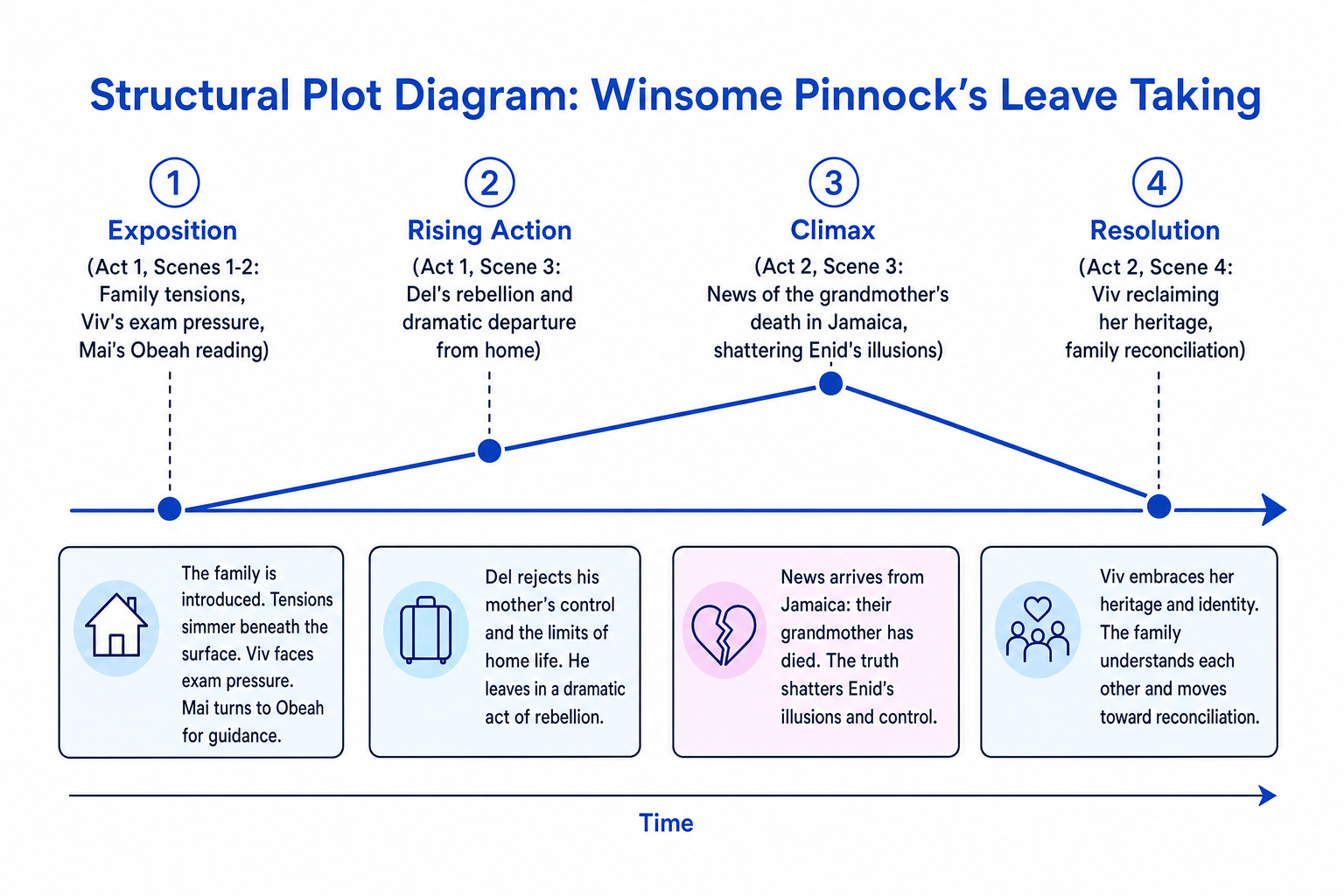
Act 1: The Setup of Conflict
Scene 1: Mai's Flat (Exposition)
The play opens in the dimly lit East London flat of Mai, an Obeah woman. Enid has brought her daughters, Del and Viv, to seek spiritual guidance. Viv is suffering from intense stress over her upcoming A-Level exams, which Enid views as her ticket to safety and success in white British society. Del is openly hostile and cynical about the session. Mai performs a reading using tea leaves and cards, sensing the deep spiritual displacement of the family and predicting that one daughter will travel far.
Obeah
A system of spiritual healing, belief, and justice practice originating in West Africa and developed by enslaved populations in the Caribbean. In the play, it represents a direct, ancestral link to Jamaican culture.
Scene 2: Enid’s Home (Rising Action)
The setting shifts to Enid's clean, carefully maintained terraced house. We meet Brod, Enid's friend and fellow immigrant, who represents the collective trauma of the first-generation Windrush pioneers. The scene establishes the crushing pressure Enid places on Viv to assimilate and achieve, alongside her growing resentment toward the rebellious Del, who refuses to conform to respectable British expectations.
Scene 3: The Clash and Departure (Inciting Incident)
Del returns home late, sparking a furious argument with Enid. The conflict exposes the deep rift between them: Enid accuses Del of being ungrateful for her sacrifices as a hospital cleaner, while Del accuses Enid of trying to erase their Black identity to appease a racist society ("You wanted us to be white"). Del packs her bags and leaves the house, fracturing the family unit.
The Split in Sisterhood
The division between the two sisters in Act 1 represents two opposing responses to the immigrant experience: Viv tries to survive by conformist assimilation (academic achievement), while Del rebels against the system entirely, refusing to play by rules that she believes are rigged.
Act 2: Crisis and Resolution
Scene 1: Viv’s Crisis of Identity
Sometime later, Viv is buckling under the weight of her studies and her sister's absence. Desperate for answers, she visits Mai's flat alone. Instead of receiving a magical cure, Viv has an honest conversation with Mai about her mother's past. She begins to realize that her mother's strictness stems from a place of deep fear and unresolved grief over leaving Jamaica.
Scene 2: Brod and Del
We see Del living a precarious life away from home. She visits Brod's flat, where they share a poignant moment of connection. Brod speaks candidly about his disillusionment with England ("the mother country") and his feelings of displacement. This scene bridges the gap between the first and second generations, showing that Del's anger is inherited from the systemic rejection that Brod experienced.
Scene 3: The Climax
Back at Enid's house, a devastating letter arrives from Jamaica: Enid's mother has died. Because Enid could not afford to travel back, she has been deprived of saying goodbye. The news completely shatters Enid's stoic façade. She collapses in grief, realizing that her obsession with working and assimilating in Britain has cut her off from her mother and her homeland forever. Del returns during this scene, witnessing her mother's raw vulnerability for the first time.
The power of the offstage death
The death of Enid’s mother happens offstage, but it acts as the primary catalyst for change. It forces Enid to recognize that her emotional ties to Jamaica cannot be ignored or buried under British "respectability."
Scene 4: The Resolution (Leave Taking)
The final scene brings all the characters together. Viv makes the brave decision to step away from the immediate pressure of her exams, choosing instead to learn about her heritage. Enid, humbled and transformed by her grief, performs a symbolic ritual of mourning with Mai's help.
The play ends on a note of tentative hope: the characters have not solved all their material problems, but they have achieved an emotional "leave taking"—letting go of the past's bitterness and their false illusions, allowing them to face the future as their authentic selves.
Confusing 'leaving' with failure
Students often assume that Del leaving home or Viv reconsidering her exams are tragic failures. In Pinnock’s structural arc, these are actually positive, necessary acts of self-determination. The characters must "leave" their prescribed roles to find genuine reconciliation.
Worked Example: Analyzing Structural Contrast
Question
How does Winsome Pinnock use the contrast between the opening scene in Mai’s flat and the final scene of the play to show the characters’ development?
Analyzing structural contrast in Leave Taking
-
Identify the structural parallel: Note how both the first and last scenes of the play feature a spiritual or ritualistic element involving Mai. In Act 1, Scene 1, Enid initiates the Obeah reading to control Viv's future. In Act 2, Scene 4, the ritual is used to lay the past to rest.
-
Analyze the character dynamic in the opening scene: Explain how the family is fragmented and defensive at the start. Quote or reference their behavior: Del is hostile, Viv is passive and terrified of failing, and Enid is desperate to force her daughters into a rigid path of success.
-
Analyze the character dynamic in the closing scene: Contrast this with the ending. Enid is no longer trying to control her daughters; she is mourning her mother openly. Viv is no longer passive; she has taken control of her own destiny, declaring, "I want to know where I come from." Del has returned, offering mature support to her mother.
-
Connect the structural change to Pinnock’s message (AO3): Explain why Pinnock structured the play this way. The transition from the forced, anxious Obeah consultation of Scene 1 to the genuine, healing mourning ritual of the final scene shows that true belonging cannot be forced through material success or assimilation. It must come from accepting one's roots and allowing each generation the freedom to choose its own path.
In the exam
- Track the narrative arc: Do not just retell the story. Always frame your points around why Pinnock places events in this order. For example, explain how the death of the grandmother is strategically placed in Act 2 to shatter Enid's emotional defenses.
- Anchor your analysis with structural terms: Use terms like exposition, rising action, climax, foil (e.g., Del and Viv as foils for each other), and resolution to show the examiner you are analyzing form and structure (AO2).
- Use the "Before and After" technique: When discussing any character's journey, contrast their state of mind at the beginning of the play with their state of mind at the end to demonstrate how the plot has forced them to change.
Check yourself
- Why is it structurally significant that the play begins in Mai's flat rather than in Enid's home?
- What is the dramatic function of Brod's conversations with Del in Act 2, Scene 2?
- How does the news of her mother's death change Enid's attitude toward her daughters and her own past?
