Understanding the plot of Julius Caesar is about much more than memorising what happens next. In your GCSE English Literature exam, you need to understand how and why Shakespeare structures the narrative to create tension, explore political ideas, and trace the tragic downfall of Brutus.
What you'll learn:
- How to navigate the five-act structure of a Shakespearean tragedy.
- The key narrative milestones, from the initial whispers of conspiracy to the chaotic battlefield of Philippi.
- How structural choices shape the play’s central themes of power, loyalty, and fate.
The Structural Blueprint: Freytag's Pyramid
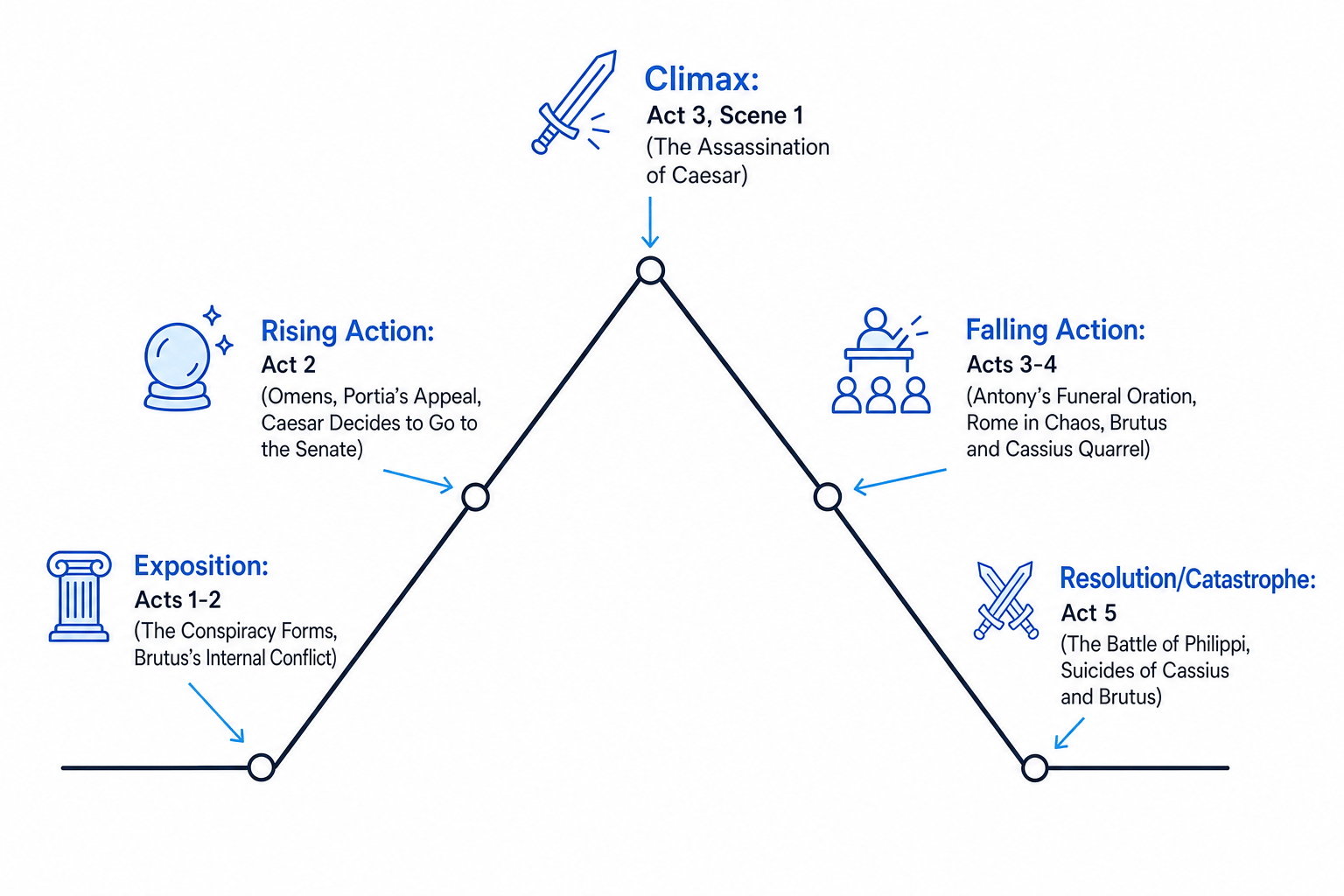
To analyse the plot effectively (gaining vital marks for AO2: Structure), you must first understand the shape of the drama. Shakespeare structured his plays using a classic five-act model, which can be mapped onto Freytag's Pyramid.
Freytag's Pyramid
A structural framework that divides a drama into five distinct parts: Exposition, Rising Action, Climax, Falling Action, and Catastrophe/Resolution.
In Julius Caesar, the climax is unusually placed. Instead of happening near the very end of the play, the assassination of Caesar occurs at the start of Act 3. This choice divides the play into two distinct halves: the rise of the conspiracy, and its bloody aftermath.
Act-by-Act Breakdown
Act I: The Seeds of Conspiracy (Exposition)
The play opens in Rome, where the commoners are celebrating Julius Caesar’s triumphant return after defeating his rival, Pompey. Two tribunes, Flavius and Murellus, fear Caesar’s growing power and tear down his victory decorations, establishing the central political tension of the play: the struggle between republicans and authoritarian rule.
During the Feast of Lupercal, a Soothsayer warns Caesar to "Beware the ides of March" (Act 1, Scene 2)—a vital piece of foreshadowing that Caesar arrogantally dismisses.
Meanwhile, Cassius, a deeply cynical and pragmatic senator, begins to manipulate the honorable Marcus Brutus. Cassius recognizes that the conspirators need Brutus's high moral reputation to justify their planned murder to the Roman public. Cassius whispers:
"I, your glass, / Will modestly discover to yourself / That of yourself which you yet know not of" (Act 1, Scene 2)
The Power of Persuasion
In Act 1, Cassius plays on Brutus's love for Rome, weaponising Brutus's fear that Caesar will crown himself king and destroy the Roman Republic.
Act II: The Conspiracy Solidifies (Rising Action)
Act II shifts to Brutus's private orchard. Through a crucial soliloquy, Brutus wrestles with his conscience.
Soliloquy
A dramatic speech in which a character speaks their thoughts aloud while alone on stage, allowing the audience direct access to their inner mind.
Brutus concludes that Caesar must die, comparing him to a "serpent's egg / Which, hatch'd, would, as his kind, grow mischievous" (Act 2, Scene 1). The conspirators meet at Brutus’s house. Brutus makes several key tactical errors here: he refuses to let them swear an oath (arguing their noble cause is enough), and he vetoes Cassius’s suggestion to kill Caesar's loyal ally, Mark Antony.
Supernatural omens dominate the night. In Act 2, Scene 2, Caesar's wife, Calpurnia, begs him not to go to the Senate after dreaming that his statue "did run pure blood". However, the conspirator Decius Brutus reinterprets the dream as a symbol of Rome's revitalisation, appealing to Caesar’s immense vanity and convincing him to leave for the Capitol.
Act III: The Turning Point (Climax)
At the Senate House, the conspirators surround Caesar. One by one, they stab him. Brutus delivers the final blow. Devastated by his friend’s betrayal, Caesar utters his famous final words:
"Et tu, Brute? —Then fall, Caesar!" (Act 3, Scene 1)
The conspirators bathe their hands in Caesar’s blood, claiming they have brought "Liberty, freedom, and enfranchisement!"
However, the political vacuum is instantly filled. Antony pretends to align with the conspirators to secure his safety, but once left alone with Caesar's body, he promises a bloody civil war: "Cry 'Havoc!' and let slip the dogs of war" (Act 3, Scene 1).
In the famous forum scene (Act 3, Scene 2), Brutus speaks to the Roman crowd in prose, rationally explaining that he killed Caesar because he "loved Rome more". Antony then takes the stage. In a masterclass of rhetoric (persuasive speech), he uses iambic pentameter and sarcastic repetition ("Brutus is an honourable man") to turn the crowd against the conspirators, sparking a violent riot.
Confusing Caesar as the Protagonist
Do not assume Caesar is the protagonist because his name is in the title. Brutus is the true tragic hero of the play. His internal conflict, fatal flaws, and ultimate downfall drive the entire plot.
Act IV: The Consequences (Falling Action)
The aftermath of the assassination is chaotic. Rome is plunged into civil war. A new government (the Second Triumvirate), consisting of Antony, Octavius (Caesar's adopted son), and Lepidus, ruthlessly executes political opponents.
Meanwhile, Brutus and Cassius have fled Rome and set up camp in Sardis. They have a bitter argument in Brutus's tent over money and morals. Brutus reveals that his wife, Portia, has committed suicide by swallowing hot coals in her grief over his absence and the rise of Antony's forces.
That night, Brutus is visited by the Ghost of Caesar, who tells him: "Thou shalt see me at Philippi" (Act 4, Scene 3).
Caesar's Ghost as a Structural Device
The Ghost is a dramatic symbol of Caesar's enduring power. It reminds us that while the conspirators could kill Caesar's physical body, they could not kill the ideology of Caesarism (absolute rule).
Act V: The Tragic End (Resolution)
The opposing armies meet on the plains of Philippi. Misinterpreting the battlefield movements and believing his best friend has been captured, Cassius falls into despair and orders his servant to kill him with the very sword he used on Caesar.
Realising the battle is lost and haunted by Caesar's ghost, Brutus also commits suicide by running onto his own sword. The play ends on a note of reconciliation. Standing over Brutus’s body, Antony delivers a final tribute:
"This was the noblest Roman of them all... / His life was gentle, and the elements / So mix'd in him that Nature might stand up / And say to all the world, 'This was a man!'" (Act 5, Scene 5)
Octavius orders a respectful burial, symbolising the restoration of order under a single, supreme ruler—paving the way for the historical rise of the Roman Empire.
Analysing the Plot: Step-by-Step
To achieve top marks, you must show the examiner how the sequence of events serves Shakespeare's wider message. Let’s look at how to construct an analytical paragraph tracing the impact of a specific structural pivot.
Analysing a Structural Pivot
Question: Explore how Shakespeare uses the transition from Act 3, Scene 1 (the assassination) to Act 3, Scene 2 (the funeral speeches) to shape the play's themes of power and instability.
- State your structural point clearly: Explain how the immediate shift from the physical death of Caesar to the battlefield of words in the Forum illustrates that political power in Rome is not won by physical violence, but by controlling public opinion.
- Select and integrate precise evidence: Quote Brutus's rational justification for the murder alongside Antony’s emotional subversion. For example, Brutus states he acted for "the general honest thought", while Antony appeals to the mob's emotions with Caesar's physical wounds: "Show you sweet Caesar's wounds, poor poor dumb mouths..."
- Analyse Shakespeare's dramatic methods: Contrast the form of the two speeches. Point out that Brutus speaks in controlled prose (the language of logic), which appeals to the intellect, whereas Antony speaks in passionate blank verse (unrhymed iambic pentameter) and uses heavy verbal irony. This structural contrast demonstrates that the plebeians are easily swayed by emotion rather than reason.
- Link to context and writer's intent (AO3): Relate this shift to Elizabethans' deep fears of political anarchy, mob rule, and succession crises. Shakespeare uses the rapid descent from noble idealism (Brutus) to chaotic violence (the mob tearing apart Cinna the Poet) to warn his contemporary audience about the fragility of social order when a ruler is deposed.
In the exam
- Never just retell the plot. Every time you mention an event (e.g., Calpurnia's dream), immediately explain its purpose (e.g., to foreshadow Caesar's imminent fall and highlight his tragic hubris).
- Track the dramatic arc. Use structural terms like exposition, climax, and falling action to show the examiner you understand the play as a constructed piece of theatre, not a real-life history lesson.
- Embed short, high-impact quotes. Memorise brief phrases like "Beware the ides of March" or "This was the noblest Roman of them all" so you can effortlessly weave them into your structural analysis.
Check yourself
- Why is the placement of the climax (the assassination) in Act 3 structurally significant for the rest of the play?
- How does the change in the crowd's reaction between Brutus's speech and Antony's speech in Act 3, Scene 2 demonstrate the instability of the Roman Republic?
- In what ways does the appearance of Caesar's Ghost in Act 4, Scene 3 foreshadow the resolution of the play in Act 5?
