Welcome to your study guide for William Shakespeare’s Julius Caesar. Written around 1599, during the twilight years of Queen Elizabeth I’s reign, this play is a gripping political thriller that explores power, betrayal, patriotism, and the chaotic consequences of political assassination.
Getting a top grade in your GCSE English Literature exam requires you to look beyond the surface plot. You must understand how Shakespeare structures the play to warn his Elizabethan audience about the dangers of civil war, and how he uses language to manipulate both the characters on stage and us, the audience.
What you'll learn
- How Julius Caesar is structured as a tragedy and how to identify its turning points.
- The core conflict between the preservation of a republic and the rise of an absolute ruler.
- How to construct a whole-text thesis statement that links character flaws to Shakespeare's structural design.
The Prerequisites: What is Julius Caesar?
Before diving into specific scenes or memorising quotes, you need to understand the genre and historical context of the play. While the events are based on real Roman history, Shakespeare was writing for an Elizabethan audience.
Tragedy
A tragedy is a serious play depicting the downfall of a noble protagonist (the tragic hero) due to a fatal error in judgment or a character flaw, known as hamartia.
Although the play is named after Julius Caesar, Caesar dies in the first scene of Act 3. Many scholars argue that the true tragic hero of the play is Marcus Brutus.
Republic
A republic is a state in which supreme power is held by the people and their elected representatives, rather than a monarch. Rome had been a Republic for nearly 500 years before Caesar's rise, and Romans were fiercely proud of this heritage.
At the start of the play, Julius Caesar is returning from a victorious military campaign. The Roman public worships him, and there are fears he will be crowned king, destroying the democratic Republic. This fear is the catalyst for the entire plot.
Structural Design: The Two Halves of the Play
To achieve high marks in your analysis of structure, you must view the play as a cohesive whole. Shakespeare structures Julius Caesar into two distinct movements, pivoted by a central climax.
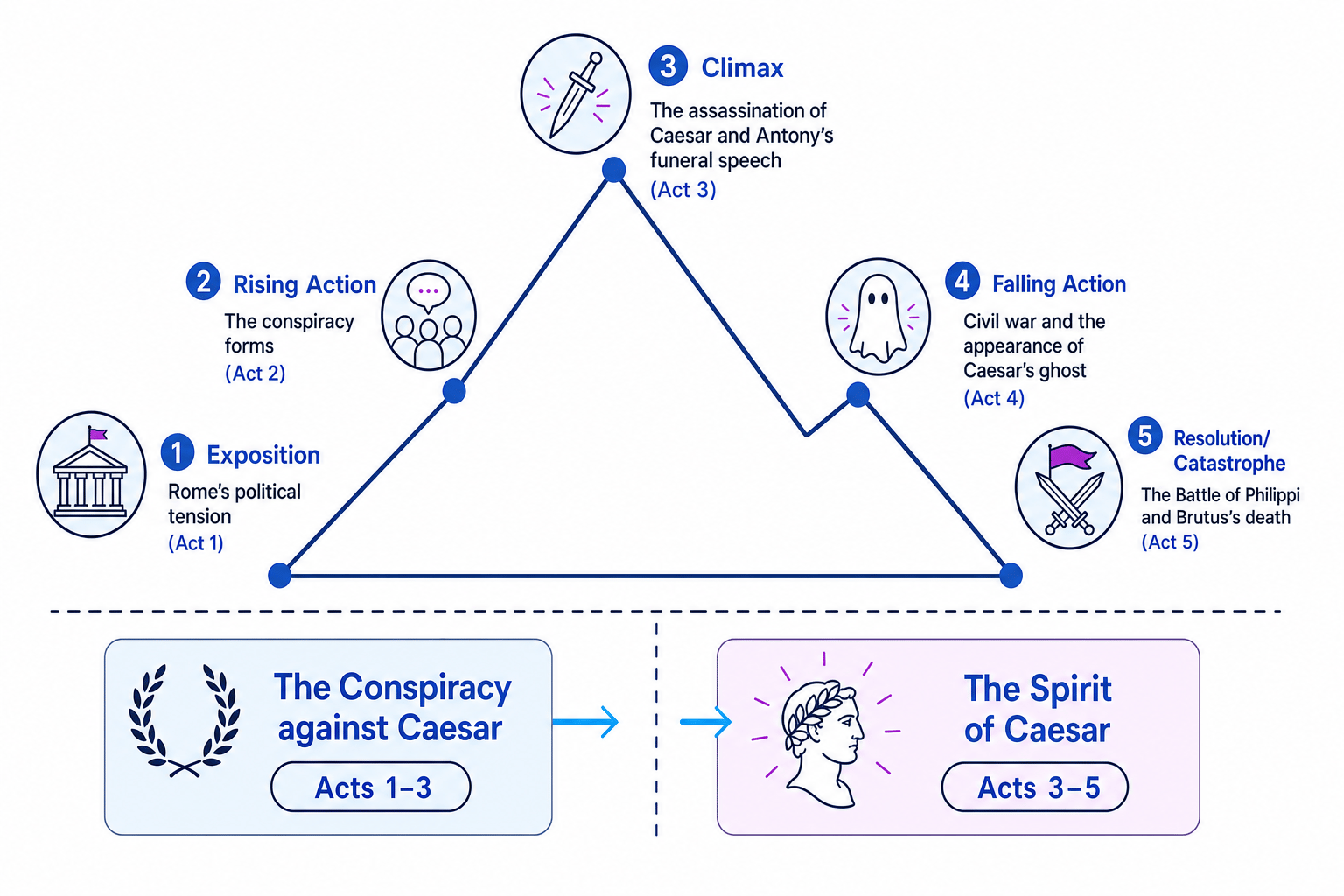
1. Acts 1–3: The Conspiracy against Caesar
This movement focuses on the physical world of Rome. We see the rising anxiety over Caesar’s growing absolute power. Cassius uses his manipulative rhetoric to recruit Brutus, a highly respected senator, into a conspiracy to murder Caesar. The tension builds to the assassination in Act 3, Scene 1, where Caesar is stabbed 23 times, gasping his final words: "Et tu, Brute? Then fall, Caesar!"
2. Acts 3–5: The Spirit of Caesar
The second movement shifts from a physical conflict to a psychological and spiritual one. After the assassination, Mark Antony delivers his famous funeral oration ("Friends, Romans, countrymen, lend me your ears..."), turning the Roman mob against the conspirators. Rome plunges into a bloody civil war.
The Lingering Ghost
Although Julius Caesar is physically killed in Act 3, his influence dominates the rest of the play. His spirit, representing the inevitable rise of absolute monarchy, haunts Brutus's conscience and physically appears to him as a ghost, proving that Caesar's ideas and power could not be destroyed by a dagger.
Confusing the Protagonist
Many students assume Julius Caesar is the main character because his name is on the front cover. In the exam, treat Brutus as the central tragic protagonist. The play is fundamentally about Brutus’s internal struggle between his personal love for Caesar and his public duty to Rome.
Analysing the Core Conflict
To write a high-level response, you must be able to track how the central themes change from the beginning to the end of the play. Let’s look at a practical way to build an argument about the play's overriding political conflict: Honor vs. Ambition.
Constructing a Whole-Play Thesis Statement
Let's walk through how to construct an essay thesis statement that covers the play’s structural arc, linking Brutus’s idealistic noble intentions to the tragic failure of the conspiracy.
-
Identify the dual forces at conflict across the play's structural pivot: We must look at what drives the conspirators (idealism, honor, preservation of the Republic) versus what actually happens after they murder Caesar (chaos, civil war, tyranny). Brutus acts out of "honor", while Cassius acts out of jealousy.
-
Select contrasting evidence representing the start and the end of this journey:
- Act 2, Scene 1 (The Start): Brutus reasons that Caesar must die because of what he might become: "And therefore think him as a serpent's egg / Which, hatch'd, would, as his kind, grow mischievous, / And kill him in the shell."
- Act 5, Scene 5 (The End): Antony looks at Brutus's body and declares: "This was the noblest Roman of them all... He only, in a general honest thought / And common good to all, made one of them."
-
Formulate a thesis statement linking these parts to Shakespeare's broader purpose: Combine these ideas to show that Shakespeare uses Brutus's tragedy to demonstrate that noble intentions ("honor") cannot justify violent political upheaval.
Drafted Thesis: "While Brutus acts out of a noble, altruistic desire to protect the Roman Republic from Caesar's potential tyranny, Shakespeare structurally demonstrates that political assassination inevitably unleashes chaos, suggesting that even the most honorable intentions cannot justify the destruction of social order."
The Power of Rhetoric
Keep a close eye on the theme of rhetoric (the art of persuasive speaking). Characters in this play do not win with swords; they win with words. Cassius sways Brutus; Brutus sways the conspirators; Antony sways the entire population of Rome. Power is held by whoever controls the narrative.
The Elizabethan Context (AO3)
You cannot fully understand Julius Caesar without understanding why Shakespeare wrote it in 1599.
- The Succession Crisis: Queen Elizabeth I was elderly, had no children, and refused to name an heir. Her subjects feared that her death would lead to a bloody civil war for the crown, much like the War of the Roses a century earlier.
- The Warning: By writing a play about the assassination of an absolute ruler (Caesar) and the subsequent collapse of Rome into civil war, Shakespeare was issuing a stark warning to his contemporary audience: rebellion and political assassination lead to absolute ruin.
- The Divine Right of Kings: Although Rome was a republic, Elizabethan England believed in the Divine Right of Kings—the idea that monarchs were appointed by God. Killing a ruler was seen as a sin against God, which is why Shakespeare presents Caesar's assassination as an act that tears the fabric of nature itself (marked by storms and supernatural events in Act 1, Scene 3).
In the exam
- Address the Extract and the Whole Play: The GCSE question will give you a short printed extract. Spend about one-third of your essay analysing the language/structure of this extract, and the remaining two-thirds discussing how these ideas manifest across the wider play.
- Anchor your analysis in Shakespeare’s intentions (AO3): Never write about characters as if they are real people. Use phrases like: "Shakespeare constructs Brutus to represent..." or "Through the character of Caesar, Shakespeare warns his audience of..."
- Integrate SPaG (AO4): The Shakespeare question is the only part of Paper 1 that carries 4 marks for Spelling, Punctuation, and Grammar. Plan your sentences carefully, use precise literary terminology (such as soliloquy, dramatic irony, blank verse), and verify that your spelling of character names is flawless.
Check yourself
- Who is the true tragic hero of Julius Caesar, and what is his tragic flaw (hamartia)?
- How does the role of Julius Caesar change before and after Act 3, Scene 1?
- Why would an Elizabethan audience in 1599 find a play about political assassination and civil war deeply alarming?
