

What you'll learn
- The basic shape of Winsome Pinnock’s Leave Taking and what makes it a modern drama.
- How the title, characters and central conflicts connect to the play’s bigger ideas.
- The main dramatic methods Pinnock uses, without turning them into a list of devices.
- How to turn overview knowledge into a clear GCSE argument.
The play in a nutshell
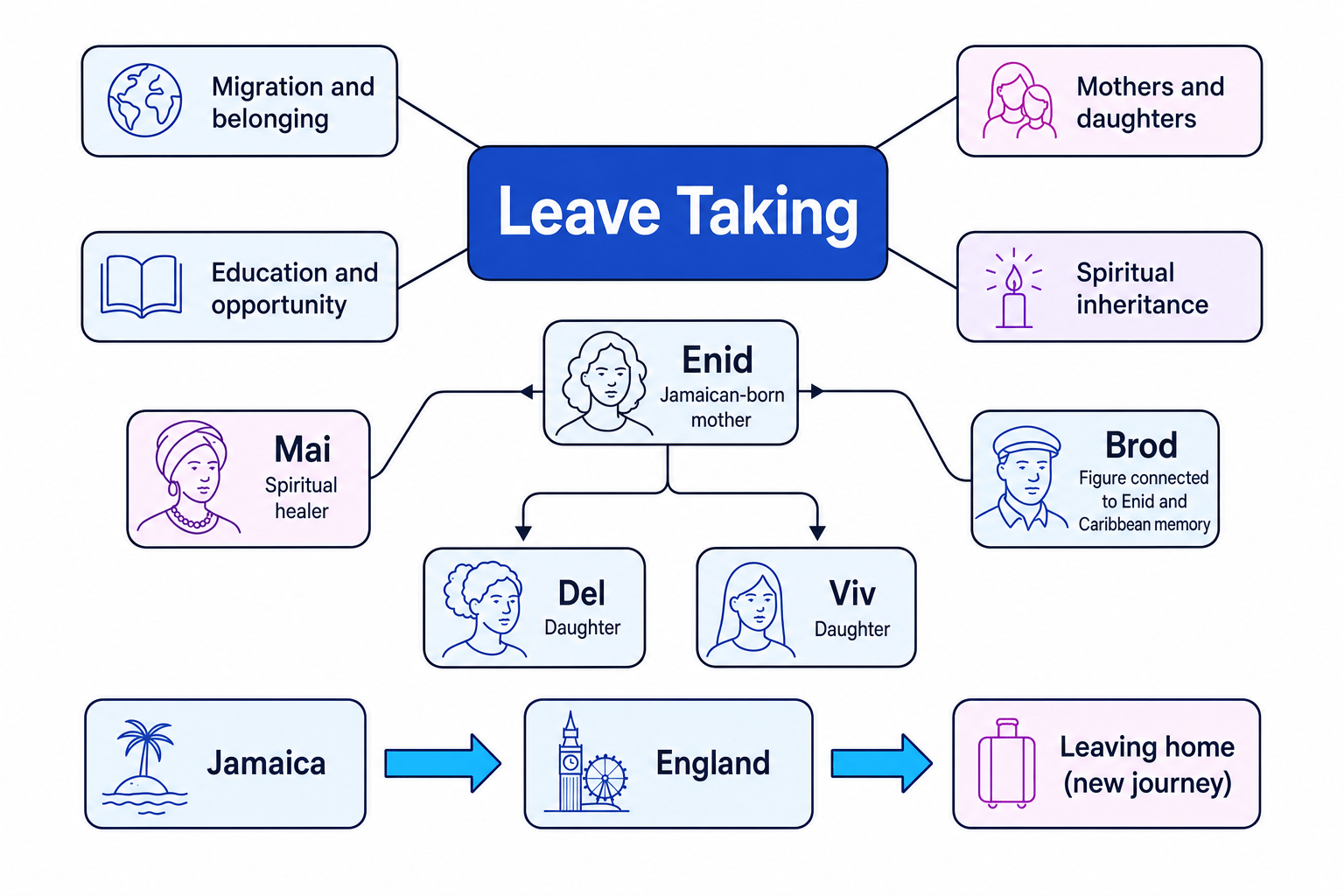
Leave Taking is a modern play by Winsome Pinnock about a Jamaican-born mother, Enid, and her two daughters, Del and Viv, growing up in England. It explores what happens when a family’s hopes for the future clash with memory, migration, education, independence and spiritual inheritance.
The play is not driven by battles, murders or a huge public event. Its drama comes from conversations, arguments, pressure, silence, and the painful gap between what family members intend and what others feel.
Modern drama
Modern drama means a play written for performance in the modern period. For GCSE, you should read it as something staged for an audience: dialogue, stage directions, entrances, exits, setting and silence all help create meaning.
The basic situation
At the centre of the play is Enid, who has migrated from Jamaica to England and has worked hard to give her daughters better opportunities. Her daughters, Del and Viv, respond differently to her hopes and expectations.
Mai, a spiritual healer, brings in a different kind of knowledge: ancestral, intuitive and connected to Caribbean traditions. Brod also helps the play open out beyond one household, reminding us that migration affects memory, identity and belonging across a whole generation.
The heart of the play
Pinnock presents family conflict as more than ordinary teenage rebellion: it is tied to migration, sacrifice, racism, cultural inheritance and the difficult question of what it means to belong.
The title: Leave Taking
The title is one of the best ways into the whole play. A leave-taking is an act of saying goodbye or departing. Pinnock’s title suggests that leaving is not a single moment; it can be a long emotional process.
A motif is a repeated idea, image or action that gathers meaning across a text. In this play, “leaving” becomes a motif: leaving Jamaica, leaving childhood, leaving home, leaving expectations, and perhaps leaving behind parts of the self.
Reading the title
-
Start with the literal meaning: Leave Taking suggests departure, farewell and separation.
-
Apply this to Enid: she has left Jamaica for England, so the title points to migration and the emotional cost of trying to build a new life.
-
Apply this to Del and Viv: they are not migrants in exactly the same way, but they still face “leave-takings” of their own as they pull away from their mother’s expectations and search for identity.
-
Link the title to structure: Pinnock does not make leaving a neat ending; instead, the play shows leaving as repeated, unfinished and emotionally complicated.
The main conflicts
A dramatic conflict is the pressure or clash that drives a play forward. It does not have to mean physical fighting. In Leave Taking, conflict often comes from people who love each other but understand life differently.
Enid versus her daughters
Enid wants security, respectability and success for Del and Viv. From her point of view, education and hard work are ways to survive in a society that can be hostile to Black immigrant families.
Del and Viv experience that pressure differently. To them, Enid’s hopes can feel like control, judgement or misunderstanding. This is why the play is emotionally rich: Pinnock does not make one side simply “right”.
Making Enid the villain
Avoid writing as if Enid is only strict or controlling. Her behaviour is shaped by fear, sacrifice and love, as well as by the pressures of migration and racism.
Jamaica versus England
The play explores how a person can live in one country while carrying the memory, language, beliefs and losses of another. Jamaica is not just a place in the background; it represents origin, memory and an inheritance the daughters may not fully understand.
England is also complex. It offers education and opportunity, but it can also feel cold, excluding or alienating.
Education versus freedom
Education matters in the play because it represents opportunity. For Enid, academic success can mean safety and social mobility. For the daughters, especially when pressure becomes intense, education can also feel like a burden.
This makes education a dramatic symbol: it is both hope and pressure.
Spiritual knowledge versus “respectable” modern life
Mai’s spiritual role introduces beliefs and practices that do not fit neatly into a purely rational or Western view of the world. Pinnock treats this seriously, not as a joke. Mai’s presence asks the audience to consider what kinds of knowledge are valued, dismissed or inherited.
How Pinnock tells the story
Form and structure
Form means the type and shape of a text: here, a stage play. Structure means how the text is organised, including the order of scenes, contrasts between characters, revelations and the ending.
Because Leave Taking is drama, you should always think about what the audience would see and hear, not only what the words mean on the page.
| Dramatic method | What to notice | Why it matters |
|---|---|---|
| Dialogue | Arguments, interruptions, different voices | Shows tension in real time between family members |
| Stage directions | Movement, setting, entrances and exits | Reminds us that power and emotion are physically staged |
| Contrast | Enid/Del, Enid/Viv, Enid/Mai, Jamaica/England | Helps the audience compare different values |
| Symbolism | Leaving, healing, home, education | Turns ordinary actions into bigger ideas |
| Realism | Everyday family life and recognisable pressures | Makes the social issues feel personal and immediate |
A useful term here is realism. In drama, realism means representing ordinary people, speech and situations in a believable way. Pinnock uses realistic family tension, but she also brings in spiritual and symbolic elements through Mai.
Write like a drama student
When analysing a scene, ask: what would an audience notice first — a pause, a confrontation, a character’s movement, or the contrast between two voices?
Context: why the play is bigger than one family
Context
Context means the historical, social, cultural and theatrical conditions around a text. In an essay, context should help explain the play’s meanings, not sit separately as a fact-file paragraph.
Pinnock is an important Black British playwright, and Leave Taking gives central stage space to Caribbean women and Black British daughters. This matters because British theatre has often marginalised such voices.
The play also connects to the history of post-war Caribbean migration to Britain, including the hopes and disappointments of the Windrush generation and their families. Enid’s ambition for her daughters makes more sense when you remember that education could seem like a route through racism, class barriers and economic insecurity.
Mai’s role also matters contextually. Caribbean spiritual traditions have often been misunderstood or dismissed in Britain. Pinnock uses Mai to challenge narrow ideas about what counts as wisdom, healing or truth.
Context dump
Do not add context as a random sentence at the end. Link it directly to the play: for example, Enid’s pressure over education makes sense because success can feel like protection in a racist society.
A clear way to remember the whole play
Try holding Leave Taking in three layers:
- Personal layer: a mother and daughters struggle to understand each other.
- Cultural layer: migration creates questions about home, memory and identity.
- Theatrical layer: Pinnock stages these pressures through dialogue, contrast, spiritual presence and family conflict.
Building a thesis about generational conflict
-
Identify the real issue: the conflict is not simply “young people versus parents”; it is a clash between Enid’s survival-based hopes and her daughters’ need for self-definition.
-
Connect it to context: Enid’s expectations are shaped by migration, work and the desire for security in Britain.
-
Link it to dramatic method: Pinnock puts different voices on stage — Enid, Del, Viv, Mai and Brod — so the audience hears competing versions of belonging and success.
-
Shape the argument: Pinnock presents generational conflict as the emotional cost of migration, where love and pressure become difficult to separate.
What examiners want you to do with this overview
For AQA GCSE English Literature, overview knowledge helps you build an informed personal response. That means you are not just retelling the plot. You are explaining what Pinnock is exploring and how she uses drama to do it.
A strong answer might begin from a big idea such as:
Pinnock presents leaving as both necessary and painful, showing how migration and growing up can separate people from places, family expectations and parts of their own identity.
That kind of sentence gives you a clear line of argument. You would then support it with precise references to moments in the play, short quotations you have memorised, and analysis of dramatic methods.
In the exam
-
Start with an argument about Pinnock’s purpose, not a plot summary.
-
Analyse the play as drama: mention dialogue, stage directions, contrast, entrances, exits or audience response where relevant.
-
Use context only when it explains meaning, especially around migration, education, racism, Caribbean identity and family pressure.
Check yourself
- What different kinds of “leaving” does the title Leave Taking suggest?
- Why should Enid be understood as more than simply a strict mother?
- How does Mai’s presence change the play from a straightforward family drama?
