

Welcome to your study guide on writing high-scoring essays for Winsome Pinnock's Leave Taking. Because this is a modern drama text assessed in Paper 2, Section A of your GCSE, you will need to write a clean, well-structured essay under exam conditions without access to the text.
To secure the highest marks, you must show the examiner that you can construct a cohesive argument, analyze Pinnock's dramatic choices, and link these choices to the historical and social context of 1980s Britain.
What you'll learn:
- How to deconstruct an exam prompt and formulate a compelling thesis statement.
- How to structure your body paragraphs to address AO1, AO2, and AO3 seamlessly.
- How to analyze a model paragraph to understand what makes a Grade 9 response.
Deconstructing the Essay Structure
Before putting pen to paper, you need to understand exactly what the examiners are looking for. Your essay should not read like a summary of the plot; instead, it must read as a conceptual, targeted argument.
To achieve this, we use three core pillars of literary analysis:
Thesis Statement
A thesis statement is a one- or two-sentence summary of your overall argument. It should appear at the very end of your introduction, directly answering the question by proposing a conceptual idea rather than just listing the characters you will discuss.
Dramatic Method
A dramatic method is any deliberate choice made by the playwright (such as structure, staging, dialogue styles, character foils, symbols, or motifs) to convey meaning to the audience.
Contextual Integration
Contextual integration is the practice of weaving historical, social, and cultural context directly into your literary analysis, showing how the text reflects or challenges the realities of the era in which it was written or set.
For Leave Taking, context is not an optional extra; it is the very fabric of the play. Pinnock wrote the play in the mid-1980s, reflecting the lived experiences of the Windrush generation and their British-born children. When analyzing the play, you must connect the characters' internal struggles to the external pressures of institutional racism, cultural displacement, and the search for identity in a hostile British society.
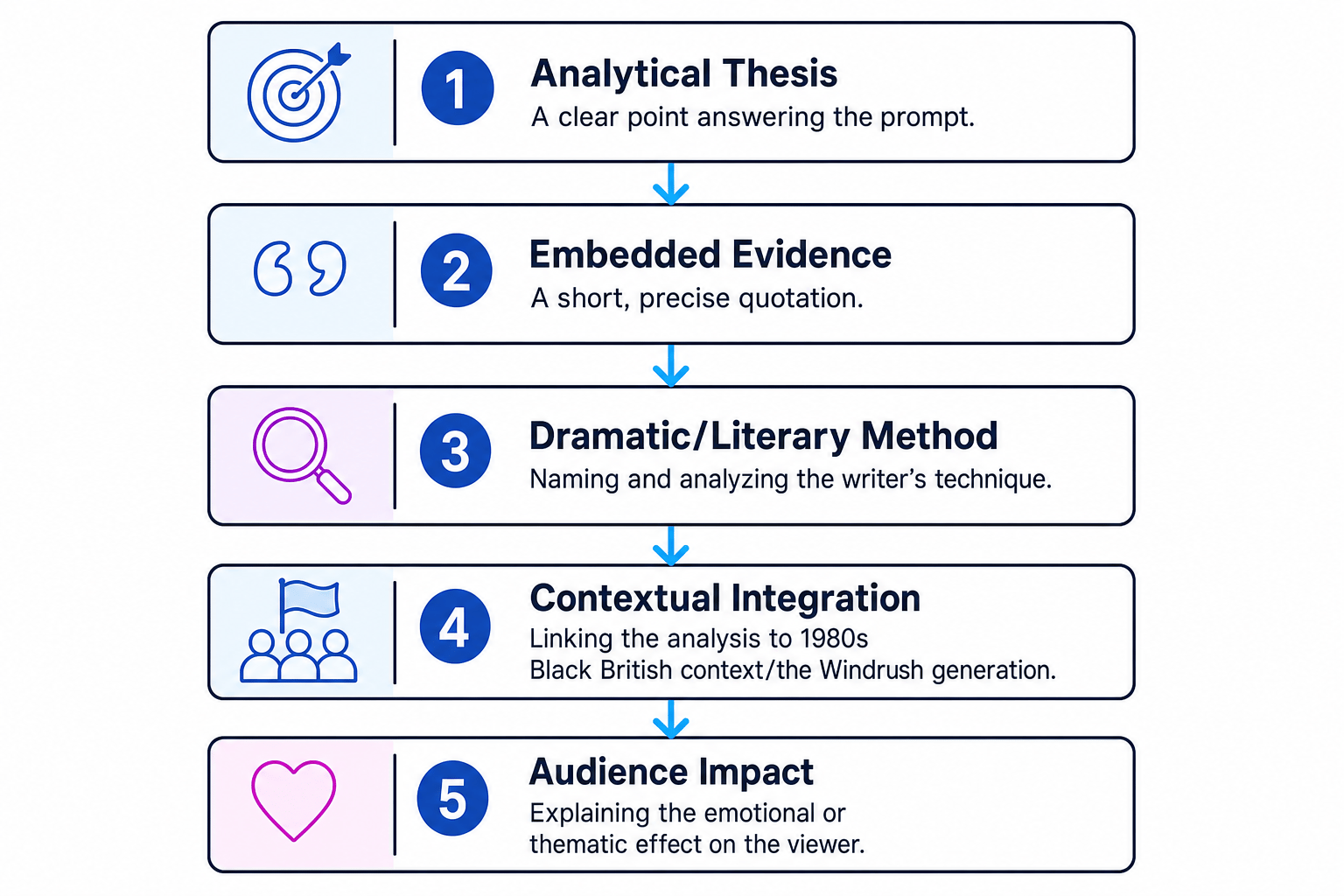
To visualize how a high-scoring paragraph flows from a thesis to its final impact, study this structural pathway:
Designing a High-Scoring Essay Plan
When you enter the exam room, you will be faced with a single essay prompt. It might ask you to explore a theme (such as belonging, family, or displacement) or a character's role (such as Enid, Del, or Mai).
Your first task is to plan. A strong plan prevents you from drifting off-topic and ensures that every paragraph you write directly answers the question.
<keyidea title="The "Thread of Argument"">
High-scoring essays have a clear "thread" or line of argument that runs from the first sentence to the last. Each paragraph should act as a stepping stone that builds on the previous point, showing a deep, nuanced understanding of Pinnock's intentions.
Let’s look at how to construct an essay plan from scratch.
Planning an essay on generational conflict
Prompt: Explore how Pinnock presents the conflict between mothers and daughters in Leave Taking.
Here is a step-by-step method to construct a Grade 9 essay plan:
-
Step 1: Formulate a conceptual thesis statement. Avoid simple summaries like "Pinnock shows that Enid fights with Del and Viv." Instead, elevate your thesis to address the why: "Pinnock presents maternal-filial conflict not merely as a typical domestic clash, but as a symbolic manifestation of the cultural and geographical divide between first-generation Caribbean immigrants and their British-born children."
-
Step 2: Map out three distinct, chronological focus points.
- Paragraph 1: Focus on Enid and Del’s overt, hostile conflict. This represents the clash between Enid's desire for assimilation/respectability and Del's rejection of British societal expectations in favour of her own path.
- Paragraph 2: Focus on Enid and Viv's quieter, internalized conflict. This explores the heavy burden of expectation Enid places on Viv to succeed academically as a way to validate Enid's own sacrifices.
- Paragraph 3: Focus on the resolution/catharsis through Mai's obeah practice. Show how the resolution of maternal conflict requires reconciling with their shared ancestral heritage, allowing Enid and her daughters to find common ground.
-
Step 3: Match precise quotes and dramatic methods to each point.
- For Paragraph 1: Use Del’s raw, emotional outburst: "You think I want to be like you? Work myself to death for nothing?" Analyze the dramatic method of confrontational dialogue and the foil relationship between Del's rebellion and Enid's rigid work ethic.
- For Paragraph 2: Use Viv's physical anxiety and the symbol of her schoolbooks. Analyze how her struggle to read the circular, cyclical pattern of her mother's life reflects the structural weight of parental expectations.
- For Paragraph 3: Use Enid’s physical transformation and emotional release during the obeah reading: "I want to go home, Mai." Analyze the dramatic shift in tone and the symbolism of water/the sea representing the painful middle passage and the desire for spiritual return.
-
Step 4: Align each paragraph with specific historical and cultural context.
- Link Enid’s strictness to the Windrush generation’s need to present as "respectable" and flawless to survive in a deeply prejudiced 1980s Britain.
- Link Del's alienation to the systemic racism, high unemployment, and lack of opportunities facing young Black Britons in London during the 1980s (e.g., the social unrest of the Brixton riots).
- Link Mai’s role to the preservation of traditional Caribbean spiritual practices (Obeah) as a form of cultural resistance against colonial erasure.
Analyzing a Model Paragraph
To write a great essay, you must be able to synthesize analysis of language and staging (AO2) with contextual understanding (AO3). Let’s look at a model paragraph that analyzes how Pinnock presents Enid’s relationship with her rebellious daughter, Del.
The Model Paragraph
Pinnock utilizes the intense, confrontational dialogue between Enid and her eldest daughter, Del, to dramatize the painful disconnect between the lived experiences of first-generation immigrants and their British-born descendants. This is starkly illustrated when Del scathingly asks Enid, "You think I want to be like you? Work myself to death for nothing?" The rhetorical question functions as a structural pivot in the scene, exposing the deep-seated resentment that defines their relationship. Through Del's bitter rejection of her mother’s lifestyle, Pinnock highlights the tragedy of Enid's sacrifice; the very "respectability" and work ethic that Enid adopted to survive in a hostile British environment is viewed by her daughter not as a triumph, but as a form of submissive self-destruction. Furthermore, the noun "nothing" underscores Del’s perception of the futility of Enid’s assimilationist efforts in a racially prejudiced society. Pinnock presents this generational conflict to show the audience that the trauma of displacement is inherited; while Enid fights to belong by quietly enduring exploitation, Del reacts to the same hostile environment with active, defensive rebellion, creating a tragic communicative barrier between mother and child.
Why this paragraph works (Analysis of Success Criteria):
- Laser-focused Point (AO1): The paragraph begins with a clear topic sentence that directly addresses the prompt (generational disconnect) rather than simply retelling a plot point.
- Seamlessly Embedded Evidence (AO1): The quotation "You think I want to be like you? Work myself to death for nothing?" is integrated naturally into the syntax of the writer's sentence.
- Precise Use of Subject Terminology (AO2): The writer identifies specific literary and dramatic terms, including "confrontational dialogue", "rhetorical question", "structural pivot", and "noun", and explains how they work.
- Deep Contextual Insight (AO3): The analysis links Enid's behavior to the historical reality of the Windrush generation's struggle for survival and "respectability" in a discriminatory post-war Britain, contrasting it with the disillusionment felt by second-generation Black British youth in the 1980s.
Context Dumping
A common mistake is "context dumping"—writing a long paragraph about the Windrush generation or 1980s London without linking it to the text. The examiners do not want a history essay. Context should only be introduced to explain why Pinnock made a specific dramatic choice or why a character thinks the way they do.
Short is Sweet
Shorter, highly accurate quotations are far easier to remember and analyze than long block quotes. Aim for quotes of 1 to 6 words (e.g., "work myself to death" or "nothing"). This allows you to perform zoom-in word-level analysis easily.
Developing Alternative Interpretations
To reach the highest mark bands (Grade 8 and 9), you must show that you can think critically about the play. This means offering alternative interpretations of characters or themes, showing the examiner that you understand the text's complexity.
For instance, rather than seeing Enid's strictness simply as harsh parenting, a higher-level response might explore it as a protective shield.
Enid's expectations as a protective armor
Think of Enid’s strict demands on Viv and Del as a form of protective armor. In a 1980s British society where young Black women faced double discrimination (racism and sexism), Enid believed that academic success and absolute respectability were the only shields strong enough to protect her daughters from systemic harm. What her daughters felt as suffocating pressure was, in reality, Enid’s desperate act of maternal love.
In the exam
- Spend 5 minutes planning: Do not skip this. Write down your thesis statement and your three main points with their corresponding quotes.
- Track the writer's craft: Always refer to Pinnock by name. Write about what she intends, what she presents, and what she criticizes. This keeps your essay analytical rather than narrative.
- Embed your context: Never write a "context paragraph" at the end of your essay. Instead, make sure every main body paragraph contains at least one sentence linking your linguistic analysis directly to the social/historical pressures of 1980s Britain.
- Focus on the beginning and end of the play: Examiners love to see that you understand character development. Contrast how characters act in Act One (e.g., Enid's rigidity, Del's alienation) with how they find resolution in Act Two through Mai's guidance.
Check yourself
- Can you write a thesis statement that explains why Pinnock uses the character of Mai, rather than just stating what Mai does in the plot?
- Do you have at least three short, memorable quotations memorized for Enid, Del, Viv, and Brod?
- How does the context of 1980s Britain explain the differing attitudes toward "home" (Jamaica) between the first-generation characters (Enid, Brod) and the second-generation characters (Del, Viv)?
