

What you'll learn
- How to turn a Leave Taking question into a clear argument, not just a plot summary.
- How to plan paragraphs that combine evidence, methods, meaning and context.
- How to build flexible plans for common question types: character, theme and dramatic method.
- How to avoid the most common planning mistakes in AQA modern drama essays.
The purpose of an essay plan
An essay plan is a route-map for your answer. In the AQA modern text question, you are not given an extract, so you need to write about the whole play from memory. A good plan stops you from drifting into storytelling.
Essay plan
An essay plan is a brief outline of your argument before you write. It usually includes your main answer to the question, three or four paragraph ideas, key evidence, the writer’s methods, and any relevant context.
For Leave Taking, your plan should always keep two things together:
- what Pinnock presents — characters, relationships, conflict, identity, belonging, migration, motherhood, education, spirituality;
- how Pinnock presents it — dialogue, stage directions, contrast, symbolism, structure, dramatic tension, entrances and exits.
Plan the argument, not the plot
The examiner rewards an informed personal response. That means your plan should answer the question with a clear view of Pinnock’s message, rather than retelling what happens scene by scene.
Here is the basic shape of a strong plan:
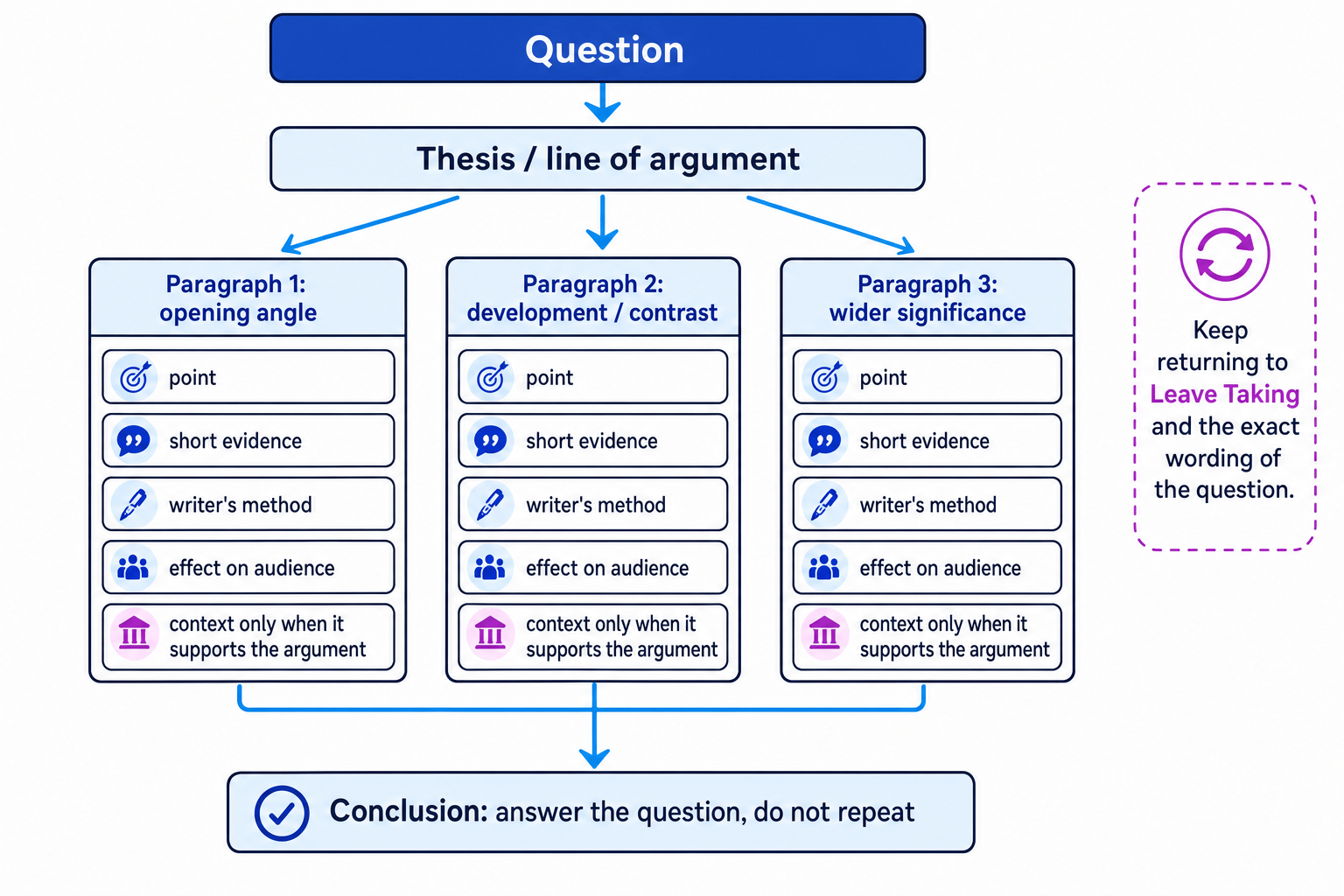
Start with a thesis
Your thesis is your overall answer to the question. It should be arguable, specific and focused on Pinnock’s purpose.
Thesis
A thesis is the central argument of your essay: the main idea you will prove across your paragraphs.
A weak thesis usually just names the topic:
Pinnock presents Enid as a strict mother.
A stronger thesis explains complexity:
Pinnock presents Enid as a loving but controlling mother whose behaviour is shaped by migration, sacrifice and fear for her daughters’ futures.
The second version gives you more to write about because it contains a tension: Enid is both protective and damaging.
Unpacking an Enid question
Question: How does Pinnock present Enid as a mother in Leave Taking?
- Decide the central tension: Enid is not simply “good” or “bad”; Pinnock presents her as protective, ambitious and emotionally wounded.
- Turn that into a thesis: Pinnock shows that Enid’s strictness comes from love, but also from fear that her daughters will waste the opportunities she has sacrificed for.
- Choose a progression across the play: begin with Enid taking Del to Mai, develop with Enid’s pressure on Viv and conflict with Del, then end with Enid’s need to confront the past.
- Attach methods to each stage: tense dialogue, dramatic contrast between the sisters, Mai as a spiritual healer, and the repeated idea of leaving or being unable to belong.
Build paragraphs around topic sentences
A topic sentence is the first sentence of a paragraph. It should make a mini-argument that supports your thesis.
Topic sentence
A topic sentence states the main analytical point of a paragraph. It should answer the question directly and prepare the evidence that follows.
For Leave Taking, avoid topic sentences that only describe events:
Enid takes Del to Mai.
Improve it by adding interpretation:
Pinnock uses Enid’s decision to take Del to Mai to show how fear and frustration have damaged the mother-daughter relationship.
That sentence already points towards character, method and theme.
Building one analytical paragraph
Plan line: Enid’s protectiveness becomes controlling because she believes her daughters must succeed.
- Make the point precise: Enid’s motherhood is driven by love, but Pinnock shows that love can become pressure when it is shaped by sacrifice and disappointment.
- Select evidence: use the moment when Enid seeks Mai’s help for Del as a key reference, because it dramatises Enid’s belief that Del’s behaviour is a problem to be fixed.
- Analyse method: Pinnock stages this through conflict in dialogue and through Mai’s role as a spiritual figure, shifting attention from Del’s rebellion to Enid’s own unresolved pain.
- Link to context: Enid’s desire for her daughters’ success reflects the pressure on first-generation Caribbean migrants who hoped Britain would offer better chances for their children.
Use evidence without inventing quotations
Because the exam is closed book, you should memorise a small number of exact quotations from your key quotes work. However, do not invent or half-remember quotations. A precise reference to a moment in the play is much better than a fake quotation.
Textual reference
A textual reference is a precise mention of something in the text. It can be a short quotation, a reference to a scene, a stage direction, a relationship, or a repeated idea.
For essay plans, you can use evidence like this:
| Essay focus | Strong evidence to plan from |
|---|---|
| Enid as a mother | Enid taking Del to Mai; Enid’s pressure on Viv; Enid’s difficulty speaking honestly about the past |
| Identity and belonging | the contrast between Jamaica and Britain; Del and Viv’s different responses to their heritage; the title Leave Taking |
| Generational conflict | Del’s resistance to Enid; Viv’s ambition; Enid’s expectations of both daughters |
| The past | Mai’s spiritual role; Brod’s memories; Enid’s buried grief and regret |
| Dramatic structure | conflict established early, revelations about the past, movement towards release or acceptance |
Making up quotations
Do not write a line unless you know it is exact. In a closed-book exam, accurate short references still count as evidence, but invented quotations damage trust in your answer.
Plan for methods, not just meanings
A method is a choice made by the writer. In drama, methods include not only language, but also what an audience sees and hears on stage.
Dramatic method
A dramatic method is a technique used in a play to create meaning for an audience, such as dialogue, stage directions, entrances and exits, contrast between characters, symbolism, or structure.
Useful methods for Leave Taking include:
- Dialogue: Pinnock often reveals tension through interruptions, disagreement and emotional defensiveness.
- Contrast: Del and Viv can be planned as contrasting responses to Enid’s parenting and to British-Caribbean identity.
- Foil: a foil is a character whose differences highlight another character. Brod and Mai can act as foils to Enid because they expose different ways of relating to the past.
- Motif: a motif is a repeated idea or image. The play’s title, Leave Taking, points to repeated acts of departure, loss, separation and emotional release.
- Structure: Pinnock gradually moves from surface family conflict towards deeper causes: migration, grief, identity and the need to let go.
Method plus meaning
Do not just name a technique. Write: Pinnock uses [method] to show [idea] so that the audience [effect]. This keeps your analysis focused.
Add context only when it supports the point
Context means the circumstances around a text: social, historical, cultural or literary. For Leave Taking, context often links to Caribbean migration to Britain, the legacy of colonialism, racism, ideas of the “mother country”, and the experience of second-generation British-Caribbean children.
Context
Context is relevant background that helps explain the writer’s ideas, such as the historical experiences, social attitudes or cultural debates connected to the text.
The key word is relevant. Context should not become a separate history paragraph. It should explain why Pinnock’s choices matter.
Linking context to identity
Focus: Pinnock explores identity through the daughters’ different attitudes to heritage and belonging.
- Begin with interpretation: Del and Viv are not simply opposites; Pinnock uses them to show different pressures faced by children of migrants.
- Add evidence: refer to their contrasting attitudes towards Enid’s expectations, education, and connection to Caribbean culture.
- Analyse method: the contrast between the sisters creates dramatic tension and prevents the audience from seeing identity as one simple choice.
- Link context carefully: as second-generation British-Caribbean characters, Del and Viv inherit both Enid’s hopes and the pain of displacement, so their conflict reflects a wider cultural struggle over belonging.
Context dumping
Do not write a paragraph explaining the Windrush generation and then forget the question. Context should be woven into analysis of Pinnock’s characters and methods.
Flexible essay plan bank
Use these as starting points. In the exam, reshape them to match the exact wording of the question.
Plan 1: Enid as a mother
Possible question: How does Pinnock present Enid in Leave Taking?
Thesis: Pinnock presents Enid as a complex mother whose love is mixed with control, fear and unresolved loss.
| Paragraph | Argument | Evidence and methods |
|---|---|---|
| 1 | Enid’s parenting is driven by anxiety about Del. | Enid taking Del to Mai; tense dialogue; conflict staged early. |
| 2 | Enid pressures Viv because she sees education as escape and success. | Viv’s academic ambition; contrast between Viv and Del; context of migrant aspiration. |
| 3 | Enid herself needs healing, not just her daughters. | Mai’s role; revelations about the past; structure moves from blame to understanding. |
Plan 2: Identity and belonging
Possible question: How does Pinnock explore ideas about belonging in the play?
Thesis: Pinnock shows belonging as painful and unstable: characters are caught between places, generations and versions of themselves.
| Paragraph | Argument | Evidence and methods |
|---|---|---|
| 1 | Enid’s life in Britain is shaped by sacrifice and displacement. | Her hopes for her daughters; contrast between past and present. |
| 2 | Del and Viv show different responses to inherited identity. | Sisterly contrast; conflict with Enid; dialogue showing generational tension. |
| 3 | Mai and Brod keep the past visible on stage. | Foils to Enid; spiritual and nostalgic connections to Jamaica; motif of leaving. |
Plan 3: Generational conflict
Possible question: How does Pinnock present conflict between generations?
Thesis: Pinnock presents generational conflict as more than ordinary family argument: it comes from migration, silence and different ideas of success.
| Paragraph | Argument | Evidence and methods |
|---|---|---|
| 1 | Enid and Del clash because Del resists being controlled. | Opening conflict; Del’s scepticism; quick, tense exchanges. |
| 2 | Enid and Viv reveal a quieter kind of pressure. | Viv’s ambition; Enid’s expectations; education as symbol of hope. |
| 3 | Conflict begins to soften when the past is acknowledged. | Mai’s intervention; structural movement towards emotional release. |
Plan 4: The importance of Mai
Possible question: How does Pinnock use Mai in Leave Taking?
Thesis: Pinnock uses Mai to connect the ordinary family drama to deeper questions about heritage, memory and healing.
| Paragraph | Argument | Evidence and methods |
|---|---|---|
| 1 | Mai exposes problems that Enid tries to hide. | Enid’s visit; Mai’s spiritual authority; dramatic tension. |
| 2 | Mai represents a link to Caribbean cultural practices. | Her role as healer; contrast with everyday London life; context of cultural survival. |
| 3 | Mai helps shift the play from conflict towards recognition. | Structure; emotional revelations; title’s idea of leave-taking as release. |
Conclusions: short but purposeful
A conclusion should not repeat all your points. It should return to the question and sharpen your overall interpretation.
A strong conclusion might say:
Overall, Pinnock presents family conflict in Leave Taking as the visible symptom of deeper displacement. Through Enid, Del, Viv, Mai and Brod, she shows that leaving a place can also mean carrying its losses into the next generation.
Notice that this conclusion links character, theme and writer’s purpose.
In the exam
- Spend about five minutes planning: thesis, three paragraph points, evidence, methods and context.
- Choose the question you can answer with the most precise references from the whole play.
- Keep returning to Pinnock’s purpose: what is she showing the audience about identity, family, migration or healing?
- Analyse drama as drama: mention dialogue, staging, contrast and structure, not just “words”.
- If a quotation is uncertain, use a precise scene reference instead of guessing.
Check yourself
- Can you write a one-sentence thesis for a question about Enid without simply calling her “strict”?
- Can you name three dramatic methods Pinnock uses in Leave Taking and explain their effects?
- Can you link context to a character or moment without turning it into a separate history paragraph?
