What you'll learn
- How to build a clear argument for a Julius Caesar essay.
- How to use short quotations accurately in a closed-book exam.
- How to analyse Shakespeare’s methods instead of just retelling the plot.
- How to adapt a model essay to different AQA Shakespeare questions.
What a model essay is — and what it is not
A model essay is not something to memorise word-for-word. In the exam, the question will be specific, and you must answer that exact question.
Instead, use model essays to learn the shape of a strong response: a clear argument, well-chosen evidence, close analysis of Shakespeare’s methods, and relevant context.
Model essay
A model essay is an example response that shows how to organise ideas, analyse quotations, and link everything back to the question.
Model essays are patterns
Learn the moves a strong essay makes, not the exact sentences. You are practising how to think like a literary critic.
The basic shape of a strong Julius Caesar essay
For AQA Shakespeare, you usually begin with an extract and then write about the play as a whole. Your answer should not stay trapped in the extract, but it should not ignore it either.
A strong essay normally moves like this:
- A short introduction with a clear argument.
- Two or three analytical paragraphs.
- A brief conclusion that returns to the question.
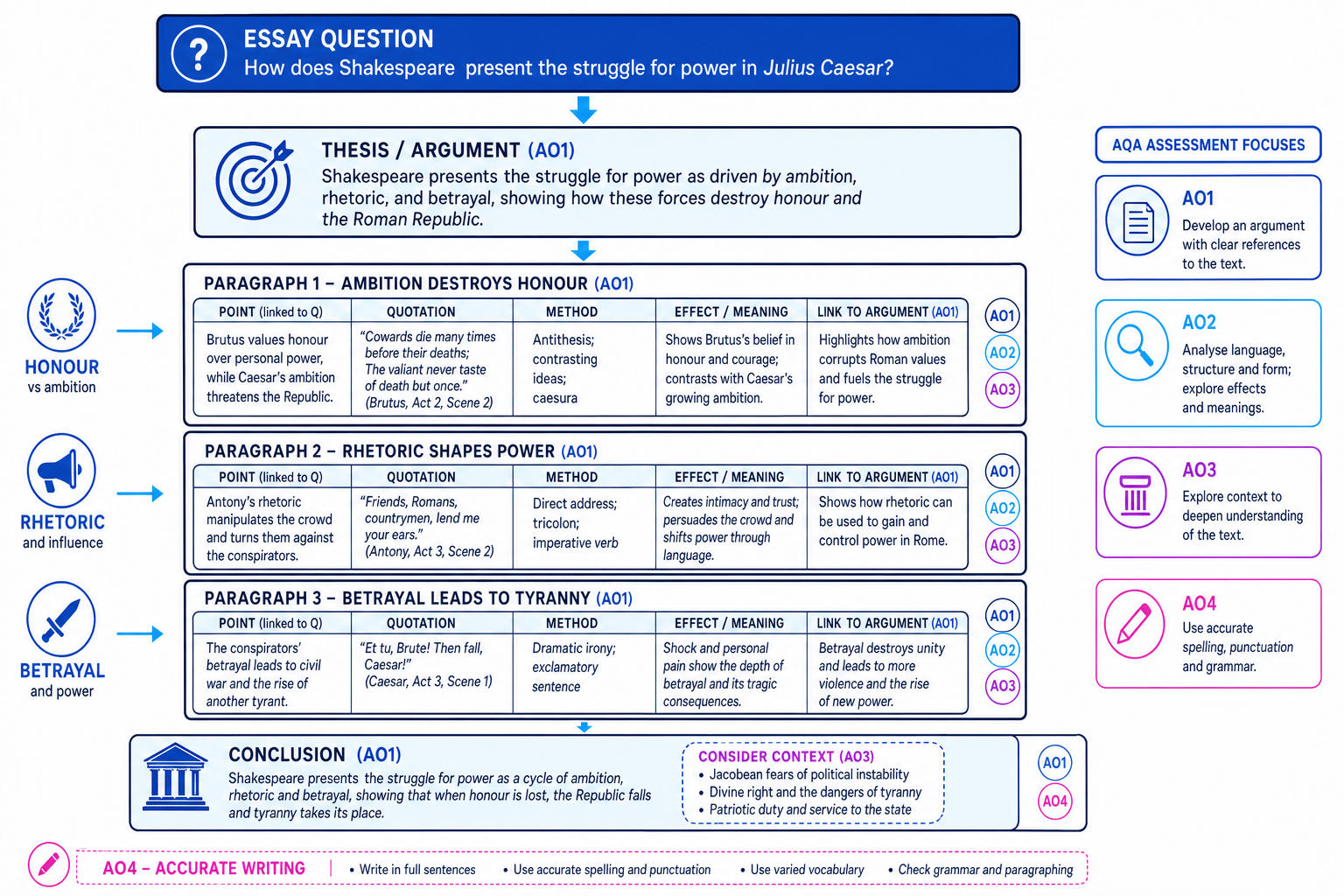
Thesis
A thesis is your overall argument: the main idea you want to prove about Shakespeare’s presentation of a character, theme, or idea.
In Julius Caesar, strong theses often recognise that Shakespeare presents ideas as complicated. For example, Brutus is honourable but dangerously idealistic; Caesar is powerful but vulnerable; Antony appears loyal but becomes politically ruthless.
Step 1: Decode the question
Most questions ask how Shakespeare presents something. That word matters.
To “present” means to explore Shakespeare’s choices: what he makes characters say, how scenes are structured, what imagery is repeated, and how the audience is encouraged to respond.
Decoding a question about Brutus
Question: How does Shakespeare present Brutus as conflicted in Julius Caesar?
-
Identify the focus: the question is not asking for everything about Brutus. It is asking about conflict, meaning a struggle between different feelings, duties, or beliefs.
-
Decide what kind of conflict Brutus faces: he loves Caesar personally, but he believes Rome may be in danger if Caesar becomes too powerful.
-
Choose moments from across the play: Brutus’s soliloquy in Act 2 Scene 1, the assassination in Act 3 Scene 1, and his later guilt or decline in Acts 4 and 5 would all be relevant.
-
Shape an argument: Shakespeare presents Brutus as conflicted because his public ideals of honour and liberty force him to betray his private loyalty to Caesar.
Answering the topic, not the question
Do not write a general essay on “Brutus” if the question asks about “Brutus as conflicted”. Every paragraph should return to the exact wording of the question.
Step 2: Build a thesis, not just a topic sentence
A topic is broad: “ambition in Julius Caesar”.
A thesis is arguable: “Shakespeare presents ambition as dangerous not only because Caesar may desire power, but because other men’s fear of ambition leads them into violence and civil disorder.”
That second version is much stronger because it gives you something to prove.
Building a thesis about ambition
-
Start with a simple idea: Caesar is accused of ambition, especially by Brutus and the conspirators.
-
Complicate it: Cassius also seems ambitious because he manipulates Brutus and resents Caesar’s superiority.
-
Add Shakespeare’s larger message: the fear of tyranny causes the conspirators to commit murder, which ironically creates more chaos.
-
Turn it into a thesis: Shakespeare presents ambition as a destructive political force, but he also shows that the fear of another man’s ambition can be just as dangerous.
A flexible thesis sentence
Try beginning with: “Shakespeare presents … as …, but also suggests …”. This helps you avoid a one-sided answer.
Step 3: Build analytical paragraphs
Each paragraph should make one clear point and then develop it properly.
A useful structure is:
- Point: answer the question directly.
- Evidence: use a short quotation or precise reference.
- Method: name Shakespeare’s technique.
- Effect: explain what the method suggests to the audience.
- Link: connect back to the question and your thesis.
Method
A method is a deliberate writer’s choice, such as metaphor, antithesis, repetition, dramatic irony, prose, verse, soliloquy, or the structure of a scene.
The best analysis does not just name a method. It explains how the method creates meaning.
Analysing Brutus’s justification
-
Make a point about Brutus: Shakespeare presents Brutus as a man who turns murder into a moral duty.
-
Choose precise evidence: in Act 2 Scene 1, Brutus says, “It must be by his death.” The modal verb “must” suggests necessity, as if Brutus has convinced himself there is no alternative.
-
Add a second method: Brutus imagines Caesar as “a serpent’s egg”. This metaphor presents Caesar as a future threat rather than a proven tyrant.
-
Explain the effect: Shakespeare makes Brutus’s reasoning seem both noble and frightening, because he kills Caesar for what he might become, not for what he has already done.
-
Link to the wider play: this supports the idea that honour in Julius Caesar can become dangerous when it is separated from human loyalty and practical judgement.
Device spotting
Do not write, “This is a metaphor, which makes it effective.” Instead, explain what the metaphor makes the audience think or feel about the character, theme, or conflict.
Step 4: Use context without forcing it
Context
Context means the historical, social, political, or literary circumstances that help us understand a text and its meanings.
For Julius Caesar, useful context can include Roman republican values, fear of tyranny, ideas of honour, public duty, and Shakespeare’s audience living under a monarchy where rebellion and succession were serious concerns.
Context should deepen your interpretation. It should not be a random sentence dropped into the paragraph.
Weaving context into analysis
-
Start with the quotation: Caesar claims, “I am constant as the northern star” in Act 3 Scene 1.
-
Analyse the image: the simile presents Caesar as fixed, unique, and above ordinary men, suggesting his confidence has become almost superhuman.
-
Connect context carefully: in a Roman republic, this kind of self-elevation would be politically alarming because it suggests monarchy or tyranny.
-
Link to meaning: Shakespeare therefore makes Caesar’s authority impressive but also unsettling, helping the audience understand why the conspirators fear his rise.
A complete model essay: rhetoric as power
Question: How does Shakespeare present rhetoric as a form of power in Julius Caesar?
Shakespeare presents rhetoric, the art of persuasive speaking, as one of the most dangerous forms of power in Julius Caesar. Public language does not simply describe political events; it helps create them. Through Cassius, Brutus and Antony, Shakespeare shows that Rome is controlled not only by swords and status, but by whoever can shape people’s beliefs.
Early in the play, Cassius uses rhetoric to weaken Brutus’s loyalty to Caesar. In Act 1 Scene 2, he tells him, “The fault, dear Brutus, is not in our stars, / But in ourselves, that we are underlings.” The direct address, “dear Brutus,” creates intimacy, while the antithesis between “stars” and “ourselves” makes Cassius sound philosophical and empowering. However, his real purpose is manipulative: he wants Brutus to feel ashamed of being an “underling.” Cassius also compares Caesar to a “Colossus,” a metaphor that makes Caesar seem unnaturally huge and politically threatening. Shakespeare therefore presents rhetoric as seductive because Cassius disguises envy and ambition as patriotic concern for Rome.
Brutus also relies on rhetoric, but Shakespeare makes his style seem more controlled and idealistic. After Caesar’s murder, Brutus tells the crowd, “Not that I loved Caesar less, but that I loved Rome more” in Act 3 Scene 2. The balanced antithesis makes his argument sound logical, as if private affection and public duty can be neatly weighed against each other. His use of prose gives the speech a plain, rational quality, matching his desire to appear honest and reasonable. Yet Shakespeare also exposes the limits of Brutus’s rhetoric. He speaks as though the Roman crowd will respond calmly to reason, but he badly underestimates their emotional instability. This suggests that Brutus’s honour is sincere, but politically naïve.
Antony’s funeral speech shows rhetoric at its most powerful and dangerous. He begins, “Friends, Romans, countrymen, lend me your ears” in Act 3 Scene 2. The tricolon moves from personal warmth to national identity, drawing the crowd close while making them feel part of a shared Roman community. Antony repeatedly calls Brutus “an honourable man,” but the repetition becomes verbal irony, meaning the phrase starts to suggest the opposite of what it literally says. By saying “This was the most unkindest cut of all,” Antony turns Caesar’s wounds into emotional evidence, especially because Brutus’s betrayal is made to seem worse than the physical stabbing. Shakespeare presents Antony as a master of public emotion: unlike Brutus, he understands that people are often moved more by grief, anger and spectacle than by abstract principles.
By the end of the play, rhetoric has helped turn political disagreement into civil war. Shakespeare does not present language as harmless decoration; he presents it as a weapon. In Julius Caesar, the power to persuade becomes the power to rule, and Rome’s tragedy is partly caused by men who use words to make violence seem necessary.
How to adapt this model essay
You can adapt the same essay structure for many different questions.
For example:
- If the question is about honour, focus more on Brutus’s belief in public duty.
- If the question is about ambition, compare Caesar’s power with Cassius’s envy and Antony’s political skill.
- If the question is about betrayal, use Caesar’s “Et tu, Brute?” from Act 3 Scene 1 and Antony’s “most unkindest cut”.
- If the question is about power, explore physical power, political power, and rhetorical power.
Use short quotations
Because the exam is closed book, learn short, accurate quotations. A tiny quote like “serpent’s egg” or “honourable man” can support detailed analysis if you know how to unpack it.
In the exam
-
Start with a clear thesis that answers the exact question, not a general introduction to the play.
-
Use the extract first, then move to one or two relevant moments from the wider play.
-
Analyse Shakespeare’s methods and effects, weaving in context only when it genuinely sharpens your point.
Check yourself
-
Can you write a thesis about Brutus that includes both his honour and his flaws?
-
Can you explain how Antony changes the meaning of “Brutus is an honourable man” through repetition?
-
Can you add context about Roman republican values without making it sound bolted on?
