

In your GCSE English Literature exam, you will be asked to write an essay on a theme or a character in Winsome Pinnock’s play Leave Taking. To write a top-tier essay, you cannot just retell the story; you must analyze how Pinnock uses the dramatic structure of the play to develop these themes and characters.
Analyzing specific, pivotal scenes allows you to demonstrate your understanding of stagecraft—how the play is constructed to be performed and heard—and how tension is built and released.
What you'll learn
- How to identify and analyze the critical turning points in Leave Taking.
- How Pinnock uses specific scenes to dramatize the generational divide and the search for identity.
- How to link language, staging, and cultural context to show how these scenes impact an audience.
Understanding Dramatic Structure in Leave Taking
Before diving into individual scenes, we must understand how a play functions differently from a novel. In a drama, the story is told entirely through dialogue, physical action, and stage directions.
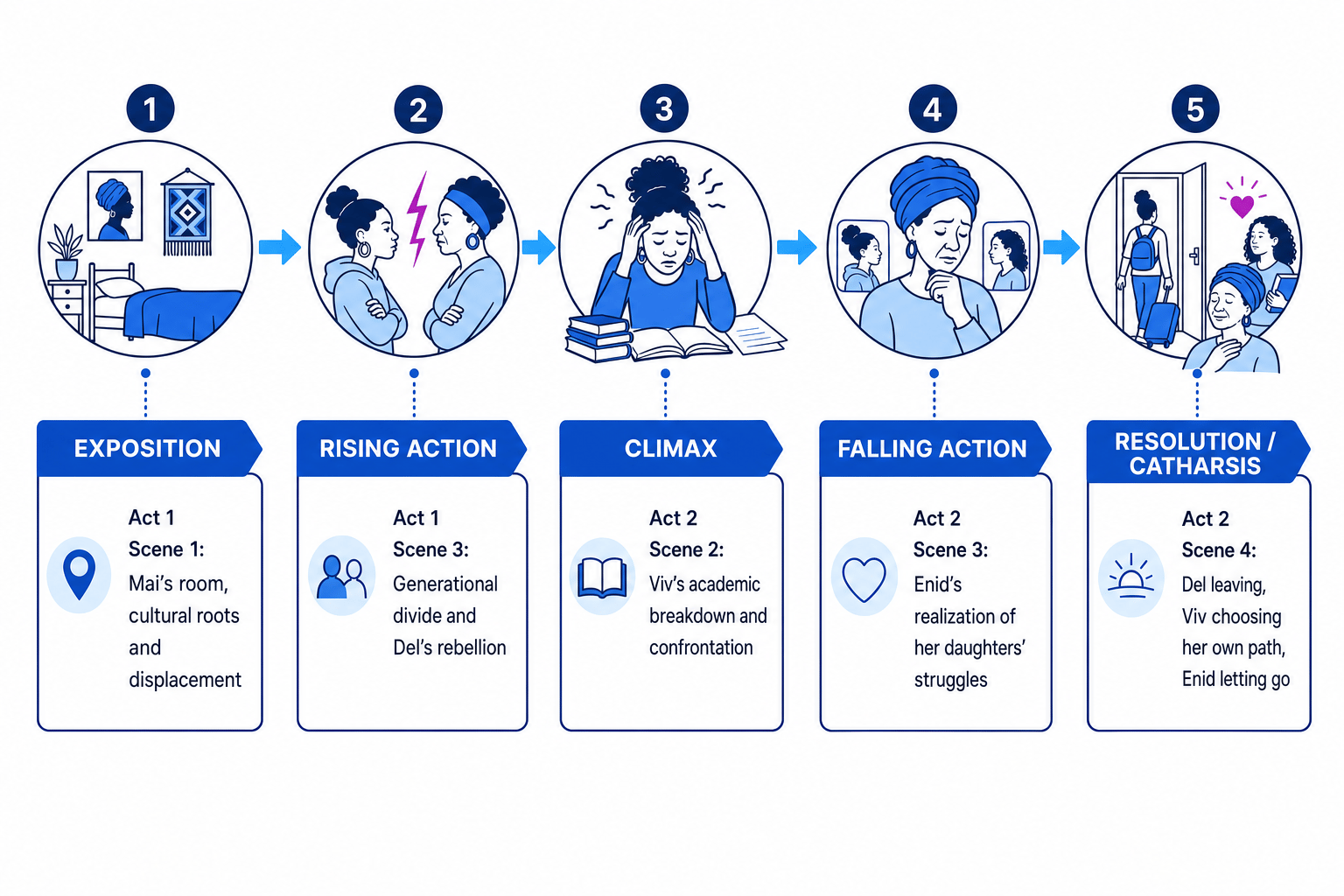
Pinnock structures Leave Taking in a two-act format. Rather than following a simple chronological timeline, the play uses shifts in setting and intense, localized interactions to chart the psychological journeys of Enid, Del, and Viv.
Dramatic Structure
The blueprint of a play's action. It is how a playwright arranges scenes, acts, and events to build emotional tension, reveal character motivations, and resolve conflicts.
The diagram below illustrates how Pinnock structures the play to move from cultural isolation to confrontation, breakdown, and eventually, a bittersweet resolution.
1. Act 1, Scene 1: The Obeah Consultation
The play opens in Mai’s room, a setting filled with sensory details: the smell of herbs, a bowl of water, and religious and cultural items. This scene acts as the exposition, introducing us to Enid’s deep-seated anxieties and her connection to her Jamaican heritage.
Why this scene is vital:
- Cultural displacement: Enid has lived in England for years, yet when faced with a crisis (her daughters growing apart from her), she turns to traditional Afro-Caribbean practices. This highlights her sense of isolation in hostile British society.
- Character foil: Mai is presented as a sharp contrast to Enid. While Enid tries to assimilate and hide her past, Mai embraces her cultural roots, providing a safe, authentic space.
Obeah
A system of spiritual healing, justice, and religious practices originating in West Africa and developed by enslaved populations in the Caribbean, particularly Jamaica. In the play, it symbolizes a direct, ancestral link to home.
2. Act 1, Scene 3: The Generational Clash
In this scene, the tension within Enid’s home reaches a boiling point. Del, Enid’s rebellious older daughter, confronts her mother about her upbringing, her absent father, and her desperate desire to assimilate into a society that rejects her.
Why this scene is vital:
- The "Ghost" Metaphor: Del accuses Enid of wanting her daughters to be "ghost people"—invisible, quiet, and subservient to white British society. This metaphor highlights the psychological cost of assimilation.
- Structural Shift: This scene marks the transition from hidden resentment to open rebellion. Del refuses to accept the "immigrant bargain" (the idea that the first generation's suffering must be repaid by the second generation's absolute obedience and success).
The dual meaning of 'Leave Taking'
The title of the play operates on two levels. It refers to the physical "leave taking" (leaving Jamaica for England, and later, Del leaving home), but also the emotional and psychological "leave taking"—the painful process of children separating from their parents to find their own identity.
3. Act 2, Scene 2: Viv's Academic Breakdown
Viv, the "good daughter" who is expected to study her way out of working-class struggle, collapses under the immense weight of her mother’s expectations. She is studying for her A-Levels, reading until her "eyes bleed," trying to fulfill Enid's dream of her becoming a doctor or lawyer.
Why this scene is vital:
- The Climax of Maternal Pressure: This scene is the dramatic climax of the play's academic theme. Viv's breakdown shows that intellectual assimilation is just as damaging as physical displacement if it cuts a person off from their heritage.
- The Loss of Voice: Viv feels she has no voice of her own; she is merely reciting other people's words. Her breakdown is a desperate cry for authenticity.
Analyzing maternal conflict and identity in Act 1, Scene 3
To write a high-level analytical paragraph on how Pinnock presents the conflict between Enid and Del, you must break down the dialogue and stage directions step by step.
- State your point clearly (AO1): Pinnock uses the confrontation between Enid and Del in Act 1, Scene 3 to demonstrate the painful divide between the first-generation Windrush immigrants and their British-born children.
- Provide precise textual evidence (AO1): Del directly challenges her mother's worldview, declaring: "You want us to be like you? Ghost people? Walking around as if we don't have no right to be here."
- Analyze the writer's methods (AO2): The noun phrase "ghost people" acts as a powerful metaphor for the invisibility and erasure experienced by immigrant communities who attempt to assimilate by blending into the background. The rhetorical question directly challenges Enid's passive survival strategy, contrasting it with Del's active, vocal demand for space and recognition in Britain.
- Link to context and thematic meaning (AO3): This conflict illustrates the psychological toll of post-Windrush displacement. While Enid views survival as staying quiet and working hard, Del recognizes that this passivity strips them of their identity, illustrating the inevitable clash when the second generation refuses to live as "invisible" citizens.
4. Act 2, Scene 4: The Final Leave Taking
The final scene of the play brings a sense of catharsis (the release of emotional tension) and resolution. Del decides to leave London, seeking a new life. Viv decides to go to university, but on her own terms, choosing to study her own history rather than just British classics. Crucially, Enid learns to let go.
Why this scene is vital:
- Reconciliation with Heritage: Enid finally speaks of Jamaica not as a place of shame or painful memories, but as a real home with beauty. She gives Viv her blessing.
- The Symbolism of the Suitcase: Staging is vital here. As Del prepares to leave, the physical act of packing and carrying bags represents the ongoing cycle of migration and self-discovery.
- Open-ended Hope: The play does not end with a perfect, neat resolution. Instead, it ends with a realistic sense of hope. The characters have not solved all their problems, but they have gained the self-knowledge needed to face them.
The significance of setting
Notice the contrast in settings between the beginning and the end. The play begins in Mai’s dark, cluttered, mystical room—a space of looking backward to the past. It ends in Enid's clean, bright space with her daughters stepping forward into the future. Staging tells the audience as much as the words do!
Pitfalls to Avoid in the Exam
Ignoring the dramatic form
Many students write about Leave Taking as if it were a novel. They refer to the "reader" instead of the "audience" and analyze the plot rather than the stagecraft. Always remember this is a script designed to be performed. Mention stage directions, props (like the bowl of water or the books), and how actors might deliver their lines.
Treating Enid as the 'villain'
It is easy to look at Enid's strictness and academic pressure on Viv as cruel. However, to achieve top marks (AO3), you must show empathy for her context. Enid is a single mother who has survived racism, isolation, and poverty in 1960s/70s Britain. Her pressure on her daughters comes from a place of deep love and fear for their survival.
In the exam
When writing about key scenes in Leave Taking, follow these three steps to structure your response:
- Contextualize the scene: Briefly state where this scene occurs in the play's wider structure (e.g., is it the exposition, the climax, or the resolution?) and how it moves the plot forward.
- Analyze the language and stagecraft (AO2): Look for key metaphors, symbols, or patterns of language (semantic fields). Make sure to mention at least one stage direction or prop to show you understand it is a play.
- Link to historical and cultural context (AO3): Explain how the scene reflects the lived experiences of the Windrush generation and their children in Britain. Consider themes of systemic prejudice, cultural inheritance, and generational trauma.
Check yourself
Before your exam, make sure you can answer these questions about the key scenes:
- How does the change in setting from Mai's room in Act 1, Scene 1 to Enid's home in Act 1, Scene 2 reflect the internal conflicts of the characters?
- What physical actions and dialogue in Act 2, Scene 2 convey the depth of Viv’s psychological breakdown?
- How does the final conversation between Enid and her daughters in Act 2, Scene 4 demonstrate a shift in Enid's understanding of "home"?
