

Winsome Pinnock’s Leave Taking is a rich, emotionally charged play that explores the lives of a Caribbean immigrant family in 1980s London. Because the GCSE English Literature exam is closed-book, you do not need to memorise vast chunks of text. Instead, you need a small, highly flexible toolkit of short, powerful quotations that you can analyse in depth.
What you'll learn
- How to select and memorise highly versatile "micro-quotations"
- How to break down a quotation using subject-specific literary terminology
- How to link language choices to the play’s core themes of displacement, generational conflict, and identity
- How to connect a character's words to the social and historical context of the Windrush generation
The Art of "Micro-Analysis"
To score highly on your exam, you need to show the examiner that you can examine the writer's craft in detail. This means moving away from simply retelling the plot and moving towards close word-level analysis.
Micro-quotation
A micro-quotation is a very short, highly focused word or phrase (often just 2–5 words) that carries significant thematic or symbolic weight.
Instead of memorising a three-line sentence, memorise a crucial phrase. This makes it easier to embed the quote smoothly into your own sentences, which improves the flow of your essay and directly addresses the assessment criteria for clear, structured expression.
<keyidea title="The "Goldilocks" Quote Rule">
The best quotations are short enough to remember easily under exam pressure, but rich enough to yield at least three distinct analytical points about language, structure, characterisation, or theme.
1. Displacement and the Windrush Experience
A central theme of Leave Taking is the sense of alienation felt by first-generation Caribbean immigrants who arrived in Britain as part of the Windrush generation. Enid, the mother, is at the heart of this struggle.
"Thirty years I spend in this country and I still feel like a stranger." (Enid, Scene 6)
This is one of the most poignant lines in the play, highlighting the deep emotional toll of migration.
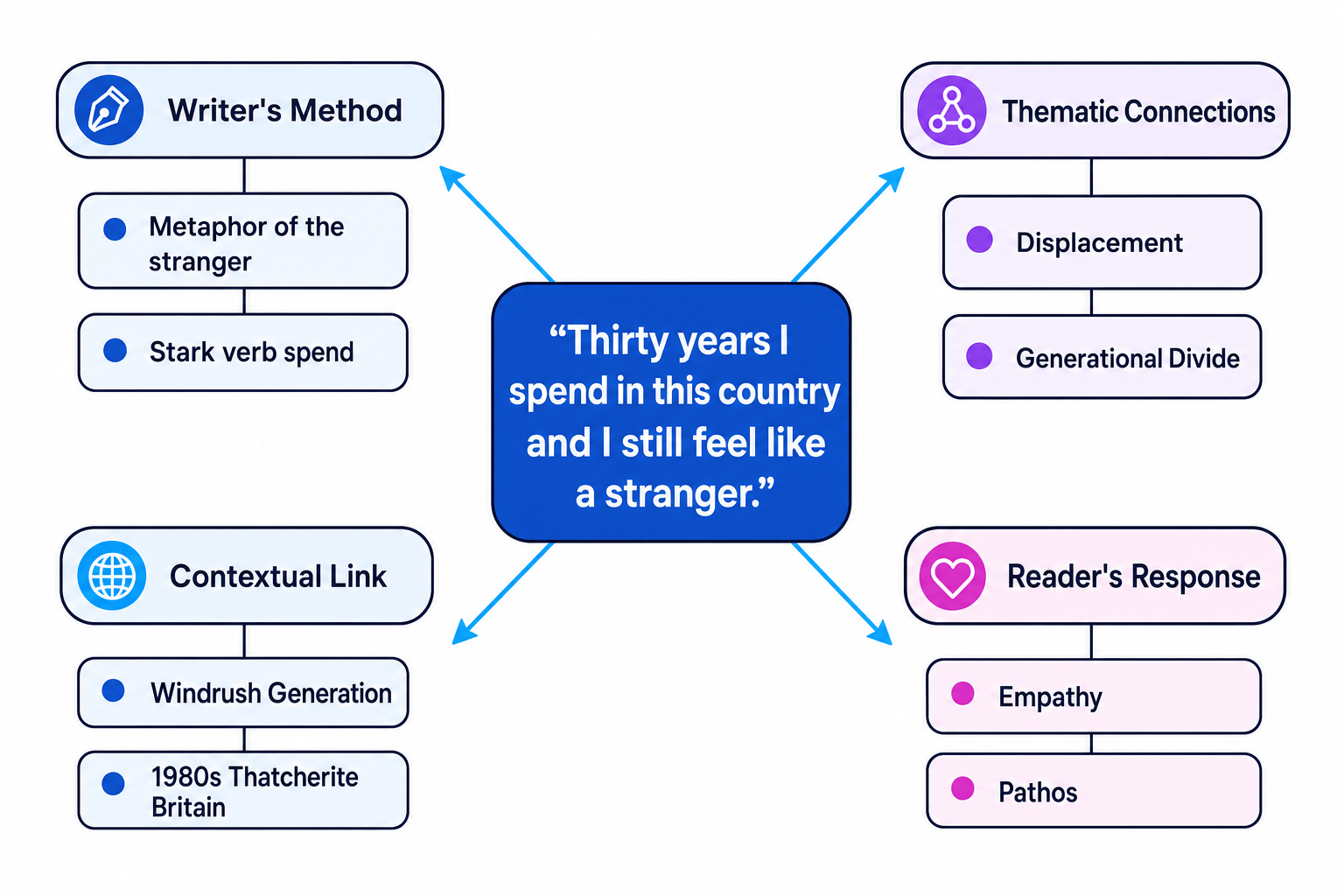
- Thematic Weight: This quotation exposes the failure of the "host" country to welcome and integrate immigrant pioneers. Despite sacrificing her youth, working hard, and raising a family, Enid remains emotionally locked out of British society.
- Language Analysis:
- The use of the noun "stranger" acts as a powerful metaphor for alienation. A stranger is someone who is unnoticed, uninvited, or viewed with suspicion.
- The verb "spend" implies a transaction. Enid has "paid" with thirty years of her life, but she has received no sense of belonging in return.
- The contrast between the long duration of time ("Thirty years") and her current emotional state ("still") emphasises the permanence of her isolation.
Patois and Dialect
Notice how Enid says "Thirty years I spend" rather than the Standard English "I have spent". Pinnock uses Jamaican Patois/Creole grammatically to show that Enid's linguistic roots remain firmly tied to her homeland, reinforcing her identity as someone who does not fully assimilate into Standard English-speaking Britain.
2. Generational Divide and Identity
The conflict between Enid (who seeks security through assimilation) and her daughters (who are caught between British reality and Caribbean heritage) is a driving force of the drama.
"I wanted them to have choices I never had." (Enid, Scene 6)
Enid expresses the classic hope of the immigrant parent, yet this hope contains the seeds of family conflict.
- Thematic Weight: Enid has worked grueling shifts to provide her daughters, Viv and Del, with opportunities. However, those very "choices" pull the girls away from Enid's traditional values, creating a painful generational divide.
- Language Analysis:
- The noun "choices" symbolizes freedom and self-determination. However, there is a bitter irony here: because her daughters have choices, they choose lifestyles and identities that Enid does not understand or approve of (Del’s rebellion, Viv’s intense academic anxiety).
- The pronoun contrast between "them" (her children) and "I" (Enid) highlights the physical and experiential gap between the two generations.
Ignoring the Parent's Perspective
Many students write essays that paint Enid as overly strict or unsympathetic. Avoid this. Use quotes like "I wanted them to have choices..." to show the deep, self-sacrificing maternal love that drives her high expectations.
3. The Search for Cultural Heritage
Del and Viv deal with their dual identities in very different ways. Viv tries to fit in through academic overachievement, but eventually realizes that schoolbooks do not hold all the answers.
"I used to think that if I read enough books I'd find out who I was." (Viv, Scene 8)
This quote marks a turning point in Viv's character development, as she acknowledges the limitations of her Eurocentric education.
- Thematic Weight: Viv's realization highlights how the British education system of the 1980s actively erased black history and Caribbean culture, leaving second-generation children feeling culturally blank.
- Language Analysis:
- The phrase "read enough books" serves as a metonym for the academic validation Viv has chased her whole life.
- The conditional phrasing "if I... I'd find out" exposes her past naivety. She believed that identity was something that could be studied and memorized, rather than lived and felt.
- The search for selfhood ("who I was") is framed as an active, painful quest.
4. Spiritual Healing and Ancestral Roots
Mai, the Obeah woman, acts as a bridge between the physical reality of London and the spiritual, ancestral heritage of Jamaica. She provides the cultural grounding that the characters desperately need.
"The spirit don't need a passport." (Mai, Scene 2)
This line is both humorous and profoundly philosophical, capturing the essence of Mai’s role in the play.
Obeah
Obeah is a system of spiritual healing and justice practiced in the Caribbean, originating from West African traditions. In the play, it represents a deep connection to ancestral wisdom and a form of mental and emotional healing outside of Western medicine.
- Thematic Weight: This quotation suggests that cultural identity and spiritual belonging cannot be restricted by political borders, immigration laws, or physical oceans.
- Language Analysis:
- The noun "passport" is a symbol of state control, borders, and national identity. By declaring that the spirit "don't need" one, Mai rejects the British state's power to define who belongs and who does not.
- The contrast between the intangible, free "spirit" and the rigid, bureaucratic "passport" highlights the conflict between natural human connection and artificial societal divisions.
Worked Example
Let's look at how to construct a high-scoring analytical paragraph in an essay using Mai's quotation: "The spirit don't need a passport."
We will follow a structured approach to ensure we hit all the key assessment objectives: making a clear point (AO1), analyzing language methods (AO2), and linking our analysis to historical context (AO3).
Analyzing a key quotation
-
Write a clear, topic-driven point (AO1): Pinnock uses the character of Mai to suggest that true cultural identity and spiritual belonging transcend geographical borders and hostile state bureaucracy.
-
Introduce the quotation smoothly, indicating who says it and when (AO1): This is most clearly demonstrated when Mai comforts the anxious Enid by declaring, "The spirit don't need a passport."
-
Identify a key language method and zoom in on specific words (AO2): Here, Pinnock uses the noun "passport" as a symbol of legal citizenship and state control. By contrasting this clinical, bureaucratic object with the intangible, ancestral concept of the "spirit," Pinnock asserts that a person's heritage and inner self cannot be governed or restricted by immigration laws. The non-standard grammatical construction "don't need" further aligns Mai with oral Caribbean traditions, rejecting the formal constraints of Standard English.
-
Connect the language analysis directly to the wider context of the play (AO3): In the context of 1980s Britain—a period marked by systemic racism and Thatcherite anxieties over immigration—this statement is quietly revolutionary. It reassures the characters, and the audience, that their connection to Jamaica remains intact, regardless of physical distance or the hostile British environment they face daily.
In the exam
- Be selective: Do not dump quotes into your essay just to prove you have memorised them. Only use a quotation if you can write at least two sentences of analysis explaining how the writer uses language or structure to convey a deeper meaning.
- Integrate seamlessly: Avoid writing "A quote that shows this is..." Instead, embed the words directly into your sentence structure: Enid feels like a "stranger" in the very country she has spent "thirty years" trying to build a life in.
- Link to the playwright's purpose: Always ask yourself why Winsome Pinnock wrote this line. What did she want a 1980s British theater audience to feel, think, or realize?
Check yourself
- Which character says, "The spirit don't need a passport," and what does this quote suggest about the nature of home and identity?
- How does the noun "stranger" in Enid’s key quote support your understanding of the Windrush generation's experience of displacement?
- What does Viv's reliance on "books" tell us about her initial attempts to understand her identity, and why does this approach ultimately fail her?
