In your AQA GCSE English Literature exam, you will be given an extract from Julius Caesar and asked a question that links the extract to the play as a whole. To secure top marks, you must understand how Shakespeare constructs his play through key scenes, using them to develop characters, build dramatic tension, and explore core themes like power, honour, and manipulation.
What you'll learn
- How to track and analyse the dramatic arc of Julius Caesar using key scenes.
- How Shakespeare uses linguistic and structural techniques to present manipulation, internal conflict, and hubris.
- How to compare the rhetorical strategies in the famous funeral speeches of Act 3, Scene 2.
Understanding Shakespearean Dramatic Structure
Before diving into individual scenes, we must understand how Shakespeare structures a tragedy. Shakespeare uses a five-act structure, which aligns closely with classical dramatic arc models. Each key scene has a specific structural function that drives the narrative forward.
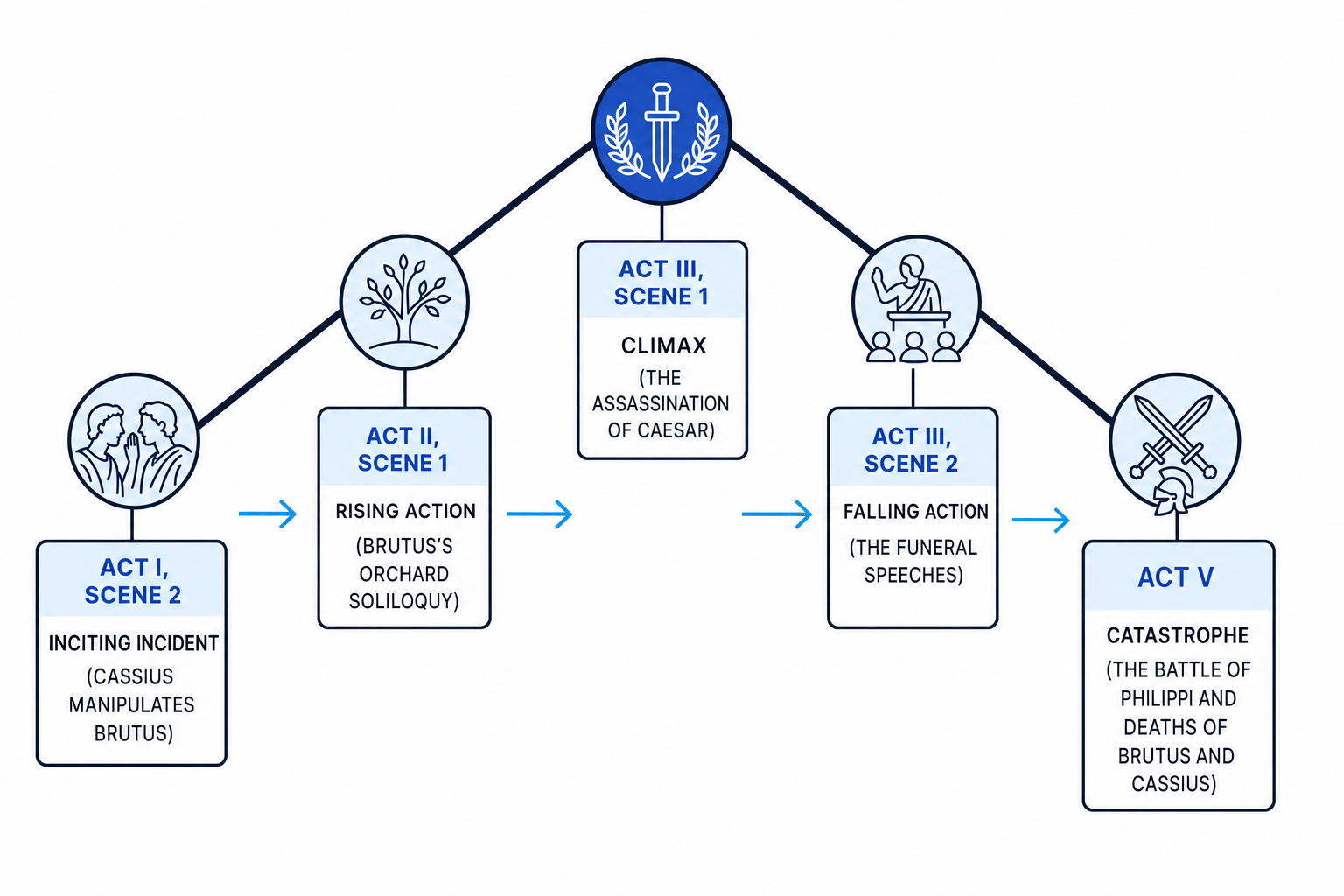
Inciting Incident
The inciting incident is the event or hook that disrupts the status quo and sets the main plot of the play into motion. In Julius Caesar, this occurs in Act 1, Scene 2, when Cassius first plants the seeds of conspiracy in Brutus's mind.
Climax
The climax is the turning point of the play's action, where the conflict reaches its peak of tension. In Julius Caesar, this occurs in Act 3, Scene 1, with the physical assassination of Caesar.
Act 1, Scene 2: The Seduction of Brutus
In this scene, Cassius attempts to recruit Brutus to the conspiracy against Caesar. Caesar has just returned to Rome in triumph, and the crowd is cheering.
Key Theme: Manipulation and Flattery
Cassius uses sophisticated rhetorical techniques to appeal to Brutus’s sense of honour. He acts as a metaphorical mirror, telling Brutus: "I, your glass, will modestly discover to yourself that of yourself which you yet know not."
Cassius exploits Brutus’s secret anxieties about Caesar’s growing power. He uses natural and classical imagery to diminish Caesar, famously comparing him to a Colossus—a giant bronze statue that spanned the harbour of Rhodes:
"He doth bestride the narrow world / Like a Colossus, and we petty men / Walk under his huge legs, and peep about / To find ourselves dishonourable graves."
Key Analytical Focus
- The Colossus Metaphor: By comparing Caesar to a giant statue, Cassius warns that Roman citizens are being reduced to slaves ("petty men").
- The Concept of Honour: Brutus declares, "I love the name of honour more than I fear death." Cassius seizes on this noble trait, framing the conspiracy not as a treasonous murder, but as a patriotic duty to save Rome from tyranny.
Cassius's Strategy
Cassius does not attack Brutus; he elevates him. By flattering Brutus’s virtue and contrasting it with Caesar’s physical weaknesses (such as Caesar's epilepsy and near-drowning in the Tiber), Cassius reframes treason as a virtuous act of Republican duty.
Act 2, Scene 1: Brutus's Orchard Soliloquy
This scene takes place in the dark of night in Brutus's orchard. It is a moment of intense psychological crisis.
Soliloquy
A soliloquy is a dramatic device where a character speaks their thoughts aloud when alone on stage, revealing their inner conflicts, secrets, and true motives directly to the audience.
Key Theme: Rationalisation of Violence
Brutus opens his soliloquy with a shocking conclusion: "It must be by his death." The rest of his speech is not an open-minded debate, but a desperate search for reasons to justify the murder of a man who has not yet done anything wrong.
To rationalise this, Brutus uses the extended metaphor of a serpent's egg:
"And therefore think him as a serpent’s egg / Which, hatch’d, would, as his kind, grow mischievous, / And kill him in the shell."
Key Analytical Focus
- The Serpent Metaphor: Brutus acknowledges that Caesar is currently harmless. However, he argues that obtaining absolute power (the crown) will change Caesar's nature.
- The Ladder Imagery: Brutus describes ambition as a ladder: "lowliness is young ambition’s ladder... but when he once attains the upmost round, he then unto the ladder turns his back."
- The Tragedy of Brutus: Unlike Cassius, who is driven by personal envy, Brutus is driven by abstract ideals. Shakespeare shows the danger of prioritizing cold political philosophy over human relationships.
Misunderstanding Brutus's Motives
Do not write that Brutus hates Caesar. Brutus explicitly states, "I know no personal cause to spurn at him, / But for the general." The word "general" refers to the general public of Rome. Brutus kills his close friend out of a theoretical fear of what Caesar might become, not what Caesar actually is.
Act 3, Scene 1: The Assassination of Caesar
The climax of the play takes place in the Senate. Caesar ignores multiple supernatural omens, showing his supreme arrogance.
Hubris
Hubris is extreme pride or self-confidence that leads a character to underestimate their own vulnerability, ultimately causing their downfall.
Key Theme: Divine Ambition vs. Human Mortality
When asked to pardon Publius Cimber, Caesar boasts of his own unyielding, god-like stability. He compares himself to the celestial world:
"But I am constant as the northern star, / Of whose true-fix'd and resting quality / There is no fellow in the firmament."
This statement is loaded with dramatic irony—the audience knows the conspirators are surrounding him with daggers at this very second. Within moments of comparing himself to an immortal star, Caesar is stabbed 33 times, proving he is only blood and bone.
Caesar's Hubris: "Constant as the Northern Star"
      │
      ▼ (Daggers of the conspirators)
Caesar's Mortality: "Et tu, Brute? — Then fall, Caesar!"
Key Analytical Focus
- "Et tu, Brute?" Caesar's final words translate to "And you, Brutus?". This Latin phrase highlights the ultimate betrayal of friendship. Once Brutus strikes him, Caesar gives up his struggle, indicating that Brutus’s betrayal is more damaging than any physical blade.
- The Irony of Liberty: Immediately after the murder, the conspirators bathe their hands in Caesar's blood and shout, "Liberty! Freedom! Tyranny is dead!" This ritualistic action foreshadows the chaotic bloodbath that will soon consume Rome.
Act 3, Scene 2: The Forum Speeches
This is perhaps the most famous scene in the play, showcasing the power of language and rhetoric to sway the masses. Following the assassination, both Brutus and Mark Antony address the Roman public (the plebeians).
Rhetorical Breakdown: Brutus vs. Antony
| Aspect | Brutus's Speech | Antony's Speech |
|---|---|---|
| Form | Prose (conversational, intellectual, lacking poetic rhythm). | Blank Verse (iambic pentameter; musical, emotional, elevated). |
| Appeal | Appeals to Logos (logic, reason, abstract civic duty). | Appeals to Pathos (emotion, grief, personal connection). |
| Key Line | "Not that I loved Caesar less, but that I loved Rome more." | "Friends, Romans, countrymen, lend me your ears; I come to bury Caesar, not to praise him." |
| Tactics | Asks the crowd to judge him rationally; assumes the crowd is educated and logical. | Uses verbal irony; uses physical props (Caesar’s bloody cloak and his will); pauses to cry. |
Key Theme: Verbal Irony and Mob Psychology
Antony is banned by Brutus from speaking ill of the conspirators. To bypass this, Antony uses structural verbal irony by repeatedly calling Brutus and Cassius "honourable men".
By juxtaposing this praise with evidence of Caesar's generosity (refusing the crown, leaving money to the public in his will), the phrase "honourable men" gradually transforms into a bitter, sarcastic insult.
"Yet Brutus says he was ambitious; / And Brutus is an honourable man."
Form Matters!
Always comment on the contrast between prose and verse in Act 3, Scene 2. Brutus speaks in prose because he treats the plebeians as intellectual equals. Antony speaks in verse because he knows poetry and rhythm have the power to hypnotise and manipulate the emotions of the crowd.
Worked Example: Analysing Rhetorical Methods
Analysing Rhetorical Methods in the Forum Scene
Prompt: Explore how Shakespeare presents the persuasive power of language in Antony's funeral speech in Act 3, Scene 2.
Step-by-Step Analysis
-
Contextualise and select contrasting evidence: Identify how Antony initiates his speech by disarming the hostile crowd. Choose a precise quotation that demonstrates his subversion of Brutus's logical arguments.
Draft quote: "Friends, Romans, countrymen, lend me your ears; / I come to bury Caesar, not to praise him."
-
Identify the dramatic and linguistic methods: Identify the poetic structure (blank verse / iambic pentameter) and rhetorical devices (such as demotic address and verbal irony). Antony addresses the crowd as equals ("Friends") rather than subjects, contrasting with Brutus's intellectual detachment.
-
Analyse the psychological and emotional effect: Explain how the language manipulates the emotions of both the stage crowd and the Elizabethan audience. By stating he has not come to "praise" Caesar, Antony lowers the crowd’s guard, gradually leading them to feel deep grief through the rhythmic control of iambic pentameter.
-
Link to thematic intent and historical context (AO3): Relate this scene to Elizabethan anxieties about demagogues, political rebellion, and the instability of the state. Queen Elizabeth I was elderly, had no heir, and the threat of civil war was a terrifying reality for Shakespeare's contemporary audience. Antony's manipulation of mob psychology illustrates how easily democratic stability can crumble in the hands of a skilled orator.
Model Response Paragraph
Shakespeare presents language as a dangerous tool of political manipulation through Antony's emotionally charged blank verse. Unlike Brutus, who speaks in cold, logical prose, Antony disarms the hostile mob by subverting expectations: "I come to bury Caesar, not to praise him." By using blank verse, Shakespeare gives Antony's speech a hypnotic, natural rhythm that targets the emotions (pathos) of the plebeians. Antony establishes a shared identity by addressing them as "Friends, Romans, countrymen," placing "Friends" first to build a personal connection.
This linguistic intimacy allows Antony to introduce subtle verbal irony, repeatedly stating that "Brutus is an honourable man" until the word "honourable" becomes entirely poisoned by the evidence of Caesar's love for the citizens. For an Elizabethan audience, living under the constant threat of succession crises and civil unrest, this scene served as a terrifying demonstration of how easily a master rhetorician can manipulate the masses to dismantle social order.
In the exam
If you get an extract from one of these key scenes, follow these steps to secure top marks:
- Map the extract: State exactly where the extract fits within the play's five-act tragic structure (e.g., "This extract occurs during the rising action of the play...").
- Examine the form: Look at whether the characters are speaking in blank verse or prose. What does this tell us about their emotional state, authority, or audience?
- Trace the dramatic irony: Identify what the audience knows that the characters do not (especially in Act 2, Scene 1 and Act 3, Scene 1). How does this create suspense?
- Integrate context (AO3): Always link the manipulation of power in these scenes to Elizabethan fears of monarchical tyranny, rebellion, and political instability.
Check yourself
- Why does Brutus use the metaphor of a "serpent's egg" in Act 2, Scene 1, and what does this reveal about his psychological conflict?
- How does the change from prose (Brutus) to blank verse (Antony) reflect the differing political strategies of the two orators in Act 3, Scene 2?
- What is the structural significance of Caesar's comparison to the "northern star" in Act 3, Scene 1, moments before his assassination?
