For your AQA GCSE English Literature Paper 1 exam, you need to show a deep understanding of Julius Caesar. Because the exam is closed-book, you cannot take the play into the exam room. This means you must memorise a bank of versatile, powerful quotations and know how to analyse them in detail.
Instead of memorising huge blocks of text, you will achieve higher marks by selecting short, precise quotations that you can weave naturally into your essays to analyse language, structure, form, and context.
What you'll learn
- How to select and memorise highly versatile "micro-quotations" for the closed-book exam.
- How to analyse Shakespeare's language, structure, and dramatic methods (AO2).
- How to link key quotes directly to the core themes of power, ambition, betrayal, and honour.
- How to connect character dialogue to Elizabethan and Jacobean political contexts (AO3).
Preparing Your Quote Bank
Before looking at the quotes themselves, it is important to understand what makes a quotation "high-yield." A high-yield quotation is short, rich in literary devices, and applicable to multiple characters or themes.
Micro-quotation
A micro-quotation is a highly condensed phrase of two to five words (for example, "serpent's egg" or "domestic fury") that carries significant thematic weight and can be easily integrated directly into your own sentences.
Using micro-quotations ensures that your writing flows smoothly and helps you avoid writing long, blocky quotes that take up space without adding analytical value.
<keyidea title="The "What, How, Why" Rule">
For every quote you use, you must explain:
- What is happening and what the quote means literally (AO1).
- How Shakespeare uses language, structure, or dramatic form to convey meaning (AO2).
- Why Shakespeare wanted his audience to think this, linking it to themes and context (AO3).
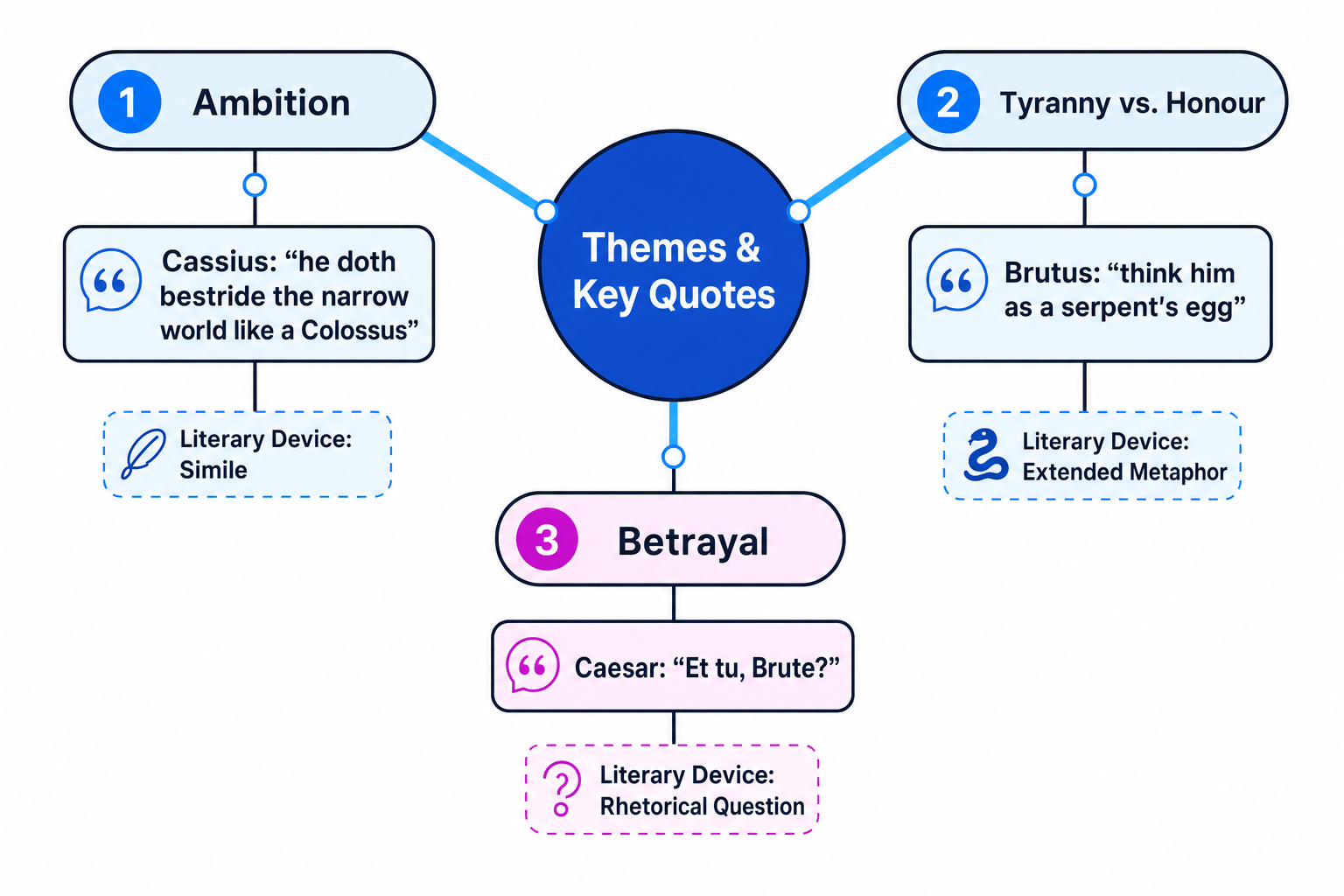
Essential Quote Analysis
Let us look at the most important quotations from the play, organised by theme.
Theme 1: Tyranny and Ambition
"Why, man, he doth bestride the narrow world / Like a Colossus" (Cassius, Act 1, Scene 2)
- Methods: Simile, classical allusion, hyperbole.
- Analysis: Cassius compares Caesar to the Colossus of Rhodes, a giant bronze statue of the Greek sun god Helios that supposedly spanned the harbor entrance. By framing Caesar as a giant and ordinary Romans as "petty men" walking under his "huge legs," Cassius uses vivid imagery to feed Brutus’s fears of tyranny.
- Context: Elizabethans were highly sensitive to the balance of power. A monarch who ruled without consulting their advisors or Parliament was seen as a tyrant. Cassius plays on this fear to make Caesar's growing power seem unnatural and monstrous.
Confusing Cassius's motives with Brutus's
Do not assume Cassius and Brutus want to kill Caesar for the same reason. Brutus acts out of a philosophical love for the Roman Republic, whereas Cassius is driven largely by personal envy and resentment of Caesar’s authority. Use Cassius's bitter language to show his personal spite.
Theme 2: Honour, Manipulation, and Logic
"And therefore think him as a serpent's egg / Which, hatch'd, would, as his kind, grow mischievous, / And kill him in the shell." (Brutus, Act 2, Scene 1)
- Methods: Soliloquy, extended metaphor, natural imagery.
- Analysis: In this soliloquy (a dramatic speech where a character speaks their thoughts aloud to the audience), Brutus attempts to justify murdering his friend. He uses the extended metaphor of a "serpent's egg" to argue that Caesar is not yet a tyrant, but has the potential to become one. The verb "kill him in the shell" represents a preemptive strike.
- Context: The snake or serpent is a traditional Christian symbol of temptation, evil, and the devil (from the Garden of Eden). By associating Caesar with a serpent, Brutus tries to frame the assassination as a moral and religious duty.
Theme 3: Rhetoric, Power, and Chaos
"Cry 'Havoc!' and let slip the dogs of war" (Antony, Act 3, Scene 1)
- Methods: Metaphor, soliloquy, animalistic imagery.
- Analysis: Antony utters these words alone over Caesar’s body. "Havoc" was a military order permitting soldiers to pillage and slaughter without mercy. The metaphor "dogs of war" represents the wild, uncontrollable forces of civil conflict (historically identified as sword, fire, and famine) that Antony intends to unleash upon Rome to avenge Caesar.
- Context: Shakespeare’s audience feared civil war above almost all else. Having lived through decades of religious instability under Tudor monarchs, the prospect of a country tearing itself apart due to a power vacuum was a terrifying, real-world anxiety.
Punctuation in Antony's Speech
Note the exclamation mark in "Cry 'Havoc!'". Antony is not speaking calmly; his soliloquies show a passionate, vengeful, and highly calculated inner life that contrasts sharply with his polite public persona.
"Friends, Romans, countrymen, lend me your ears" (Antony, Act 3, Scene 2)
- Methods: Blank verse, inclusive pronouns, rhetoric.
- Analysis: Antony begins his funeral speech by subverting Brutus’s earlier address. While Brutus addressed the crowd as "Romans, countrymen, and lovers" (prioritising the state first), Antony places "Friends" first. He uses inclusive, democratic language to build a bridge with the plebeians before gradually turning them against the conspirators.
- Context: Antony's speech is a masterclass in Classical Rhetoric—the art of persuasive speaking. Shakespeare shows how easily the public can be manipulated by an eloquent speaker, reflecting Renaissance anxieties about the instability of the common people (the "mob").
Worked Example: Deconstructing a Quotation
To get top marks in your GCSE, you must be able to break down a quote step-by-step to show how its language reveals deeper thematic meaning.
Analyzing Brutus's internal conflict
Quote to analyze: "Let's be sacrificers, but not butchers, Caius." (Brutus, Act 2, Scene 1)
-
Contextualise the quote: Place the quote in the dramatic narrative of the play. Here, Brutus is addressing the conspirators in his orchard as they plan the assassination. Cassius has suggested they also kill Mark Antony, but Brutus rejects this.
-
Identify the core contrast (antithesis): Identify the structural juxtaposition of opposites. Brutus contrasts the nouns "sacrificers" and "butchers."
-
Analyse the connotations of "sacrificers": Examine what "sacrificers" implies. A sacrifice is a holy, ritualistic, and necessary act done for the greater good of the gods and the community. This reveals Brutus's desperate need to view the murder as a clean, honorable, and noble duty rather than a crime.
-
Analyse the connotations of "butchers": Examine what "butchers" implies. A butcher kills animals brutally and violently for meat, motivated by raw consumption or profit. Brutus rejects this term because it exposes the ugly, bloody, and treasonous reality of their actions.
-
Link to character and theme (AO1/AO3): Connect these linguistic choices to Brutus's fatal flaw (his hamartia). His insistence on nobility blinds him to the political danger of leaving Antony alive. It also highlights the theme of appearance versus reality: Brutus wants to paint a bloody political coup as a holy ceremony.
Summary Table: Key Quotes at a Glance
| Quote | Speaker | Key Theme | Key Method | Why it matters |
|---|---|---|---|---|
| "Beware the ides of March." (1.1) | Soothsayer | Fate and Foreshadowing | Direct address | Establishes the tragic trajectory of the play and Caesar's hubris (blind pride) in ignoring it. |
| "The fault, dear Brutus, is not in our stars, / But in ourselves..." (1.2) | Cassius | Free Will vs. Fate | Metaphor | Cassius argues that Romans are cowards for allowing Caesar to rule; humans control their own destiny. |
| "Et tu, Brute? Then fall, Caesar!" (3.1) | Caesar | Betrayal and Tragedy | Latin phrasing / Tragic climax | The switch to Latin emphasizes Caesar's shock and heartbreak at his close friend's betrayal. |
| "O, pardon me, thou bleeding piece of earth, / That I am meek and gentle with these butchers!" (3.1) | Antony | Revenge and Loyalty | Soliloquy / Metaphor | Reveals Antony's true, raging fury and his plan to avenge Caesar while pretending to cooperate with Brutus. |
| "This was the noblest Roman of them all." (5.5) | Antony | Honour and Tragedy | Epitaph / Hyperbole | Antony acknowledges that Brutus was the only conspirator who acted out of love for Rome, not envy. |
In the exam
- Keep quotes short: Integrate micro-quotations of 2–4 words directly into your sentences (e.g., Brutus fears Caesar will "grow mischievous" once crowned).
- Track shifting language: If analyzing Antony, show how his language shifts from private fury ("bleeding piece of earth") to public sarcasm ("honourable men"). This scores highly for tracking character development and dramatic irony.
- Link form to character status: Note who speaks in blank verse (noble characters, using unrhymed iambic pentameter) versus prose (everyday speech used by the plebeians or when characters lose their mental balance).
- Context is not a history add-on: Never write a random paragraph of history. Always tie Elizabethan/Roman context directly to the words in your quote (e.g., explain how "serpent's egg" plays on Christian beliefs of temptation).
Check yourself
- Can you name the key structural contrast Brutus makes in Act 2, Scene 1 to justify the murder without looking like a murderer?
- What classical allusion does Cassius use to describe Caesar's towering ambition in Act 1, and what does it reveal about his motives?
- Why is Antony's private soliloquy over Caesar's body crucial for understanding his public speech to the Roman citizens?
