What you'll learn
- How to turn a Julius Caesar question into a clear argument.
- How to plan paragraphs that cover both the printed extract and the wider play.
- How to choose short quotations and methods without retelling the plot.
- How to adapt plan routes for common themes like honour, power, rhetoric and fate.
Why essay plans matter
An essay plan is a quick map of your argument before you start writing. In AQA GCSE English Literature, the Julius Caesar question gives you an extract and asks you to write about that moment and the play as a whole.
Because the exam is closed book, you need a plan that uses short, secure quotations you can remember. You are rewarded for a thoughtful personal response, close analysis of Shakespeare’s methods, relevant context, and accurate writing.
Essay plan
An essay plan is a brief structure for your answer: your main argument, your paragraph order, the quotations you will use, and the methods you will analyse.
The aim of planning
A strong plan stops you from writing “what happens next”. It helps you build an argument about how Shakespeare presents an idea or character across the play.
The basic shape of a Julius Caesar essay
Most strong answers have a simple shape:
- Thesis — your overall answer to the question.
- Paragraph 1 — the extract or an early moment in the play.
- Paragraph 2 — a turning point, conflict or complication.
- Paragraph 3 — later consequences or Shakespeare’s final judgement.
- Conclusion — a short final sentence that returns to the question.
A turning point is a moment when the direction of the drama changes. In Julius Caesar, obvious turning points include Brutus deciding “It must be by his death”, Caesar’s assassination, and Antony’s funeral speech.
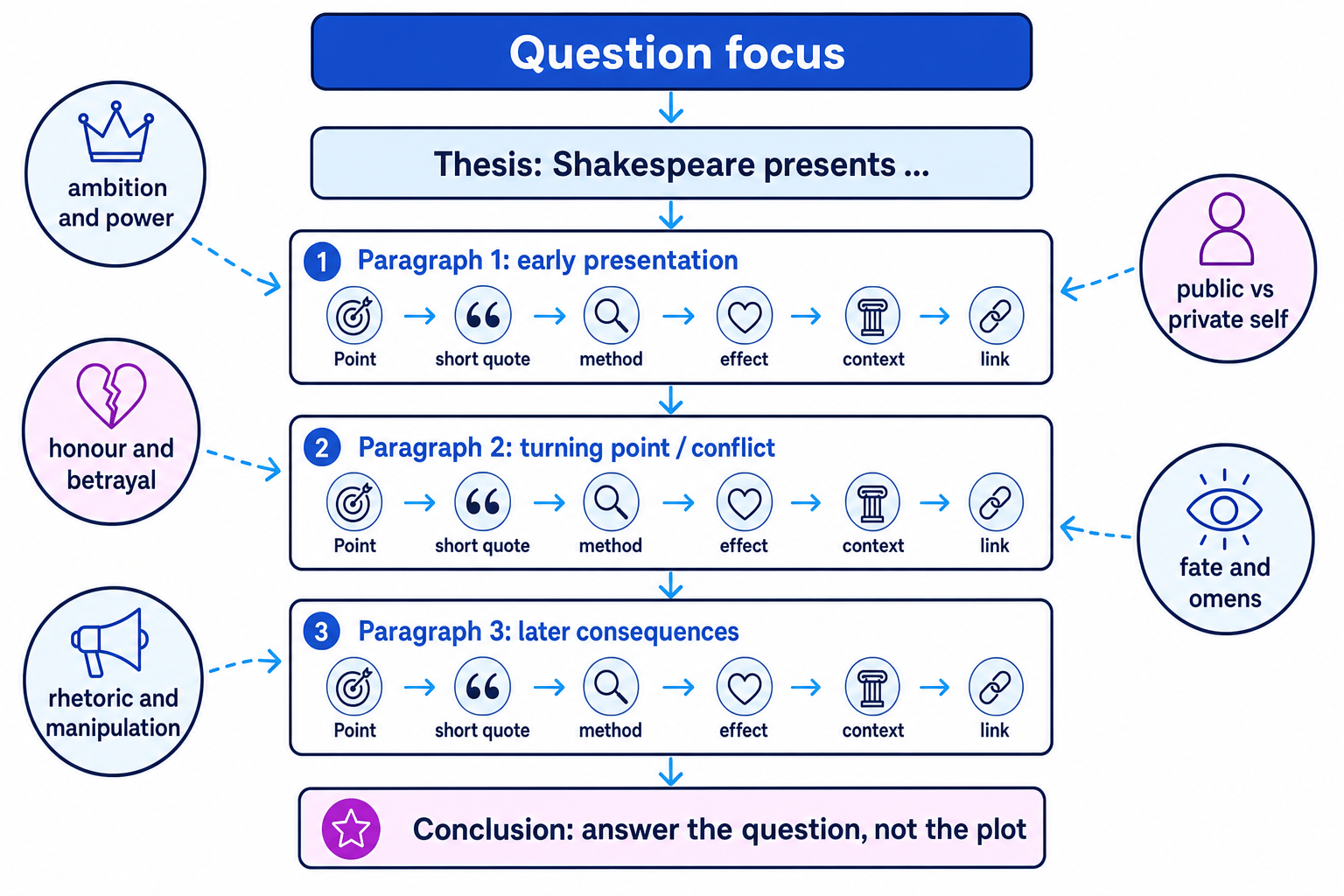
Thesis and line of argument
A thesis is your main judgement. A line of argument is the way that judgement develops from paragraph to paragraph.
A weak thesis says: “Shakespeare presents Brutus as honourable.”
A stronger thesis says: “Shakespeare presents Brutus as genuinely honourable but dangerously naïve, showing how private ideals can cause public disaster.”
The second version is better because it gives you something to prove.
Turning a question into a thesis
Question focus: How does Shakespeare present Brutus as a conflicted character?
-
Separate the character from the idea: the essay is not just about Brutus, but about his inner conflict between loyalty to Caesar and duty to Rome.
-
Make a judgement: Shakespeare presents Brutus as morally serious, but his honour makes him vulnerable to manipulation by Cassius.
-
Build a line of argument: start with Brutus’s private reasoning in Act 2, move to his public justification after the murder, then end with Antony’s judgement that he was “the noblest Roman of them all”.
Step 1: Read the question as an argument prompt
Most questions begin with “How does Shakespeare present…?” This means you should discuss methods, not just events.
A method is a choice made by the writer. In Shakespeare, methods include language, imagery, dramatic structure, contrast, irony, soliloquy and stage action.
If the question is about ambition, do not just write about who wants power. Ask: What does Shakespeare seem to suggest about ambition? Is it dangerous, necessary, hidden, public, political?
Use the wording of the question
Turn the question into your first sentence. If the question asks about honour, your thesis should use the word honour or a close synonym such as “reputation”, “virtue” or “public nobility”.
Step 2: Choose a three-part route through the play
A good Julius Caesar plan usually moves through the play in order. This is called a chronological structure, meaning you arrange your ideas according to when they happen.
You can still be analytical. The point is not “first this happens, then this happens”. The point is: Shakespeare develops the idea over time.
A simple three-part route
| Paragraph | Purpose | Julius Caesar examples |
|---|---|---|
| 1 | Establish the idea early | Cassius describes Caesar “Like a Colossus”; Brutus values “honour” |
| 2 | Explore conflict or turning point | Brutus decides “It must be by his death”; Caesar ignores warnings |
| 3 | Show consequences | Antony manipulates the crowd; civil war follows; Brutus is judged “noblest” |
Planning an honour question
Question focus: How does Shakespeare present honour in Julius Caesar?
-
Decide the overall argument: Shakespeare presents honour as attractive and admirable, but also dangerously unstable because different characters use the word for different purposes.
-
Select three moments: Cassius appeals to Brutus’s sense of “honour” in Act 1; Brutus justifies murder by claiming he loved Rome more than Caesar in Act 3; Antony repeats “honourable man” until the phrase becomes an accusation.
-
Attach methods to the moments: Cassius uses persuasive rhetoric, Brutus uses balanced contrast in “not that I loved Caesar less, but that I loved Rome more”, and Antony uses verbal irony to turn public opinion against the conspirators.
Step 3: Build each paragraph around method and effect
Each paragraph should do more than include a quotation. It should explain how Shakespeare’s choices shape the audience’s response.
Evidence, method and effect
Evidence is a short quotation or precise reference. Method is the writer’s choice, such as metaphor or irony. Effect is what that choice makes the audience think, feel or understand.
A strong paragraph plan might look like this:
- Point: Shakespeare presents Cassius as politically clever and manipulative.
- Evidence: He tells Brutus, “The fault, dear Brutus, is not in our stars, / But in ourselves”.
- Method: Cassius uses antithesis, contrasting “stars” with “ourselves”.
- Effect: He makes rebellion seem like an act of personal courage rather than betrayal.
- Context link: In a play shaped by Roman republican politics and Elizabethan fears of disorder, Shakespeare explores how persuasive speech can destabilise a state.
- Link: This supports the idea that language is a form of power.
Device spotting
Do not write: “This is a metaphor, which makes the reader interested.” Instead, explain what the method reveals about power, honour, fear or manipulation.
Step 4: Use the extract without getting trapped in it
In the exam, you must write about the printed extract and the whole play. The extract gives you a starting point, but your plan should quickly connect it to other moments.
A safe plan is:
- Start with the extract.
- Link to an earlier moment that prepares for it.
- Link to a later moment that shows its consequences.
For example, if the extract is from Caesar’s assassination in Act 3 Scene 1, you could link backwards to Brutus’s soliloquy “It must be by his death” and forwards to Antony’s “Cry ‘Havoc!’ and let slip the dogs of war”.
Linking an assassination extract to the whole play
-
Identify the central idea in the extract: Caesar’s murder presents political violence as shocking, intimate and theatrical, especially when Caesar says “Et tu, Brute?”
-
Connect backwards: Brutus’s earlier metaphor of Caesar as a “serpent’s egg” shows that he convinces himself murder is preventative, not personal.
-
Connect forwards: Antony’s “dogs of war” image shows that the assassination does not save Rome but releases chaos, making Shakespeare’s structure tragic and ironic.
Extract-only answers
If you only discuss the printed extract, your answer will feel narrow. Even one or two well-chosen references to the wider play can make your argument much stronger.
Adaptable plan routes for common questions
Use these as flexible routes, not scripts. In the exam, adjust them to the wording of the question.
| Question focus | Possible thesis | Useful route |
|---|---|---|
| Brutus | Shakespeare presents Brutus as honourable but politically naïve. | Act 2: “It must be by his death” shows private conflict. Act 3: “loved Rome more” shows public justification. Act 5: “noblest Roman” creates a mixed final judgement. |
| Caesar and power | Shakespeare presents Caesar as powerful, but also vulnerable to pride and performance. | Cassius says Caesar bestrides the world “Like a Colossus”. Caesar claims he is “constant as the Northern Star”. His fall after “Et tu, Brute?” reveals the fragility of political image. |
| Rhetoric and manipulation | Shakespeare shows that public language can control political reality. | Cassius persuades Brutus that “the fault” lies “in ourselves”. Brutus uses logical contrast in his funeral speech. Antony’s “Friends, Romans, countrymen” and repeated “honourable man” turn the crowd. |
| Fate and omens | Shakespeare creates tension between destiny and human choice. | The Soothsayer warns “Beware the ides of March”. Calpurnia says “the heavens themselves blaze forth”. Cassius rejects fate by saying the fault is “not in our stars”. |
| Honour and betrayal | Shakespeare presents honour as both a moral ideal and a dangerous public label. | Cassius appeals to honour. Brutus betrays Caesar for Rome. Antony’s irony exposes how “honourable” actions can look dishonourable. |
Context: small, relevant, and attached to analysis
Context means the social, historical or political ideas surrounding the text. For Julius Caesar, useful context includes Roman republican values, fears about tyranny, assassination, civil war, and Shakespeare’s late Elizabethan audience, who lived with anxiety about succession and rebellion.
Do not bolt context on at the end of a paragraph. Make it part of your interpretation.
Weak context: “Shakespeare was writing in the Elizabethan era.”
Stronger context: “For an Elizabethan audience anxious about rebellion and succession, the chaos after Caesar’s murder would make political assassination seem dangerously unpredictable.”
Context test
If your context sentence could be copied into an essay on any Shakespeare play, it is probably too vague. Tie it to Rome, rule, rebellion, honour or public speech.
A quick planning template
Before writing, spend a few minutes filling this in mentally or in brief notes:
| Part of essay | What to plan |
|---|---|
| Thesis | “Shakespeare presents…” plus your judgement |
| Paragraph 1 | Extract point, short quote, method, effect |
| Paragraph 2 | Wider play moment before or after the extract |
| Paragraph 3 | Consequence, contrast or final judgement |
| Conclusion | One sentence returning to the question |
Do not over-plan
A plan should help you start writing, not delay you. Aim for brief bullet points: character, idea, quote, method, effect.
Mini quote bank for planning
Keep quotations short. You do not need long passages if you can analyse precisely.
- Soothsayer: “Beware the ides of March” — fate, warning, dramatic tension.
- Cassius: “Like a Colossus” — Caesar’s power, exaggeration, resentment.
- Cassius: “not in our stars” — free will, persuasion, anti-fate argument.
- Brutus: “It must be by his death” — conflict, tragic decision, soliloquy.
- Caesar: “constant as the Northern Star” — pride, authority, inflexibility.
- Caesar: “Et tu, Brute?” — betrayal, shock, personal collapse.
- Antony: “Friends, Romans, countrymen” — rhetoric, public address, control.
- Antony: “honourable man” — verbal irony, manipulation, changing opinion.
- Antony: “dogs of war” — violence, chaos, consequences.
- Antony: “noblest Roman” — final judgement, honour, tragedy.
In the exam
-
Spend a few minutes planning your thesis, three paragraph points and short quotations before you write.
-
Cover both the extract and the wider play: use the extract as your starting point, then move to earlier or later scenes.
-
Analyse Shakespeare’s methods in every paragraph, linking language and structure to meaning, audience response and relevant context.
Check yourself
- Can you turn a question about Brutus, Caesar or Antony into a clear thesis?
- Can you plan three paragraphs without simply retelling the plot?
- Can you attach a method and an effect to each quotation you choose?
