

When studying a play like Winsome Pinnock’s Leave Taking for your GCSE English Literature exam, it is easy to treat it like a novel. However, plays are written to be performed on a stage in front of a live audience.
To score highly in your exam, you must show the examiner that you understand the text as a piece of drama. This means analysing how Pinnock uses theatrical tools to convey her themes of identity, belonging, displacement, and the generational divide.
What you'll learn:
- How to define and identify "dramatic methods" distinct from purely literary devices.
- How Pinnock uses the physical stage design and setting to externalise her characters' inner conflicts.
- The way dialogue, linguistic code-switching, and character foils generate dramatic tension.
- How to write high-level analytical paragraphs linking stagecraft directly to its impact on an audience.
What are Dramatic Methods?
Before looking at the play specifically, we must establish what we mean by a "dramatic method".
Dramatic Methods
Dramatic methods are the specific theatrical techniques and tools a playwright uses to build meaning, character, and tension on stage. This includes physical elements like set design, lighting, sound, props, and stage directions, as well as structural elements like character foils, dialogue variations, and dramatic irony.
When writing about Leave Taking, your focus must remain on the audience's experience. Instead of writing "this shows the reader," you should write "this makes the audience witness" or "Pinnock presents this visually to the spectator."
Structural Contrast: The Two Worlds of the Play
One of Pinnock's most powerful dramatic methods is her use of setting. In Leave Taking, the action is split between two main locations in 1980s London: Enid's semi-detached home and Mai's flat.
This spatial division is not just geographical; it is a structural representation of the characters’ psychological split between British assimilation and Caribbean heritage.
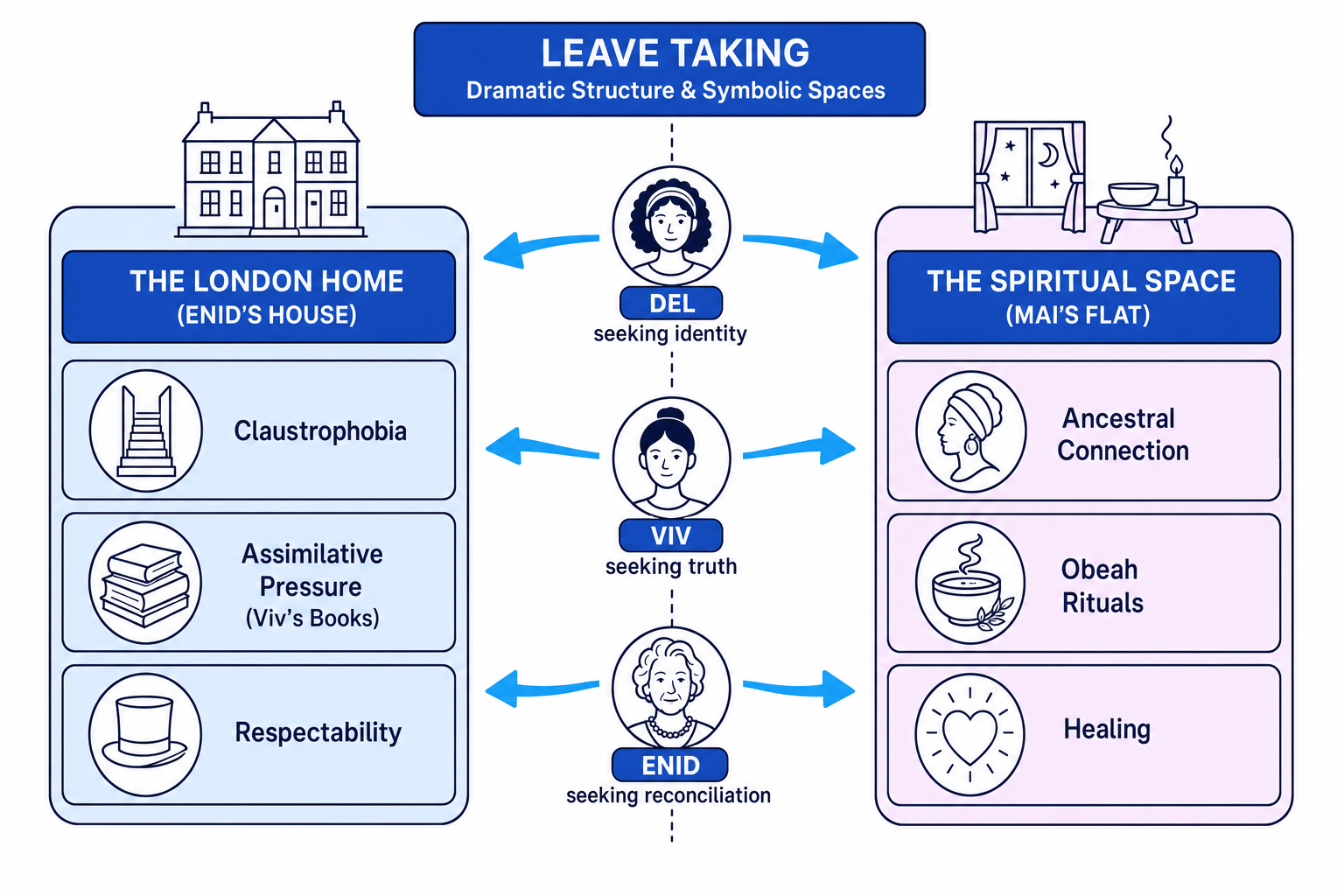
The Dramatic Contrast of Space
- Enid’s House (The London Home): This setting represents the drive for Western respectability and assimilation. It is orderly, clean, and filled with symbols of achievement (such as Viv’s schoolbooks). However, it is also a site of extreme emotional claustrophobia. The walls represent Enid’s desperate attempt to keep the hostile outside world of 1980s racist Britain at bay.
- Mai’s Flat (The Spiritual Space): In contrast, Mai's flat is a sensory-rich, alternative space filled with the smells of herbs, a bowl of water, and elements of Caribbean spiritual heritage (Obeah). It is a space where the past is active and must be confronted.
Setting as Outer Conflict
Pinnock uses the physical movement of characters between these two locations to dramatise their internal progress. A character's decision to leave one space and enter another signifies a shift in their search for identity.
Stage Directions and Claustrophobia
At the start of Act One, Scene One, Pinnock’s stage directions immediately establish the tense atmosphere of Enid’s home.
The play opens with Viv studying while Enid works on a sewing machine. The stage directions note the "hum of the sewing machine" and the piles of books around Viv. This immediately establishes two ideas:
- Industry and Sacrifice: Both mother and daughter are working tirelessly. Enid works a manual job (and sews at home) to survive; Viv studies to escape her mother's fate.
- Confinement: The noise of the machine and the physically dominant presence of the books create a cluttered, high-pressure environment.
When Del enters, she disrupts this carefully controlled domesticity. Her physical movements—slamming doors, turning up music, or refusing to sit—shatter the silence, acting as a direct visual rebellion against Enid's rigid rules.
Analyse Stage Directions
Always look at what characters are doing in the stage directions, not just what they are saying. Physical actions (like Enid scrubbing the floor or holding onto a passport) often speak louder than their dialogue.
Character Foils: Viv and Del
A key structural method Pinnock employs is the creation of character foils.
Character Foil
A character foil is a character who contrasts sharply with another character (usually the protagonist or a sibling) in order to highlight and clarify particular qualities of both.
Pinnock structures the play around the contrasting sisterly dynamic of Viv and Del to show the different ways second-generation immigrants navigate identity:
- Viv is studious, quiet, and attempts to please her mother by working within the British academic system. Her foil, Del, is loud, defiant, and rejects her mother's path entirely, seeking survival through street-smart independence.
- Despite their differences, both sisters are trapped. Viv's academic success causes her to feel disconnected from her heritage ("I look in the mirror and I don't see anything"), while Del's rebellion leaves her rootless and vulnerable.
By placing them on stage together, Pinnock forces the audience to see that neither assimilation nor rebellion is an easy solution to systemic displacement.
Language, Dialect, and Code-Switching
Language is a battleground in Leave Taking. Pinnock uses different linguistic styles as a dramatic method to signal characters' loyalty, age, and emotional states.
- Jamaican Patois (Creole): Spoken heavily by Brod and Mai, and used by Enid when she is highly emotional or remembering her childhood. Patois represents authenticity, a connection to Jamaica, and solidarity.
- Standard British English: Spoken by Viv, representing her academic training and her assimilation into British society.
- London Vernacular: Spoken by Del, demonstrating her connection to the urban Black British youth culture of the 1980s.
When characters interact, they often engage in code-switching (shifting between dialects). For example, Enid tries to speak "properly" to show her respectability, but slips into Patois when arguing with her daughters or speaking with Brod.
This linguistic shift shows the audience her psychological division: she cannot fully suppress the "home" she left behind.
Ignoring the Sound of the Play
Do not just write about the meaning of words on the page. Remember that an audience hears the clash of dialects. The rhythm of Brod's patois contrasted with Viv's precise English creates an auditory clash of generations and cultures on stage.
Analyzing a Dramatic Method
Let's look at how to construct a high-level analytical response to a question on how Pinnock uses dramatic methods to present character conflict.
We will focus on the symbolic prop of Enid's letters from her mother in Jamaica, which she keeps hidden away.
Analysing a symbolic prop
Analyze how Pinnock uses the letters to dramatize Enid's conflict with her past.
-
Identify the dramatic method and its immediate context: State clearly what the method is and where it appears. Example: Pinnock uses the physical prop of the unread letters from Enid's mother, kept hidden in a drawer, as a visual metaphor for Enid’s suppressed grief and avoidance of her past.
-
Analyse the stage action and character interaction with the prop: Look closely at the physical actions associated with the prop and how it affects the scene's tension. Example: In Act One, the letters are physically hidden, mirroring Enid's psychological denial of her mother's death. When Del uncovers them, it forces a physical confrontation on stage. The physical act of holding these letters brings the "ghost" of the matriarch in Jamaica directly into the London living room, shattering Enid's defensive posture of stoic silence.
-
Link the dramatic method to the wider themes and historical context (AO3): Explain how this specific moment reflects the universal struggles of the Windrush generation. Example: Through this prop, Pinnock dramatises the painful "leave taking" experienced by the Windrush generation. The letters represent the unpaid emotional toll of migration; by ignoring them, Enid tries to protect herself from the guilt of abandoning her mother. The dramatic revelation of the letters forces the audience to understand that Enid’s harshness toward her daughters stems from unhealed ancestral trauma.
Key Motifs and Symbols
Pinnock utilizes several recurring objects or ideas (motifs) to anchor the play's themes visually for the audience.
1. The Passport
Enid keeps her passport locked away safely. It is a vital physical proof of her right to exist in a hostile 1980s Britain. For Enid, the passport represents security and her hard-won legal status. However, for Del, who steals it, it represents a potential escape route or a commodity. The physical struggle over the passport dramatises the fragility of "belonging" for black immigrants in the UK.
2. The Tea
Throughout the play, Enid constantly offers characters "tea". This is a highly British domestic ritual. By repeatedly performing this action, Enid is trying to assert her mastery of British domestic respectability. However, when she visits Mai, the "tea" is replaced by herbal mixtures and spiritual washes. This shift in beverage reflects the transition from superficial British conformity to deep-rooted Caribbean healing.
3. Viv's Books
Viv is constantly surrounded by stacks of schoolbooks. On stage, these books act as a physical barrier between her and her sister Del, and also between her and her heritage. They symbolize the heavy burden of her mother's expectations—the pressure to be "twice as good" to succeed in a white-dominated society.
In the exam
When answering a question on Leave Taking, make sure you follow these strategies:
- Think like a director: When selecting quotes, choose ones that involve stage directions, physical movements, or explicit prop usage. Discuss how you would direct the actors to stand or speak.
- Structure by dramatic arc: Instead of jumping around the text, try to trace how a dramatic method (like the setting or a character foil relationship) develops from the exposition of Act One to the resolution of Act Two.
- Use the correct terminology: Do not write "Pinnock writes about...". Write "Pinnock structures the scene to...", "Pinnock uses the setting of Mai's flat to...", or "The physical contrast between the sisters on stage highlights...".
Check yourself
Before closing this topic, make sure you can answer these questions:
- How does the physical contrast between Enid’s living room and Mai’s flat reflect the play's central themes?
- What does the symbolic prop of the passport represent to Enid, and how does this contrast with what it means to Del?
- Why is the linguistic technique of "code-switching" so dramatically important for Enid's character?
