To score top marks in your GCSE English Literature exam (AQA 8702), you must analyze not just what characters say, but how Shakespeare constructs their words and the overall architecture of the play. This is the heart of assessment objective AO2.
In Julius Caesar, Shakespeare uses structural shifts, differences between verse and prose, and masterclasses in classical rhetoric to show how political power is won, lost, and manipulated.
What you'll learn
- How to identify and analyze Shakespeare’s use of blank verse and prose to show social status and mental state.
- How the five-act tragic structure builds tension, peaks at the assassination, and descends into civil chaos.
- How to break down the highly persuasive rhetorical devices used by Brutus and Mark Antony.
- How to trace key motifs—such as sickness and the cosmos—to show structural decay in Rome.
1. Dramatic Form: Verse, Prose, and Meter
Shakespeare did not write his plays in a single continuous style. Instead, he constantly moved between different types of writing. The two main forms you need to know are blank verse and prose.
Blank Verse
Blank verse is unrhymed poetry written in iambic pentameter. It is typically spoken by noble, aristocratic, or high-status characters to signal their education, control, and authority.
Iambic Pentameter
Iambic pentameter is a poetic line of five beats (ten syllables total) following a unstressed-stressed pattern (da-DUM da-DUM da-DUM da-DUM da-DUM). It mimics a natural heartbeat or the rhythm of natural English speech, but with a elevated, formal quality.
Prose
Prose is ordinary written or spoken language without metrical structure or rhyme. In Shakespeare’s plays, it is generally used by lower-class characters (like the plebeians/commoners) or by noble characters when they are behaving informally, losing rational control, or trying to appear "common."
Social Status and the Shift of Form
At the very beginning of the play (Act 1, Scene 1), Shakespeare establishes a clear divide using form. The Tribunes (Flavius and Murellus) speak in dignified blank verse:
"Wherefore rejoice? What conquest brings he home? / What tributaries follow him to Rome..."
The commoners (the Cobbler and the Carpenter) reply in witty, pun-filled prose:
"Truly, sir, in respect of a fine workman, I am but, as you would say, a cobbler."
By contrasting these two forms, Shakespeare instantly reveals the class divisions and political instability gripping Rome before Julius Caesar even steps onto the stage.
Form reflects status and control
When noble characters break their usual pattern and drop from blank verse into prose, it always signals something important: either a deliberate attempt to speak "down" to the public, or a loss of mental clarity, emotional poise, or moral authority.
2. Dramatic Structure: The Five-Act Arc
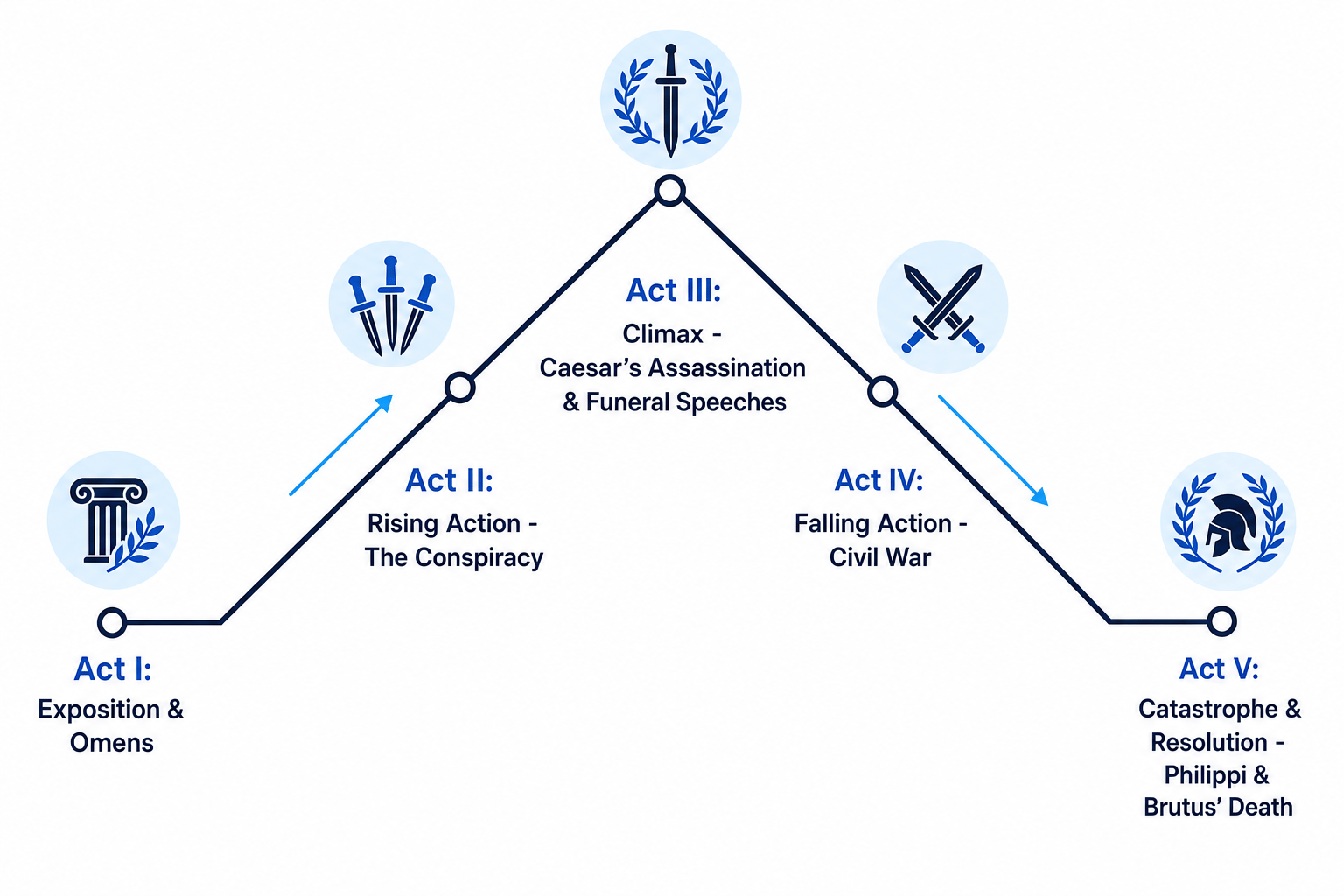
Shakespearean plays follow a classic five-act structure, which can be mapped onto a narrative framework called Freytag’s Pyramid. Understanding where a scene sits within this structure helps you explain why a character speaks or acts a certain way at that specific moment.
Analyzing Structural Pivots
The macro-structure of Julius Caesar is symmetrical. It rises with the conspiracy and falls with the consequences of their action.
- Act 1: Exposition & Inciting Incident. We learn of Caesar's rising dominance, the public's fickle nature, and Cassius's plan to recruit Brutus.
- Act 2: Rising Action. The conspirators meet; Brutus wrestles with his conscience in his orchard and ultimately commits to the murder.
- Act 3: The Climax. Caesar is assassinated at the exact center of the play (Act 3, Scene 1). Power shifts immediately to the conspirators, but is instantly thrown into jeopardy by Mark Antony's funeral oration.
- Act 4: Falling Action. Rome descends into civil war. The conspirators flee; Brutus and Cassius argue in their tent, showing their crumbling alliance.
- Act 5: Resolution/Catastrophe. The Battle of Philippi. The tragic deaths of Cassius and Brutus restore a grim sort of order under Octavius and Antony.
Do not treat the climax as the end
A common mistake is treating Caesar's death as the resolution of the play. In terms of structure, his death is the catalyst for the second half. The tragedy of the play actually belongs to Brutus, whose descent and death form the tragic resolution.
3. The Language of Persuasion: Rhetoric in Act 3, Scene 2
Nowhere in the play is Shakespeare’s command of language more evident than in the funeral speeches of Act 3, Scene 2. This scene is a direct battle between two opposing rhetorical styles.
Rhetoric
Rhetoric is the art of persuasive speaking or writing. Classical Roman education placed immense value on rhetoric, categorizing appeals into three types: logos (appeals to logic/reason), pathos (appeals to emotion), and ethos (appeals to the speaker's character/credibility).
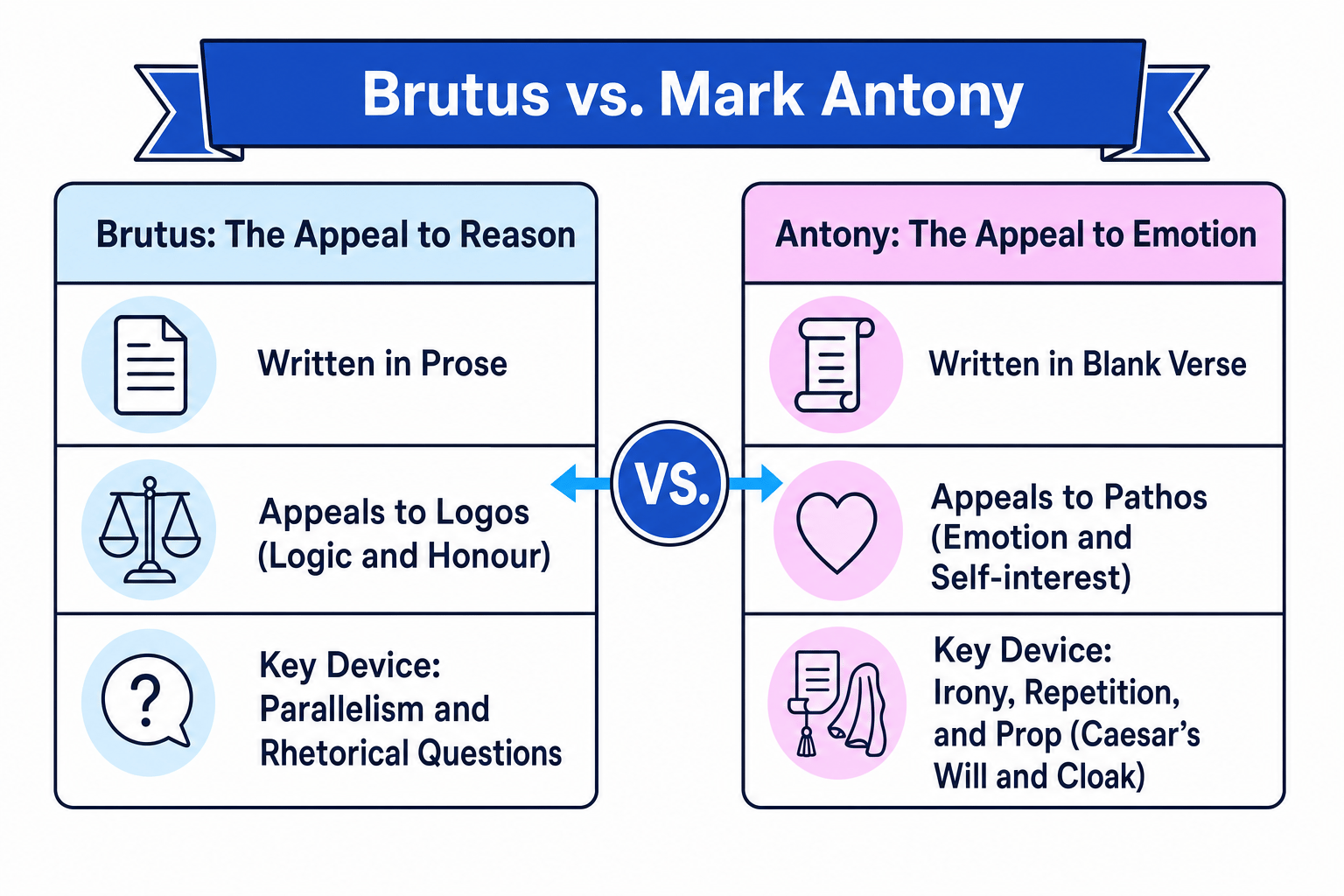
Brutus’s Rational Prose (Logos)
Brutus speaks to the crowd first. Crucially, he chooses to speak in prose, not blank verse. He does this because he wants to appeal to the citizens' intellect and reason, treating them as rational equals. He asks them to:
"...censure me in your wisdom, and awake your senses, that you may the better judge."
His speech is rigid, balanced, and intellectual. He uses antithesis (contrasting ideas in a parallel grammatical structure):
"Not that I loved Caesar less, but that I loved Rome more."
While highly logical, Brutus’s speech is emotionally cold. It relies on the abstract concept of "honour" and fails to capture the crowd's passion.
Antony’s Passionate Verse (Pathos)
Antony steps up next and speaks in blank verse. He does not intellectualize; he feels. He immediately establishes a personal connection:
"Friends, Romans, countrymen, lend me your ears..."
Antony systematically dismantles Brutus’s speech using several linguistic techniques:
- Verbal Irony: He repeatedly calls Brutus and the conspirators "honourable men" until the word "honourable" loses all its positive meaning and begins to sound like an insult.
- Aposiopesis (Dramatic Pauses): He stops speaking because his "heart is in the coffin there with Caesar," pretending to weep so the crowd can talk amongst themselves and build their own anger.
- Visual Props: He physically holds up Caesar’s blood-stained cloak, pointing to the tears made by the daggers of Cassius and "the well-beloved Brutus."
- Self-Deprecation: He claims, "I am no orator, as Brutus is," which is itself a highly sophisticated rhetorical trick designed to make him look like an honest, simple man.
Missing the manipulation
Do not assume Antony is just expressing genuine grief. While he does love Caesar, his speech is a calculated, highly political weapon designed to spark a riot. Always analyze how his language acts as a tool of manipulation.
Analyzing Antony's use of verbal irony
Analyze how Antony uses the repetition of the word "honourable" in Act 3, Scene 2 to change the mind of the Roman crowd.
- Identify the device and context: Locate the repeated phrase ("But Brutus says he was ambitious, / And Brutus is an honourable man") and note that it is delivered immediately after Brutus has convinced the crowd of the assassination's necessity.
- Examine the linguistic shift: Explain how the word "honourable" is initially accepted by the crowd at face value. Show how Antony pairs it with concrete counter-examples of Caesar's generosity (bringing captives home, weeping for the poor) to create a logical contradiction.
- Analyze the dramatic effect: Describe how the repetition turns the compliment into sarcasm. By the time Antony says it for the fourth time, the crowd is shouting that the conspirators are "villains" and "traitors," showing that Antony has completely inverted the meaning of the word without ever directly calling Brutus a liar.
4. Imagery and Motifs: Bodily and Cosmic Disorder
To write a top-tier analysis (AO2), look at how Shakespeare uses recurring patterns of imagery (motifs) to reflect the play's themes on a deeper level.
Sickness and the Body Politic
In the play, the health of the physical body represents the health of the state (the "body politic"). Rome is sick because its leadership is fractured.
- In Act 2, Scene 1, Brutus's wife Portia notices his inner turmoil and states he has a "sick offence within [his] mind."
- Immediately after, the conspirator Ligarius arrives wearing a kerchief (a sign of illness) and says, "Soul of Rome, / Brave son... Thou hast conjured up a sick man."
- Caesar himself has physical ailments—he suffers from "the falling sickness" (epilepsy) and is deaf in one ear. Shakespeare uses these physical limits to contrast Caesar’s frail reality with his god-like reputation.
Storms, Omens, and the Supernatural
Shakespeare uses the physical environment to reflect political chaos (an Elizabethan dramatic technique called pathetic fallacy).
In Act 1, Scene 3, a terrifying tempest rages over Rome. Casca witnesses unnatural events: a slave’s hand burning without being scorched, a lion walking through the Capitol, and men walking on fire.
Context Link (AO3)
To Tudor audiences, the King was chosen by God (the Divine Right of Kings). Assassinating a leader violated the Great Chain of Being—the natural order of the universe. Shakespeare uses storms and supernatural omens to show that murdering Caesar is not just a political crime, but a sin against nature itself.
In the exam
- Analyze the form first: When examining your printed extract, check whether the characters are speaking in blank verse (arranged in neat poetic lines) or prose (running to the edge of the page). Ask why Shakespeare chose that form for that character at that moment.
- Focus on the pivot points: Look for structural shifts within the extract. Does a character's tone suddenly change? Do they shift from logical arguments to emotional outbursts?
- Track rhetorical devices: Do not just list devices like "antithesis" or "rhetorical questions." Explain exactly how those devices are designed to manipulate the listener (whether it is the crowd on stage, another character, or the theatre audience).
- Integrate context seamlessly: When analyzing stormy weather, ghosts, or sickness, connect your language analysis directly to Elizabethan beliefs about the social hierarchy and the divine order of the state.
Check yourself
- Why does Brutus choose to speak in prose during his funeral speech, and what does this choice reveal about his view of the Roman plebeians?
- How does the structural placement of Julius Caesar's death (in Act 3, Scene 1) challenge the traditional idea of who the play's main tragic hero is?
- What does the motif of "sickness" in Acts 1 and 2 foreshadow about the future of the Roman Republic?
