When studying Shakespeare’s Julius Caesar, it is easy to get lost in the dusty streets of ancient Rome. However, to unlock top marks in your GCSE, you must understand that this play is as much about 1599 London as it is about 44 BC Rome.
Shakespeare used historical events as a safe "mirror" to reflect the terrifying political anxieties of his own time. By exploring the tension between absolute power and democracy, he was directly addressing the fears keeping his contemporary audience awake at night.
The Golden Rule of Shakespearean Context
Always remember that Shakespeare wrote for a living, breathing Elizabethan audience. Every political conflict, supernatural event, or philosophical debate in Julius Caesar was designed to resonate with the social and political realities of England in 1599.
What you'll learn
- How to navigate the dual context of the play (the Roman setting vs. the Elizabethan production).
- Why the aging Queen Elizabeth I made the assassination of Julius Caesar incredibly topical.
- How the Elizabethan belief in the Great Chain of Being clashed with Roman ideals of republicanism.
- How to weave context (AO3) naturally into your essays without "context-dumping".
The Principle of Dual Context
To analyze this play effectively, you must balance two distinct historical eras. We call this dual context.
Dual Context
Dual Context refers to the two layers of history operating simultaneously in a literary work: the historical setting where the story takes place (Rome, 44 BC) and the time period in which the author wrote the text (England, 1599 AD).
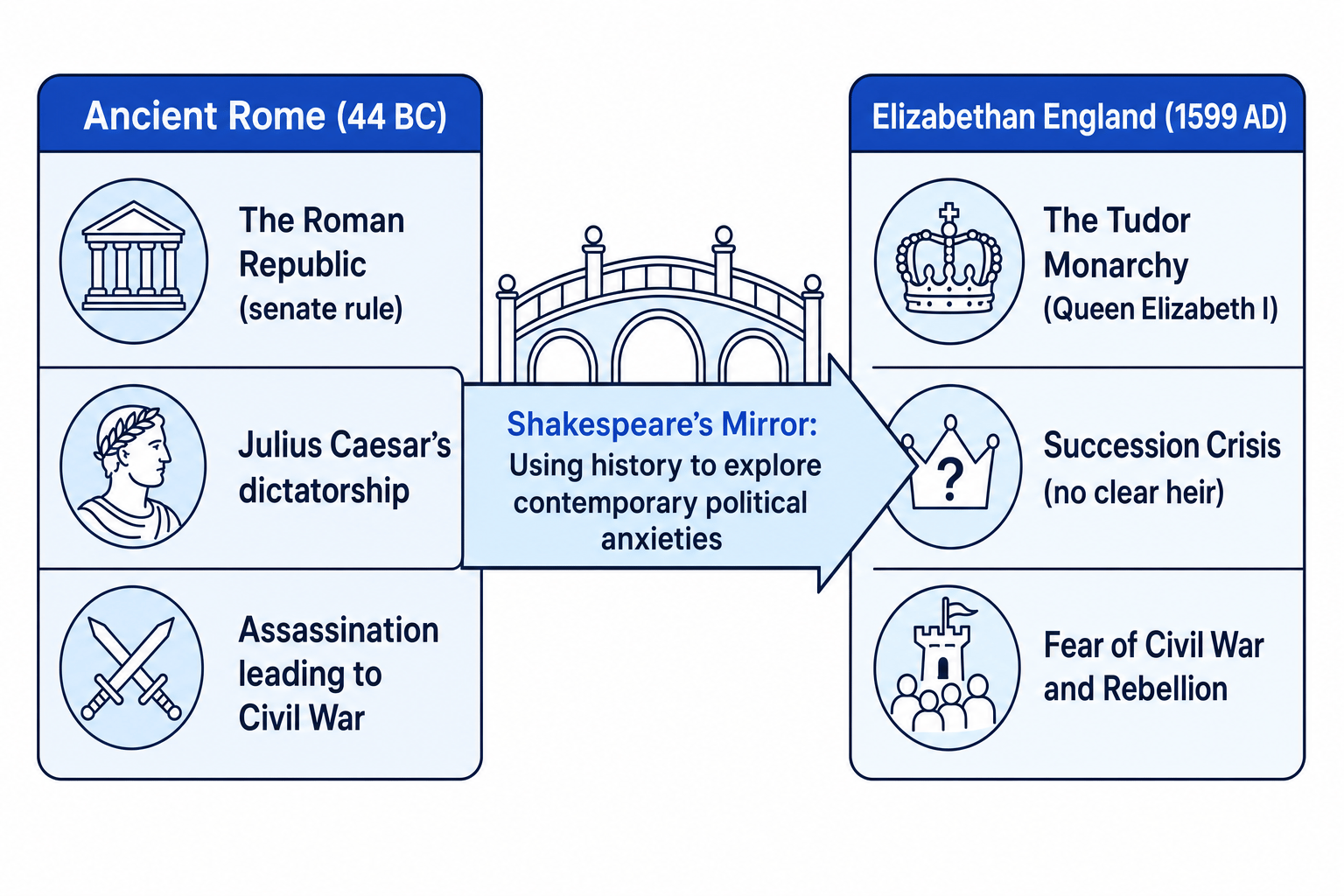
Setting Context: Ancient Rome (44 BC)
Before Julius Caesar's rise, Rome had been a Republic for nearly 500 years. It was ruled by a Senate (a group of wealthy noblemen called patricians) to ensure no single man could ever hold absolute power as a king.
When Caesar defeated his rival Pompey and was declared dictator perpetuo (dictator for life), the senators feared the death of their Republic and the birth of a tyranny. This tension is what drives the conspiracy led by Brutus and Cassius.
Production Context: Elizabethan England (1599 AD)
When Shakespeare wrote the play in 1599, Queen Elizabeth I had been on the throne for over 40 years. She was elderly, in failing health, and crucially, had no heir. She consistently refused to name a successor, creating an atmosphere of intense political paranoia.
Elizabethans feared that her death would trigger a violent power vacuum and plunge England into a bloody civil war—exactly what happens in the second half of Julius Caesar after Caesar is assassinated.
The Great Chain of Being vs. Roman Republicanism
The conflict in Julius Caesar is a clash of two very different political worldviews. Your ability to explain this clash is highly rewarded under AO3 (Context).
The Elizabethan View: The Great Chain of Being
Elizabethans believed in a strict, divinely ordered hierarchy created by God, known as the Great Chain of Being. God was at the top, followed by angels, the monarch, nobles, commoners, animals, and plants.
- The Monarch as God's Deputy: Under the Divine Right of Kings, the monarch was chosen by God. To rebel against, depose, or murder a monarch (the sin of regicide) was an act of treason against God Himself.
- Cosmic Chaos: If the chain was broken by killing the ruler, God would punish the land with chaos, natural disasters, and civil war. This explains the terrifying, unnatural storm in Act 1, Scene 3, where Casca sees lions walking the streets and men on fire. To Shakespeare's audience, these supernatural events were a direct warning of the cosmic consequences of the conspiracy.
The 'Good Brutus' Misconception
Many students write that Brutus is the outright hero of the play because he wants to save Rome from a tyrant. However, an Elizabethan audience would have been deeply conflicted. Even if Caesar was ambitious, Brutus was plotting regicide—the ultimate sin against God and the natural order. Shakespeare intentionally leaves Brutus’s morality ambiguous.
The Roman View: Liberty and Republicanism
To noble Romans like Brutus, the ultimate civic duty was to protect the Republic from the rule of a single monarch.
Republicanism
Republicanism is a political ideology centered on citizenship and a state ruled as a republic, where power is held by the people and their elected representatives, rather than an absolute monarch.
In Roman culture, submitting to a king was equivalent to slavery. When Cassius tells Brutus in Act 1, Scene 2 that he "would as lief not be as live to be / In awe of such a thing as I myself," he is expressing this intense Roman pride. For Brutus, killing Caesar is not a personal betrayal, but a painful sacrifice required to preserve Roman "liberty."
Censorship and the Essex Rebellion
Why did Shakespeare choose to write about Rome instead of just writing a play about England's modern succession crisis? The answer is simple: survival.
All plays in Elizabethan London had to be approved by the Master of the Revels, the government censor. Any play directly criticizing the Queen or openly discussing her death would be shut down, and the playwright could face imprisonment or worse. Setting the play in ancient Rome allowed Shakespeare to safely debate highly dangerous contemporary issues.
Furthermore, 1599 was the year of the Essex Rebellion. The Earl of Essex, a charismatic but ambitious military general, was growing increasingly popular and defiant of the Queen's authority.
When Shakespeare presents Caesar as a military hero whose ambition threatens the state, and Antony as a master manipulator of the common people, he is directly commenting on the dangers of populist, powerful military figures seizing control—a very real threat in late-Elizabethan London.
Analyzing Brutus's moral dilemma through dual context
Walk through this structured process to analyze Brutus’s soliloquy in Act 2, Scene 1 ("It must be by his death..."), linking his language to both Roman and Elizabethan contexts.
- Analyze the literary methods in the quotation: Identify Brutus's key metaphor where he compares Caesar to a poisonous snake: "It is the bright day that brings forth the adder, / And that craves wary walking." The "bright day" represents the crown/power, and the "adder" represents the tyrant Caesar might become once crowned.
- Apply the Roman context (Setting): Explain how Brutus’s fear of the "adder" reflects the Roman Republican terror of absolute power. As a Roman patrician, Brutus feels a civic duty to prevent Caesar from obtaining supreme authority, even though Caesar has not yet acted like a tyrant ("to speak truth of Caesar, / I have not known when his affections swayed / More than his reason").
- Apply the Elizabethan context (Production): Contrast this with the Elizabethan perspective. By plotting to kill Caesar before he has even done anything wrong, Brutus is committing pre-emptive regicide. According to the Great Chain of Being, his conspiracy is an act of spiritual treason that will disrupt the natural order, transforming Brutus from a "noble Roman" into a dangerous rebel who is inviting chaos upon his country.
- Synthesize into a high-level analytical paragraph: Combine these steps into a coherent point: Shakespeare uses the zoomorphic metaphor of the 'adder' to illustrate Brutus’s agonizing internal conflict, bridging the gap between Roman civic duty and Elizabethan political anxiety. While a Roman audience would view Brutus’s desire to crush the 'adder' in its shell as a noble defence of republican 'liberty', Shakespeare’s Elizabethan audience would recognize the deep irony of his actions. By committing regicide to prevent a hypothetical tyranny, Brutus breaks the Great Chain of Being, unleashing the very 'chaos' and civil war that the Elizabethans feared would follow the death of their own childless Queen.
In the exam
- Never "context-dump": Do not write paragraphs of pure history. The examiner wants to see how context influences Shakespeare's language, characterization, and dramatic structure (AO3 serving AO2).
- Use the "Dual-Context" formula: Try using the phrase "While Shakespeare's Roman characters are motivated by... his Elizabethan audience would have perceived this as..." to show sophisticated critical distance.
- Link context to the supernatural: If the question is about fate, the supernatural, or chaos, always link the storms and ghosts to the disruption of the Great Chain of Being caused by the assassination of a ruler.
Check yourself
- Why did the Elizabethan audience fear a monarch dying without a clear heir, and how does this relate to the ending of Julius Caesar?
- What was the "Great Chain of Being," and how does Shakespeare show it being broken in Act 1, Scene 3?
- Why did Shakespeare use ancient Rome as the setting for his political play instead of Tudor England?
