

To truly understand Winsome Pinnock’s play Leave Taking (first performed in 1987), you need to look beyond the dialogue on the page and explore the historical and cultural forces that shape the characters' lives. In the GCSE English Literature exam, context is assessed under Assessment Objective 3 (AO3). This doesn't mean writing a history essay; it means showing how the social, political, and cultural realities of the mid-to-late 20th century directly influence the characters, their relationships, and the play's themes.
What you'll learn
- How the post-war migration of the Windrush generation created a complex cultural landscape in Britain.
- The differences between the lived experiences of first-generation and second-generation immigrants.
- The significance of Obeah and Caribbean spiritual traditions as tools of resistance and healing.
- How to integrate this context naturally into your literary analysis.
1. The Historical Foundation: The Windrush Generation
To understand Enid’s character—and her intense pressure on her daughters—you must understand her journey.
Windrush Generation
The Windrush Generation refers to the people who migrated from Caribbean countries (such as Jamaica, Barbados, and Trinidad) to the United Kingdom between 1948 and 1971. They were invited by the British government to help rebuild the nation after the devastation of World War II, filling vital labor shortages in the NHS, transport systems, and service industries.
The Dream vs. the Reality
Many Caribbean migrants held a deep respect for Britain, having been raised under colonial rule to see England as the "Mother Country." However, upon arrival, they were met with a harsh reality:
- Hostility and Racism: Instead of a warm welcome, they faced widespread prejudice. Signs reading "No Irish, No Blacks, No Dogs" were common in shop windows and lodging houses.
- Economic Downgrading: Many highly skilled professionals found their qualifications unrecognised in the UK. They were forced to take low-paid, manual jobs. Enid, for example, works as a hospital cleaner, despite having made immense sacrifices to migrate.
- The Psychological Toll: This rejection forced many first-generation immigrants to adopt a survival strategy of assimilation—trying to fit in, work exceptionally hard, and avoid drawing negative attention.
Enid's Drive for Respectability
Enid’s strict parenting style and her obsession with her daughters' academic and social respectability are direct coping mechanisms designed to protect them from the hostile, racist society she encountered upon her arrival in London.
2. The Generational Divide: 1980s Britain
While Enid’s worldview is forged by her migration in the 1960s, her daughters, Del and Viv, grow up in the London of the 1980s. This creates a massive cultural and ideological gulf between the generations.
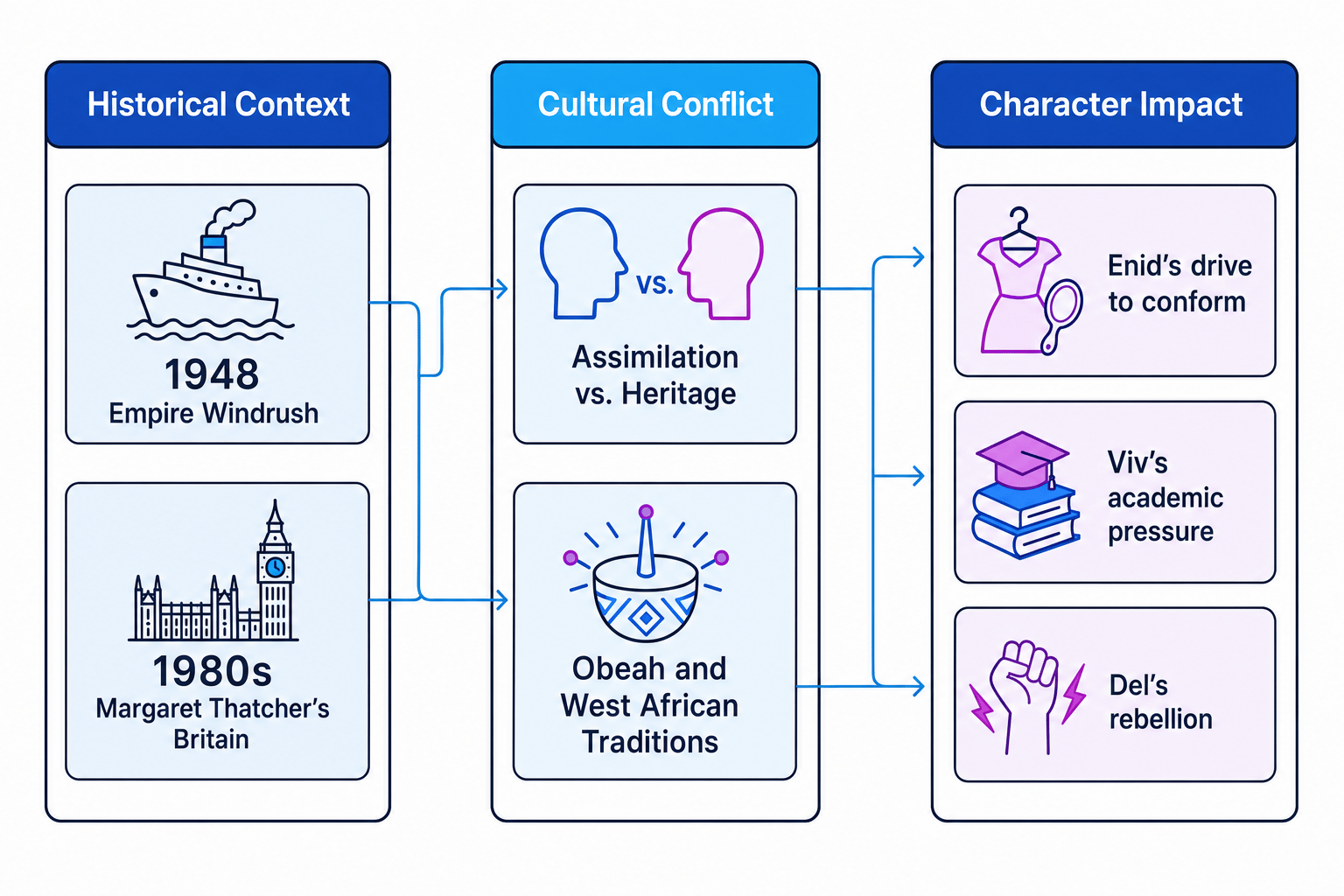
The First Generation (Enid)
- Goal: Survival through assimilation and hard work.
- Motto: "They've got to be twice as good." Enid believes that if her daughters conform to British standards and excel academically, they will be protected from racism.
- View of Home: Jamaica is romanticised as a distant, lost paradise, yet Enid is terrified of returning because it would mean admitting that her British dream did not fully succeed.
The Second Generation (Del and Viv)
- The Identity Crisis: Born in Britain, Del and Viv have never been to Jamaica. Yet, they are not fully accepted as British by the society around them. They experience a "hyphenated identity" (Black-British) that feels fragmented.
- Viv’s Path: Viv internalises her mother's pressure, studying constantly. However, she finds that the Eurocentric school curriculum ignores her heritage, leaving her feeling empty and disconnected.
- Del’s Path: Del rebels against her mother’s conservative, British-conforming values. She embraces Black British youth culture, street slang, and rejects the idea that she must please white society to have worth.
The Socio-Political Backdrop of the 1980s
Pinnock wrote Leave Taking in the mid-1980s, a decade marked by intense racial tension in the UK.
- Thatcherism: The conservative government of Margaret Thatcher was characterised by high unemployment, public spending cuts, and aggressive policing.
- Urban Unrest: Under the discriminatory "SUS laws" (stop and search), young Black men and women were disproportionately targeted by police, leading to major riots in Brixton (1981 and 1985), Toxteth, and Broadwater Farm.
- The Context in the Play: When Del rebels and stays out late, or when the characters feel the weight of systemic limitations, they are living through this era of active hostility and resistance.
Bolting on context
Do not write paragraphs of pure history. The examiner does not want a summary of the Brixton Riots. Instead, show how these historical tensions manifest in the characters' choices—such as Viv's intense academic anxiety or Del's anger at the system.
3. Cultural Heritage: Obeah and Healing
In the play, Mai plays a pivotal role as an Obeah woman. This is not just a quirky character trait; it is a profound cultural and political statement by Pinnock.
Obeah
Obeah is a system of spiritual healing, spell-casting, and justice practiced in the Caribbean, particularly Jamaica. It has its roots in West African spiritual traditions brought over by enslaved people. Under British colonial rule, Obeah was criminalised because colonial authorities feared it would unite enslaved populations and spark rebellions.
Why Mai and Obeah Matter
- Alternative to Western Systems: When Enid faces emotional collapse, she does not turn to British doctors or social workers (who do not understand her cultural trauma). She turns to Mai.
- A Connection to the Past: For Del and Viv, Mai’s home is a sensory gateway to a Caribbean they have never seen. It is filled with the smells of herbs, the sounds of traditional wisdom, and a different way of understanding the world.
- Reclaiming Identity: By centering the play's climax around an Obeah reading, Pinnock suggests that healing for the diaspora (scattered population) cannot come from assimilating into British culture alone; it requires looking back and reclaiming lost cultural heritage.
4. Applying Context in Your Essays
To score highly on AO3, you must weave context directly into your analysis of the writer's language and structural choices. Let's look at how to construct a high-level analytical paragraph using this integrated approach.
Integrating context into character analysis
Analyze how Pinnock uses the character of Enid to explore the emotional cost of immigration.
- Point (Topic Sentence): Pinnock presents Enid as a character caught between the trauma of her past migration and her desperate desire to secure a safe future for her children in a hostile Britain.
- Evidence (Embedded Quotation): This internal conflict is highlighted when Enid reprimands her daughters, declaring, "They've got to be twice as good. I didn't come here to raise no failures."
- Analysis of Method (AO2): The hyperbole in "twice as good" and the double negative "no failures" reveal Enid's urgent, demanding tone. The noun "failures" reflects her deep-seated fear that any deviation from perfection will expose her family to societal rejection.
- Integration of Context (AO3): This anxiety directly mirrors the lived experiences of the post-war Windrush generation. Having arrived in the UK to face systemic exclusion and racism, parents like Enid believed that total conformity and exceptional achievement were the only shields against a prejudiced British state.
- Link back to Theme: Ultimately, Pinnock shows that Enid's high expectations are not born of cruelty, but are a defensive armor forged by the harsh reality of being a first-generation immigrant in a society that refuses to fully accept her.
Patois and Standard English
Pay attention to code-switching. Notice how Enid shifts between Jamaican Patois (dialect) and Standard English. Patois is her authentic, cultural voice, whereas Standard English is the "acceptable" language she uses to navigate white British society.
In the exam
- Avoid "Context Dumping": Never start an essay with a long paragraph about the history of the Empire Windrush. Start with the play, and introduce historical context only when it explains a character's behavior or a thematic point.
- Use the Writer's Name: Keep your focus on Pinnock's intentions. Instead of saying "People in the 1980s were racist," say "Pinnock uses the generational conflict between Enid and Del to expose the social divisions of 1980s Britain."
- Look for Symbols of Context: Identify physical objects in the play that represent wider contextual issues—such as Viv's school books (representing British academic pressure) or Mai's basin and herbs (representing Caribbean spiritual heritage).
Check yourself
- Why did first-generation immigrants like Enid feel they had to be "twice as good" to survive in post-war Britain?
- How does the socio-political climate of the 1980s explain Del's rebellious attitude compared to her sister Viv's conformist behavior?
- Why is the practice of Obeah in the play culturally significant, and how does it challenge the characters' British surroundings?
