

Winsome Pinnock’s Leave Taking is a powerful, intimate drama that explores the lives of five characters navigating identity, displacement, and family in 1980s London. By understanding these characters, you will unlock the main themes of the play, including the generational divide, the legacy of the Windrush generation, and the search for belonging.
What you'll learn:
- How Enid represents the sacrifices and trauma of the first-generation Windrush pioneers.
- Why Del and Viv act as foil characters, demonstrating different responses to growing up Black and British.
- The roles of Brod and Mai as spiritual and cultural anchors to Jamaica.
- How to write a high-scoring analytical paragraph showing how Pinnock uses dialogue to reveal character conflicts.
The Landscape of the Characters
To understand the play, we must first look at how the characters are connected. At the heart of the play is the family unit: Enid and her two daughters, Del and Viv. Surrounding them are Brod and Mai, who connect the family to their Jamaican heritage.
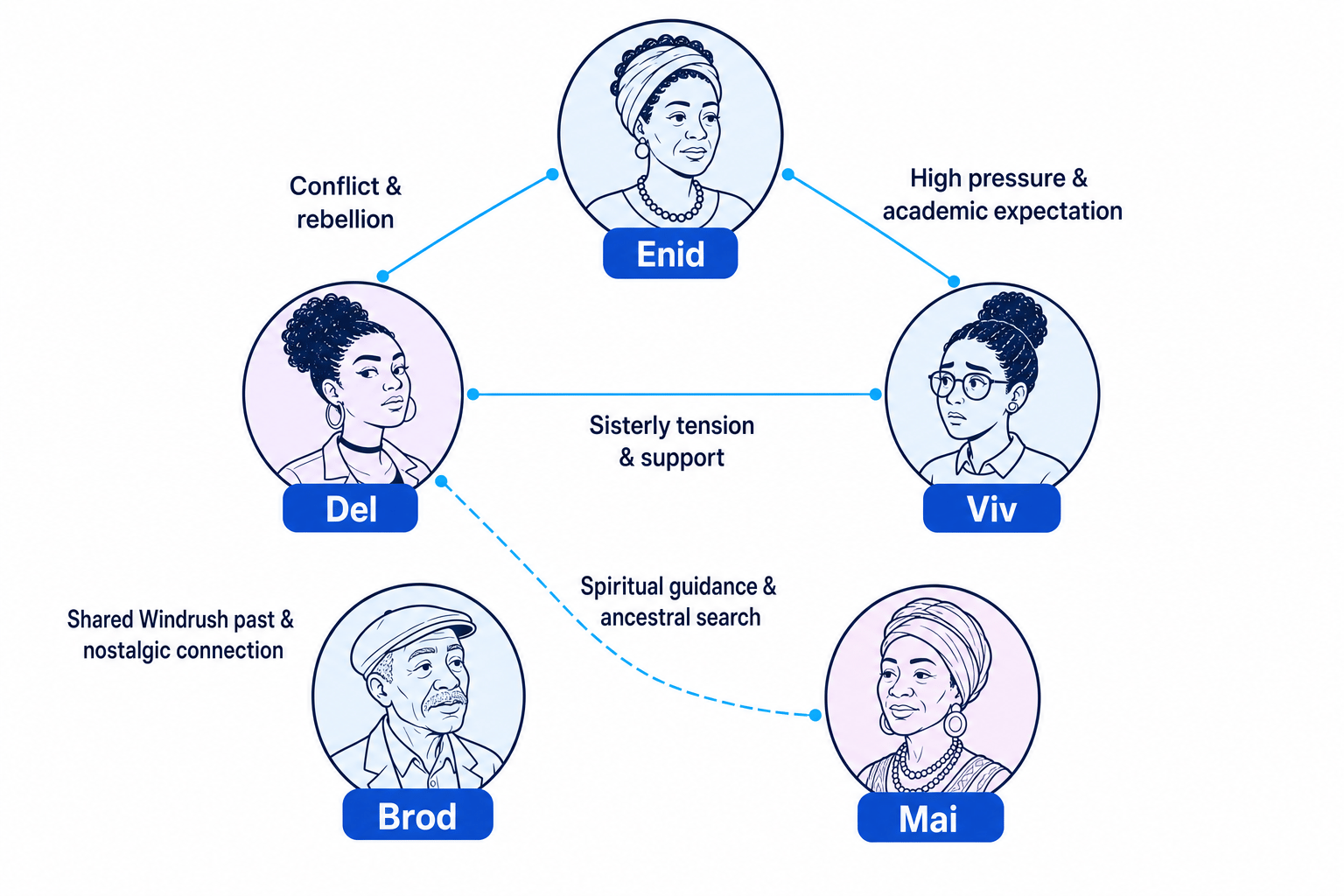
Enid: The Matriarch's Burden
Enid is a first-generation immigrant from Jamaica who arrived in London during the Windrush era. She is a single mother working long hours as a hospital cleaner to provide for her daughters.
Matriarch
A matriarch is a female head of a family, clan, or tribe. In literature, a matriarchal figure often carries the emotional and financial burden of keeping a family together, sometimes resulting in controlling or strict behavior.
Enid's character is defined by a fierce determination to protect her daughters, Viv and Del, from the racial prejudice she experienced when she first arrived in England. She believes the best way to do this is through assimilation (completely integrating into British society and shedding Jamaican cultural markers).
Key Characteristics and Quotes:
-
Strict and Protective: Enid's maternal love is expressed through high expectations and control. She desperately wants her daughters to achieve social mobility.
-
The "Neat Package" Metaphor: In a poignant moment of self-reflection, Enid tells her daughters:
"I wanted to make a neat package of my life and give it to you."
This metaphor of a "neat package" reveals her desire to hide the messy, painful realities of her past—including her grief over her mother's death in Jamaica and the racism she faced in Britain—to present her daughters with a clean, trouble-free future.
-
Fear of Failure: Enid associates Jamaican folk traditions, such as Obeah, with backwardness and poverty, which is why she initially reacts with hostility to Mai.
Enid's Conflict
Enid's tragedy is that her efforts to protect her children by cutting off their Jamaican heritage actually alienate them, leaving them feeling uprooted and disconnected.
Del and Viv: The Second-Generation Divide
Del and Viv are Enid’s daughters. Born in Britain, they represent the second-generation immigrant experience. Although they share the same upbringing, they react to their mother's high expectations in opposite ways, making them classic literary foils.
Foil
A foil is a character who contrasts sharply with another character (usually the protagonist) to highlight particular qualities of the other character.
Del: The Rebel
Del is the older daughter. She openly rebels against Enid’s strict rules and rejects her mother’s pressure to assimilate.
- Identity Crisis: Del feels rejected by both her mother and British society. She is deeply hurt by Enid’s apparent favoritism toward the academic Viv.
- Search for Roots: Del seeks out Mai, the Obeah woman, to find the spiritual connection and sense of belonging that Enid has denied her. Del feels a deep, instinctual pull toward her Jamaican heritage, even though she has never been there.
- Language as Defiance: Del often uses Jamaican Patois (dialect) as a linguistic tool to assert her identity and rebel against the "proper" British English her mother values.
Viv: The Dutiful Daughter
Viv is the younger, academic sister. On the surface, she is the "perfect" daughter who studies constantly to pass her exams and go to university.
- The Burden of Expectation: Viv's compliance comes at a heavy psychological cost. She suffers from severe anxiety and claustrophobia under the weight of Enid’s ambitions. She remarks:
"I feel like I'm carrying her whole life on my back."
- Reconciliation: Unlike Del, who rebels outwardly, Viv’s journey is internal. By the end of the play, she realizes she must pursue education for her own fulfillment, not just to validate her mother's sacrifices. She successfully merges her British academic path with a newfound pride in her Caribbean roots.
Oversimplifying the Sisters
Do not write about Del as simply "bad" and Viv as "good." Pinnock paints a highly sympathetic portrait of both young women. They are both struggling with the same core issue: how to form a coherent Black British identity in a society that often makes them feel like outsiders.
Mai and Brod: The Keepers of Heritage
Mai and Brod are older-generation characters who do not belong to the immediate nuclear family but play crucial roles in guiding them.
Mai: The Spiritual Healer
Mai is an Obeah woman living in London. She acts as a bridge between the physical reality of 1980s Britain and the spiritual, ancestral world of Jamaica.
Obeah
Obeah is a system of spiritual healing, justice, and divination practiced in the Caribbean, with roots in West African spiritual traditions. It involves herbal medicine, communication with ancestors, and spiritual rituals.
- Pragmatism and Wisdom: Mai is not a mystical caricature; she is highly practical. She charges for her services because she has to survive in a capitalist London.
- Catalyst for Truth: Mai helps both Del and Enid face their repressed traumas. She warns Enid that denying her roots will only damage her children:
"You think because I live in England I don't know who I am?"
- The Ritual: The reading Mai performs is a turning point in the play, forcing the characters to acknowledge their grief and the ancestral spirits they have tried to leave behind.
Brod: The Disillusioned Companion
Brod is a family friend of Enid's and another member of the Windrush generation. He serves as a tragic yet humorous voice of experience.
- The Reality of Displacement: Brod speaks openly about the coldness of England—both the weather and the societal prejudice. He exposes the lie of the "Mother Country" (the colonial promise that Britain would welcome its Commonwealth citizens).
- The Pain of the Passport: Brod highlights the pain of conditional citizenship when he points out that although his passport says he is British, the hostile reactions of people on the street tell him otherwise.
- Support System: Despite his cynicism and fondness for drinking, Brod is a loyal friend to Enid. He understands her pain because he shares it, reminding the audience of the collective struggle of their generation.
Analysing Characterisation in Your Essays
In your GCSE exam, you will need to write an analytical essay on how Pinnock presents characters and themes. To do this effectively, you must link the writer's methods (AO2) directly to their historical and social context (AO3).
Let's look at how to walk through an analysis of a key character interaction using the Point-Evidence-Method-Effect-Link (PEMEL) structure.
Analysing Enid's character through dialogue
Analyze how Pinnock presents Enid's internal conflict and maternal pressure in Act 1.
- Formulate a clear point (AO1): Start by stating how Pinnock uses Enid to show the heavy psychological burden placed on first-generation immigrant parents, which manifests as intense pressure on their children.
- Select and integrate a precise quotation (AO1): Choose a short, powerful quote that highlights this pressure. For instance, when Enid discusses her high hopes for Viv's school exams, she states: "I wanted to make a neat package of my life and give it to you."
- Identify the writer's methods (AO2): Name the specific literary device. Here, Pinnock uses the metaphor of a "neat package." Analyze the word choices within the metaphor: "neat" implies order, cleanliness, and the concealment of any messy, traumatic struggles, while "package" suggests a finished, complete gift.
- Explain the effect on the audience/reader (AO2): Explain how this language choice helps us understand Enid. The audience realizes that her strictness and high expectations do not come from a place of coldness, but from a desperate maternal desire to shield her children from the raw, untidy struggles of racism and low-income labor she experienced.
- Link to historical and social context (AO3): Ground this in the post-colonial context of the Windrush generation. Immigrants arriving in Britain in the 1950s and 60s faced intense systemic discrimination, hostile housing markets, and limited job prospects. Enid’s obsession with Viv's academic success reflects the historic pressure on second-generation Black British children to achieve upward mobility as a shield against prejudice.
Patois vs. Standard English
Pay close attention to how characters switch between standard English and Jamaican Patois. When Del uses Patois, she is claiming her heritage; when Enid slips into it, she is dropping her protective British shield. This code-switching is a powerful dramatic method!
In the exam
- Focus on character relationships: Do not write about characters in isolation. The exam questions often ask about relationships (e.g., mothers and daughters, or the younger generation). Always structure your essay to contrast characters (like Del and Viv) to show how Pinnock presents different facets of an issue.
- Integrate context seamlessly: Never "dump" historical facts about the Windrush generation or 1980s London at the start of your essay. Instead, weave them directly into your analysis of character motivation, as shown in the worked example.
- Use dramatic terminology: Remember that Leave Taking is a play. Refer to characters' lines as "dialogue," their physical movements as "stage directions," and their structural positions (e.g., foils) to show the examiner you understand the dramatic form.
Check yourself
- How does Winsome Pinnock use Viv and Del as foils to highlight different responses to the second-generation immigrant experience?
- What does Enid's fear of Mai's spiritual practices reveal about her attitude toward her Jamaican past?
- Identify two ways in which Brod's experiences of living in Britain mirror and contrast with Enid's experiences.
