In your GCSE English Literature exam, you won't just be asked to describe what happens in Charlotte Brontë’s Jane Eyre; you will be asked to analyse why Brontë wrote it and how she uses the novel to explore big ideas about human nature, society, and morality. These big, guiding ideas are what we call themes.
What you'll learn:
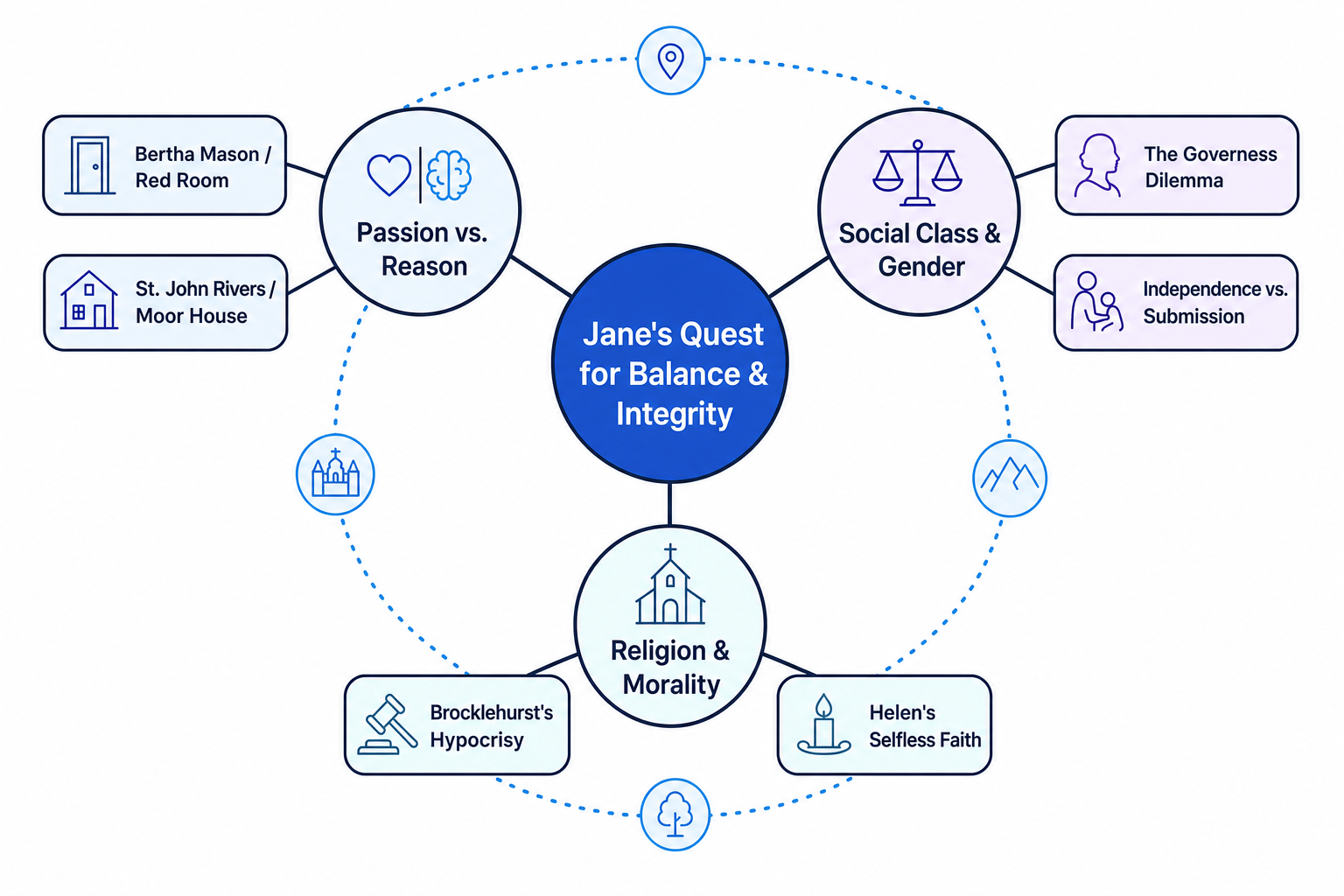
- How to track the central conflict between passion and reason across Jane’s development.
- How Brontë uses Jane's journey to critique Victorian attitudes towards social class and gender.
- How to distinguish between different forms of religion and morality in the novel and analyze how Brontë exposes religious hypocrisy.
Understanding Theme in the 19th-Century Novel
To write a high-scoring essay, you must treat the novel not as a real-life history, but as a deliberate construct. Brontë uses her characters, settings, and symbols as vehicles to deliver her thematic messages.
Theme
A theme is a central, recurring idea, message, or moral lesson explored by a writer throughout a literary text. Themes are universal and go beyond the specific details of the plot.
When you analyse a theme in Jane Eyre, you are directly addressing the examiners' focus on the writer's craft and social context. You need to connect:
- The Theme: The abstract idea (e.g., gender inequality).
- The Method: How Brontë shows it (e.g., the symbolic confinement of the Red Room or the characterisation of Bertha Mason).
- The Context: Why this mattered to Victorian readers in 1847 (e.g., the legal status of women as coverture—where a woman's legal rights were subsumed by those of her husband).
Core Theme 1: Passion vs. Reason
At the heart of Jane Eyre is a psychological and moral struggle: how to balance intense, emotional impulses (passion) with self-control, logic, and moral duty (reason).
Throughout the novel, Brontë presents passion and reason not just as personality traits, but as destructive forces if left unbalanced.
- Unregulated Passion: Leads to madness, chaos, and self-destruction. This is symbolised by the young Jane’s tantrums at Gateshead and, most vividly, by Bertha Mason, Rochester’s secret wife locked in the attic, who represents the terrifying extreme of untamed physical passion and rage.
- Uncompromising Reason: Leads to coldness, emotional death, and the crushing of the human spirit. This is embodied by St. John Rivers, who demands that Jane marry him not out of love, but out of cold, religious duty.
The Journey to Equilibrium
Jane's growth is defined by her attempts to find a middle ground. She cannot survive under the ice of St. John, nor can she lose her moral integrity in the fire of Rochester's lawless passion.
- When Rochester tries to persuade Jane to become his mistress after their failed wedding, her passion urges her to stay, but her reason and self-respect command her to leave. She declares:
"I care for myself. The more solitary, the more friendless, the more unsustained I am, the more I will respect myself."
- Structurally, Jane only returns to Rochester when they are on equal terms: she has gained financial independence (wealth) and familial belonging (the Rivers cousins), while Rochester's physical pride has been humbled by the fire at Thornfield.
The Fire and Ice Motif
Brontë uses a recurring motif (a repeated image or symbol) of fire and ice to represent the conflict between passion and reason. Fire represents feeling, warmth, anger, and sexual desire; ice represents emotional coldness, loneliness, suppression, and death.
Core Theme 2: Social Class, Gender, and the "Outsider"
Victorian society was highly structured, rigid, and patriarchal (male-dominated). Brontë uses Jane—a "poor, obscure, plain, and little" protagonist—to challenge these social hierarchies.
The Liminal Space of the Governess
In the 19th century, a governess occupied a difficult, transitional social position. She was a middle-class, educated woman who had to work for a living, placing her in a social limbo:
- She was superior to the working-class domestic servants.
- She was treated as an inferior, paid employee by her aristocratic employers.
This ambiguous status is called liminality. Jane experiences this sharply at Thornfield when Rochester’s wealthy guests, such as Blanche Ingram, speak contemptuously of governesses in her direct presence, viewing them as social nuisances.
The Caged Bird
Jane compares herself to a wild, trapped animal when her freedom is threatened. When Rochester tries to claim her as a prize and shower her with expensive gifts, she resists being treated like a submissive pet, asserting: "I am no bird; and no net ensnares me; I am a free human being with an independent will." This analogy emphasizes that to Jane, absolute romantic devotion must not come at the cost of personal liberty.
Challenging the Patriarchal Order
Jane consistently rebels against the domestic limits placed upon Victorian women. In one of the novel's most famous proto-feminist passages (Chapter 12), Jane stands on the roof of Thornfield and demands more than domestic confinement:
"Women are supposed to be very calm generally: but women feel just as men feel; they need exercise for their faculties, and a field for their efforts as much as their brothers do..."
Through Jane’s refusal to submit to Rochester's attempt to make her his mistress, and St. John's attempt to make her his missionary wife, Brontë argues that a woman's soul and intellect are entirely equal to a man's.
Confusing Jane's feminism with modern rebellion
Do not write that Jane wants to "destroy" the Victorian class or marriage system. Jane is a reformer, not a revolutionary. She values traditional marriage, social order, and Christian morality; she simply demands that these institutions respect her humanity, autonomy, and equality.
Core Theme 3: Religion and Morality
Religion is a dominant presence in Jane Eyre, but Brontë draws a sharp contrast between hypocritical, institutionalized religion and true, compassionate Christian faith.
Throughout her life, Jane encounters different models of religious belief:
1. Mr. Brocklehurst: Hypocritical Evangelicalism
The headmaster of Lowood School uses religion as a weapon of control and deprivation. He preaches humility and mortification of the flesh to poor girls (even ordering a girl’s naturally curly hair to be cut off to prevent "vanity"), while his own family lives in luxury, dressed in silks and furs. His religion is cruel, cold, and profoundly un-Christian.
2. Helen Burns: Selfless Stoicism and Christian Forgiveness
Helen reacts to injustice with absolute submission and turning the other cheek. While Jane finds Helen’s capacity to love her enemies beautiful, she cannot fully adopt this passive stance. Helen’s faith is pure but ultimately unsuited for survival in the harsh physical world, and she dies young of consumption.
3. St. John Rivers: Calvinist Duty and Zealotry
St. John's religion is cold, ambitious, and demanding. He views his missionary work as a military campaign and seeks to sacrifice himself—and Jane—on the altar of duty. He lacks Christian charity and love, prompting Jane to observe that his heart is as cold as stone.
4. Jane's Personal Faith
Jane rejects Brocklehurst's cruelty and St. John's cold duty, but adopts Helen's faith in a loving God. Jane's religion is internal and deeply moral. It is her personal relationship with God that gives her the strength to flee Thornfield when her moral integrity is threatened.
Watch your context (AO3)
In 1847, many Victorian critics found Jane Eyre highly controversial, with some even calling it "preeminently anti-Christian." This was because Brontë dared to criticise high-ranking church figures like Brocklehurst. Make sure you explain that Brontë was not attacking Christianity itself, but rather the hypocritical, uncharitable ways some Victorians practised it.
Applying Your Knowledge: Structuring a Theme Analysis
To score highly on AO2 (analysis of language, form, and structure) and AO1 (structured, personal response), you should write analytical paragraphs that show how a theme develops. Avoid simply listing quotes; instead, trace the progression of a theme and explain how Brontë's choices of language and structure convey her message.
The worked example below demonstrates how to construct a high-scoring analytical paragraph on the theme of gender and confinement.
Analysing the theme of female confinement
Evaluate how Brontë presents the theme of female confinement in Jane Eyre.
- Step 1: State your thesis clearly (AO1)
Begin with a direct point that links the concept of physical confinement to its psychological and thematic meaning.
Drafting: "Brontë uses physical confinement to symbolise the societal restrictions placed on Victorian women, showing how intellectual and physical entrapment can lead to psychological suffering." - Step 2: Introduce precise evidence and analyze literary methods (AO2)
Select a memorable, short quotation and identify the writer's craft (e.g., imagery, adjectives, motifs, or settings) and analyze its immediate effect.
Drafting: "This is established early in the novel through the gothic symbol of the Red Room at Gateshead, where Jane is locked away as punishment. Brontë describes the room as 'cold', 'dark', and 'silent', with the bed loomingly compared to 'a tabernacle'. The noun 'tabernacle' carries heavy religious connotations, suggesting that the patriarchal structures of the home are backed by a rigid, institutionalized moral authority designed to crush Jane's rebellious spirit." - Step 3: Connect the analysis to the wider text and context (AO3)
Extend your point to show how this specific moment of confinement foreshadows Jane's later struggles, and explain why this would resonate with a Victorian audience.
Drafting: "This early imprisonment foreshadows the later, literal confinement of Bertha Mason in the attic of Thornfield Hall. Bertha acts as a double—a 'madwoman in the attic'—representing the ultimate destination for Victorian women who refuse to suppress their passion. For a contemporary 1847 reader, Jane's struggle against being physically and emotionally hemmed in by men like Brocklehurst and Rochester reflected the wider Victorian debate on the 'Woman Question', highlighting the lack of legal, professional, and personal autonomy available to middle-class women."
In the exam
- Focus on the prompt's theme, not just characters: If the question asks you to write about the theme of social class, do not simply write a biography of Jane or Rochester. Use those characters as evidence to show how Brontë challenges class structures.
- Track structural development: High-scoring essays explain how a theme evolves from the start of the novel (Gateshead), through the middle (Lowood and Thornfield), to the resolution (Moor House and Ferndean). Showing how Jane's perspective changes scores highly for structure (AO2).
- Integrate context naturally: Never paste in a paragraph of pure Victorian history. Instead, weave historical facts directly into your language analysis. For example: "Brontë uses the noun 'governess' to highlight the liminal social position Jane occupies, reflecting Victorian anxieties surrounding class mobility and women's economic self-reliance."
Check yourself
- How does the "Red Room" act as a symbol of both physical and social confinement for Jane?
- What are the differences between Helen Burns’s religious attitude and St. John Rivers’s approach to faith?
- How does Jane's ultimate financial independence alter her relationship with Rochester at the end of the novel?
