What you'll learn
- What context means in Jane Eyre and how to use it for AQA.
- How Victorian ideas about gender, class, religion, and education shape Jane’s story.
- How to handle difficult context around empire, race, and Bertha Mason carefully.
- How literary context — especially the Gothic and the Bildungsroman — affects Brontë’s methods.
What “context” means
Context
Context means the circumstances surrounding a text’s writing and reception: historical events, social attitudes, religious beliefs, literary traditions, and relevant details about the writer’s life.
For AQA, context is assessed through AO3, which means explaining the relationship between the novel and the world it came from. It is not a separate history paragraph. You need to show how context helps us understand Brontë’s choices and the reader’s response.
Context is not decoration
The best context is attached to a precise moment in the novel: a quotation, a character choice, a narrative method, or a key contrast.
Use this map as a quick overview of the main contexts that shape Jane Eyre.
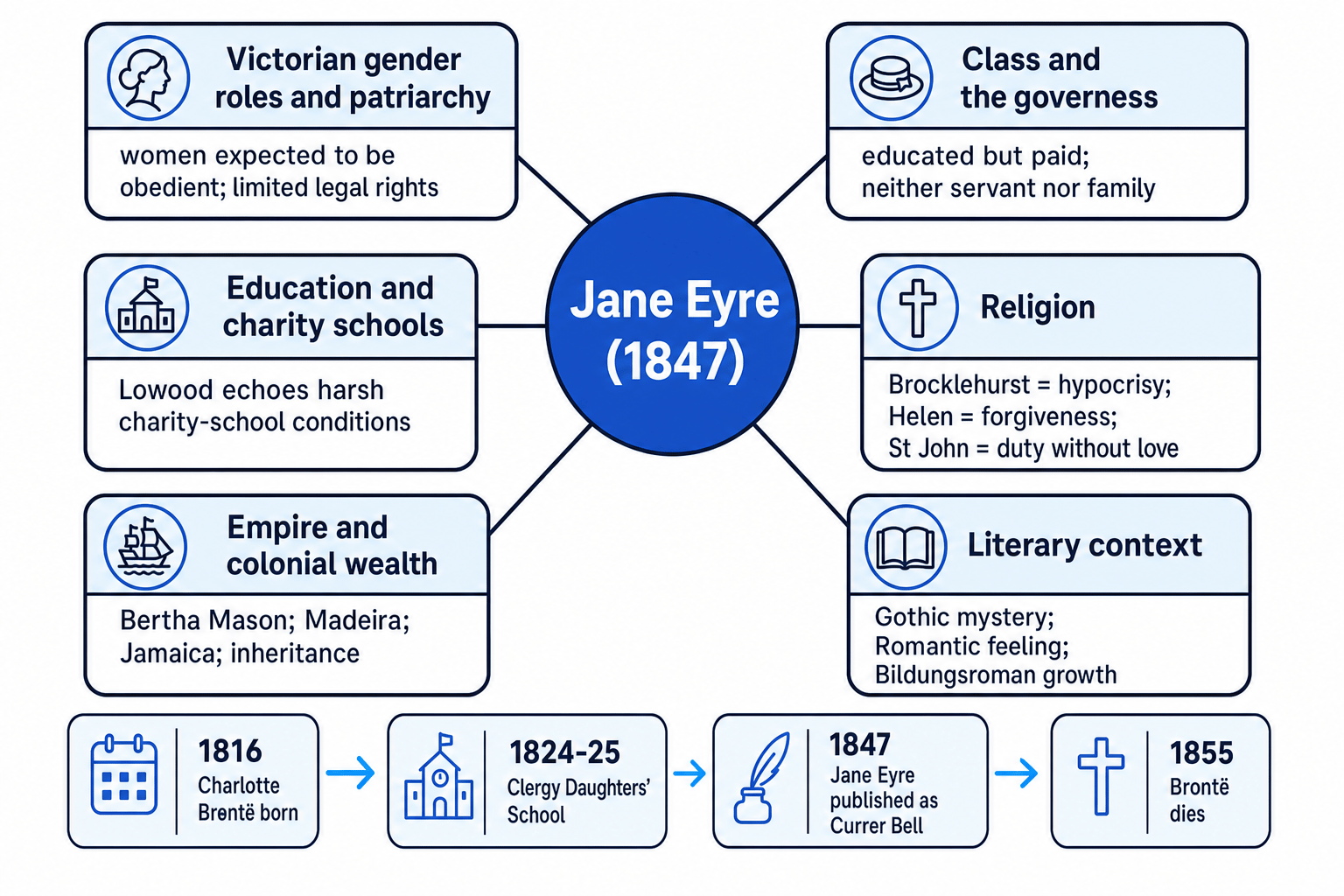
Charlotte Brontë and the Victorian world
The Victorian period means the years of Queen Victoria’s reign, from 1837 to 1901. Jane Eyre was published in 1847, early in this period.
Charlotte Brontë published the novel under the male-sounding pseudonym — a pen name — “Currer Bell”. This matters because women writers often faced prejudice: their work could be dismissed as improper, emotional, or intellectually weaker than men’s writing.
Brontë’s own life also matters. She was the daughter of a clergyman, attended the Clergy Daughters’ School at Cowan Bridge, and worked as a governess. Lowood and Jane’s governess role are not simple autobiography, but Brontë clearly uses experiences she understood.
Turning context into biography
Avoid writing as if Jane is simply Charlotte Brontë. Say “Brontë may draw on…” or “Brontë uses experiences similar to…” rather than claiming every event in the novel directly happened to the author.
Adding context to Jane’s unrest
- Jane says in Chapter 12, “Women are supposed to be very calm generally: but women feel just as men feel,” so her dissatisfaction is presented as a shared female human reality, not a personal flaw.
- The balanced phrase “just as” makes Jane’s claim sound logical and fair; Brontë’s first-person narration lets a young woman argue from lived experience.
- Early Victorian middle-class culture often praised female quietness and domestic duty, so Jane’s statement challenges the idea that women should be content with passivity.
- The effect is that Brontë invites readers to see Jane’s desire for work, movement and feeling as morally legitimate.
Gender and patriarchy
Patriarchy is a social system in which men hold most power in the family, law, politics, and public life. In Victorian Britain, respectable women were often expected to be modest, obedient, domestic, and dependent on male protection.
Married women also had limited legal independence. The legal idea often called coverture meant that a married woman’s property and legal identity were largely controlled by her husband. This makes Jane’s insistence on independence especially important.
Jane repeatedly refuses to be treated as a decorative or passive woman. Her famous declaration, “I am no bird; and no net ensnares me,” uses metaphor — describing one thing as another — to reject confinement. The “net” suggests the social traps of gender, marriage, and dependency.
The ending is important too. “Reader, I married him” gives Jane grammatical control: she is the subject of the sentence. Brontë does not simply reject marriage; she imagines a marriage that can only become acceptable once Jane has money, choice, and moral independence.
Useful gender context
When writing about gender, focus on agency: Jane’s ability to choose, speak, refuse, work, inherit, and marry on her own terms.
Class and the governess
A governess was an educated woman paid to teach children in a wealthy home. She occupied an awkward class position: too educated to be treated as an ordinary servant, but still paid and dependent, so not fully equal to the family.
Jane’s position at Thornfield is therefore socially unstable. She is close enough to Rochester to talk with him intelligently, but far enough below him in wealth and rank for their relationship to seem improper.
Linking class and gender to equality
- At Thornfield, Jane calls herself “poor, obscure, plain, and little,” which compresses class disadvantage, social invisibility, appearance, and gendered powerlessness.
- She rejects those limits with “equal—as we are!” The dash makes the claim feel emotionally urgent, as if Jane is breaking through social “custom”.
- As a governess, Jane is educated enough to speak to Rochester but financially dependent on his household; the context makes their emotional equality socially shocking.
- The scene therefore does not simply show romance. It tests whether love can exist without class and gender domination.
Education, charity, and Lowood
A charity school was a school intended for poor or dependent children, often funded by wealthy donors and linked to religious teaching. Lowood is Brontë’s fictional charity school.
Lowood exposes how charity can become cruel when it is mixed with pride, hypocrisy, and class superiority. Mr Brocklehurst preaches humility and self-denial to poor girls while his own family appears comfortable and well-dressed. Brontë criticises a system where vulnerable children are expected to suffer in the name of moral improvement.
The outbreak of typhus at Lowood also reflects Victorian anxieties about disease, poor sanitation, and institutional neglect. Jane survives, but Helen Burns dies, making Lowood a place where spiritual lessons and physical suffering are painfully connected.
Religion: faith, hypocrisy, and conscience
Victorian society was deeply shaped by Christianity. Evangelicalism was a Christian movement that emphasised scripture, moral discipline, personal conversion, and reform. In the novel, Brontë presents several versions of religion rather than one simple message.
Mr Brocklehurst represents religious hypocrisy: he uses Christian language to control and shame children. Helen Burns represents forgiveness and endurance, especially when she tells Jane to “Love your enemies”. St John Rivers represents duty taken to a cold extreme: his missionary ambition demands self-sacrifice without love.
Jane’s own faith is different. It is linked to conscience, self-respect, and moral choice.
Reading religion through Jane’s refusal
- After the interrupted wedding, Jane is tempted to live with Rochester, but Christian law and Victorian morality define that as sinful because he is already married.
- Her line “Laws and principles are not for the times when there is no temptation” uses abstract nouns to make conscience sound like a structure that protects her under pressure.
- This separates Jane’s faith from Brocklehurst’s hypocrisy: religion becomes inward self-command rather than public punishment.
- Brontë makes Jane’s refusal empowering because she keeps both moral integrity and self-respect.
Empire, race, and colonial wealth
Colonialism means one country controlling or exploiting another territory. Britain’s empire shaped Victorian wealth, trade, and attitudes. Jane Eyre contains important colonial links: Bertha Mason comes from Jamaica, Rochester’s marriage brings West Indian money, and Jane’s inheritance comes through her uncle in Madeira.
This context needs care. British slavery was abolished in most colonies in 1833, before the novel was published, but West Indian wealth was still associated with plantation history and racial exploitation. The novel reflects some racist and racialised assumptions — meaning people are described or judged through ideas about race.
Bertha Mason is especially difficult. She is locked away, silenced, and often described through animalistic Gothic imagery. A modern reader can recognise that the novel uses troubling stereotypes while still analysing how Bertha functions in the plot.
Handling Bertha and empire
- The description “whether beast or human being” places Bertha in a Gothic scene of horror, using dehumanising language to make her seem frightening.
- Because Bertha comes from Jamaica and Rochester’s marriage is tied to West Indian money, this horror is connected to Britain’s colonial world, not just a private family secret.
- A context-aware reading can note the novel’s racialised assumptions: Bertha is “othered” through stereotypes of madness, violence, and excess.
- This gives a more mature argument: the novel critiques Rochester’s hidden past while also relying on troubling colonial stereotypes that modern readers should recognise.
Do not excuse the language
Context can explain why racist or dehumanising descriptions appear in the novel, but it should not excuse them. Strong answers can acknowledge that modern readers may find these representations deeply problematic.
Literary context: Gothic, Romanticism, and the Bildungsroman
The Gothic is a literary mode involving mystery, fear, secrets, confinement, threatening buildings, and supernatural-seeming events. Thornfield is full of Gothic features: locked rooms, strange laughter, night-time danger, and hidden violence.
Romanticism was a literary movement that valued emotion, imagination, nature, and individual experience. Jane’s intense feelings, spiritual independence, and love of wild landscapes show Romantic influence.
A Bildungsroman is a novel of growth and development, following a character from youth towards maturity. Jane Eyre is a Bildungsroman because Jane moves through Gateshead, Lowood, Thornfield, Moor House, and Ferndean while developing moral judgement and independence.
Connecting Gothic form to social fear
- Thornfield initially uses Gothic signs: locked rooms, a “strange laugh”, night-time fire, and secrecy.
- These signs make the ordinary country house feel unstable, suggesting that respectable homes can hide violence and repression.
- When Bertha is revealed, the supernatural-seeming mystery becomes a human and legal crisis, so Gothic form exposes social pressures around marriage, property, and confinement.
How to write context well
A strong context sentence usually follows this pattern:
- Make a point about the novel.
- Attach a short quotation.
- Name Brontë’s method.
- Connect to a relevant context.
- Explain the effect on meaning or the reader.
For example: Brontë uses Jane’s metaphor “I am no bird” to reject the Victorian expectation that women should be passive and contained; the image of the “net” makes social restriction feel like physical entrapment.
The bolted-on history paragraph
Do not write a paragraph that starts, “In Victorian times…” and never returns to the novel. Always connect context to Brontë’s language, structure, characterisation, or themes.
In the exam
- Choose context that answers the question, not everything you know about Victorian Britain.
- Attach context to a precise quotation or method: for example, Jane’s first-person voice, the “bird” metaphor, Lowood’s cruelty, or Bertha’s Gothic presentation.
- Keep your argument balanced: Brontë challenges many Victorian attitudes, but she also reflects some assumptions of her time, especially around empire and race.
Check yourself
- Can you explain why Jane’s role as a governess makes her relationship with Rochester socially complicated?
- Can you link one short quotation to Victorian gender expectations?
- Can you discuss Bertha Mason using both Gothic context and colonial context carefully?
