Charlotte Brontë’s Jane Eyre is more than just a Victorian love story; it is a profound exploration of identity, morality, and social class. To score highly in your GCSE English Literature exam, you must understand that the characters are not just "real people" but carefully constructed literary devices used by Brontë to convey her central themes.
In these study notes, you will learn how to analyse the protagonist’s journey, interpret the relationships between characters, and master the use of character foils to elevate your exam essays.
What you'll learn
- How Brontë uses Jane's psychological development to challenge Victorian expectations of gender and class.
- The structural role of character foils like Helen Burns, Bertha Mason, and St. John Rivers.
- How Edward Rochester fits the literary archetype of the Byronic hero.
- How to write analytical character responses that link writer's methods directly to Victorian context.
Jane Eyre: The Protagonist of a Bildungsroman
To understand Jane, you must first understand the structural form of the novel.
Bildungsroman
A Bildungsroman is a novel that tracks the moral, psychological, and spiritual growth of a protagonist from youth to adulthood. Typically, the character undergoes a series of trials, leaving home to find their place in a hostile society.
Jane's journey takes her through five distinct physical locations: Gateshead, Lowood School, Thornfield Hall, Moor House (Marsh End), and finally Ferndean. Each location represents a stage in her psychological development, testing her ability to balance her two main internal forces: passion and reason.
- At Gateshead, Jane is a victim of emotional abuse and social exclusion. Her passion is wild and unchecked, culminating in her explosive rebellion against her aunt, Mrs Reed: "My soul began to rise and expand in the vigor of a newly-acquired strength."
- At Lowood, she learns discipline and emotional suppression, influenced by the saintly Helen Burns and the cruel, hypocritical Mr Brocklehurst.
- At Thornfield, her emotional and sexual desires are awakened by Rochester. However, when she discovers his secret marriage, she refuses to become his mistress, choosing self-respect over passionate submission.
- At Moor House, she faces the opposite extreme: St. John Rivers, who demands absolute reason, duty, and the complete sacrifice of her passions.
- At Ferndean, Jane achieves ultimate balance. She returns to a blinded, humbled Rochester on equal terms—having acquired both wealth and independence.
Jane's Core Conflict
Jane's primary goal is to maintain her moral integrity and autonomy without sacrificing her capacity to love and be loved. She refuses to let Victorian class and gender structures define her value.
Character Foils: The Art of Contrast
Brontë uses a structural technique called foiling to highlight Jane's unique qualities.
Foil
A foil is a character who contrasts sharply with another character (usually the protagonist) to highlight particular qualities, moral choices, or flaws in that character.
By placing Jane between characters who represent extreme versions of her own traits, Brontë allows the reader to see Jane's growth and her balanced path.
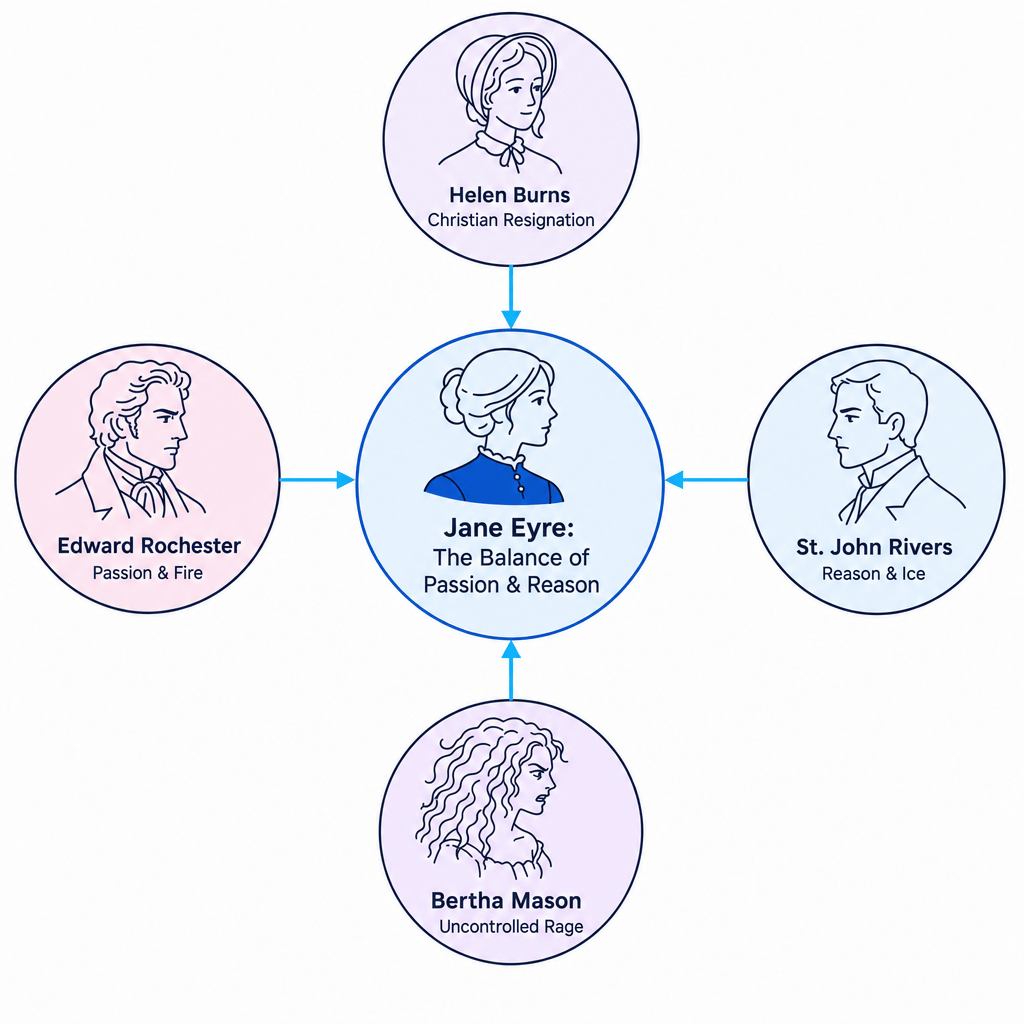
1. Passion vs. Reason: Rochester vs. St. John Rivers
The two men who propose to Jane represent the central conflict of the novel:
- Edward Rochester represents passion, fire, and lawlessness. He urges Jane to ignore social and religious laws to be with him. His love is intense but potentially destructive; it threatens to consume Jane’s independence.
- St. John Rivers represents reason, ice, and duty. He is described using cold imagery ("a cold cumbrous column", "an iceberg"). He offers Jane a life of religious duty in India, but it requires her to marry him without love. This would utterly freeze her passionate nature.
By rejecting both of their extreme demands, Jane carves out her own path of passionate independence and moral duty.
2. Emotional Extremes: Helen Burns vs. Bertha Mason
Jane’s inner impulses are mirrored by two female characters who meet tragic ends because they cannot find the balance Jane achieves:
- Helen Burns represents Christian resignation and passive endurance. When abused, Helen turns the other cheek, trusting in the afterlife. While Jane admires Helen's faith, she cannot adopt her passive submission: "When we are struck at without a reason, we should strike back again very hard."
- Bertha Mason represents uncontrolled, animalistic rage and passion. Locked in the attic, Bertha is the physical manifestation of the anger Jane has tried to repress since childhood. Bertha acts as Jane's "dark double" (Doppelgänger); she literally tears Jane's wedding veil in half, acting out the rebellion Jane feels but cannot express.
Both Helen (who dies of consumption/spiritual purity) and Bertha (who dies in the fire of her own mad rage) perish because their lifestyles are unsustainable. Jane survives because she learns to balance Helen's self-control with Bertha's fierce urge for liberty.
Edward Rochester: The Byronic Hero
Edward Rochester is one of literature's most famous examples of a Byronic hero.
Byronic Hero
A Byronic hero (named after the poet Lord Byron) is a brooding, melancholic, and rebellious male character who is haunted by a dark, secret past. He is highly intelligent, passionate, and socially non-conforming, but carries deep moral flaws.
Rochester does not fit the traditional mold of a handsome, perfect Victorian gentleman:
- Physicality: Jane notes that he is not handsome, possessing a "dark face, with stern features and a heavy brow."
- Moral Ambiguity: He has traveled Europe, kept mistresses, and attempts to enter a bigamous marriage with Jane, willfully tricking her.
- Redemption: Rochester's moral redemption is physical. He must lose his eye and his hand in the Thornfield fire—trying to save his servants and even Bertha—before he is spiritually cleansed. When Jane returns to him, his hubris (excessive pride) has been broken, allowing them to marry as equals.
Ignoring the equalizing ending
Many students write that Rochester "rescues" Jane. In reality, the power dynamic is reversed by the end of the novel. Jane is the one who is financially independent (having inherited £20,000) and physically capable, while Rochester is blind, maimed, and dependent on her. This structural reversal is crucial for showing Jane's ultimate victory.
Worked Example: Analysing Characterisation
Let us walk through how to write a high-scoring analytical paragraph on how Brontë presents Jane's character in a key passage.
We will focus on Jane's famous declaration to Rochester in Chapter 23, when she believes he is going to marry Blanche Ingram and send Jane away:
"Do you think, because I am poor, obscure, plain, and little, I am soulless and heartless? You think wrong!—I have as much soul as you,—and full as much heart!... I am not talking to you now through the medium of custom, conventionalities, nor even of mortal flesh;—it is my spirit that addresses your spirit; just as if both had passed through the grave, and we stood at God’s feet, equal,—as we are!"
Analysing Jane's assertion of equality
- Identify the character's core conflict in the scene: In this passage, Jane is resisting the Victorian societal expectation that she should suffer in silence as a low-status governess. She is asserting her moral and spiritual equality to her wealthy employer, Rochester.
- Select specific methods and quotations: Focus on the listing of adjectives ("poor, obscure, plain, and little") used to define her low social standing, followed by the rhetorical question and the spiritual imagery of the "spirit" standing at "God's feet, equal".
- Analyze the language and structural choices: Brontë uses a syndetic list ("poor, obscure, plain, and little") to acknowledge the harsh social labels Victorian society places on Jane. However, she immediately subverts this with a passionate rhetorical question. The noun "spirit" and the religious allusion to standing at "God’s feet" elevates their connection from a earthly, class-bound relationship to a transcendental, spiritual equality.
- Link the analysis to Victorian context (AO3): In 1847, Victorian society was highly stratified by class, and women were expected to be submissive and quiet (the "Angel in the House" ideal). By having Jane assert her spiritual equality directly to a wealthy man, Brontë challenges both class hierarchy and patriarchal power, presenting Jane as a modern, self-determined heroine who demands respect.
Short quotes are best
In your exam, you won't have the text. Memorise short, high-impact phrases rather than long blocks of text. For Jane's independence, simply memorise: "poor, obscure, plain, and little" and "I am no bird; and no net ensnares me."
In the exam
- Never write about characters as real people. Always frame your essay around what the writer is doing. Use active verbs: "Brontë constructs...", "Brontë uses St. John to symbolise...", "Brontë challenges Victorian ideals of..."
- Track character development structurally. A high-level answer looks at how a character changes from the beginning of the novel, through the middle, to the end. Connect their state of mind to the physical setting they are in.
- Contrast is your secret weapon. If you are asked to write about Rochester, write a paragraph comparing his fiery passion to St. John's cold rationality. If you are asked to write about Jane's anger, contrast her with Bertha Mason's madness and Helen Burns's submission. This shows the examiner you understand the novel's design.
Check yourself
- Can you list the five locations Jane lives in during the novel, in the correct chronological order, and explain what each represents?
- How does the character of Blanche Ingram act as a social foil to Jane at Thornfield?
- Why must Rochester be blinded and maimed at the end of the novel for Jane's narrative journey to be complete?
