

Analyzing short stories for your GCSE English Literature exam requires a slightly different set of analytical tools than those you use for a full-length novel. Because of their brief form, writers of short stories must be incredibly precise. Every word, symbol, and structural shift is loaded with meaning.
In this guide, we will break down three of the most popular and culturally rich stories from the Telling Tales anthology:
- Chemistry by Graham Swift
- The Darkness Out There by Penelope Lively
- My Polish Teacher's Tie by Helen Dunmore
What you'll learn
- How to identify and analyze key structural devices unique to the short story form.
- How to decode complex symbolism and characterization across the selected texts.
- How to construct high-scoring comparative paragraphs that link themes to writers' intentions.
Mastering the Short Story Form
Before diving into the individual stories, you must understand the core structural dynamics that writers use to build tension and meaning in a condensed space.
Epiphany
An epiphany is a sudden, profound moment of realization or clarity experienced by a character. In a short story, this often acts as the emotional climax or turning point, changing how the character (and the reader) views their world.
Unlike novels, which have room for complex subplots and gradual character development, short stories often focus on a single event, a limited cast of characters, and a compressed timeline. They rely heavily on juxtaposition (placing two contrasting things close together to highlight their differences) and retrospective narration (looking back on past events with the benefit of hindsight).
The Power of Compression
In the Telling Tales anthology, writers do not waste space. If an object is mentioned repeatedly (like a model boat, a cup of tea, or a tie), it is not just background detail; it is a motif—a recurring element that represents a larger thematic idea.
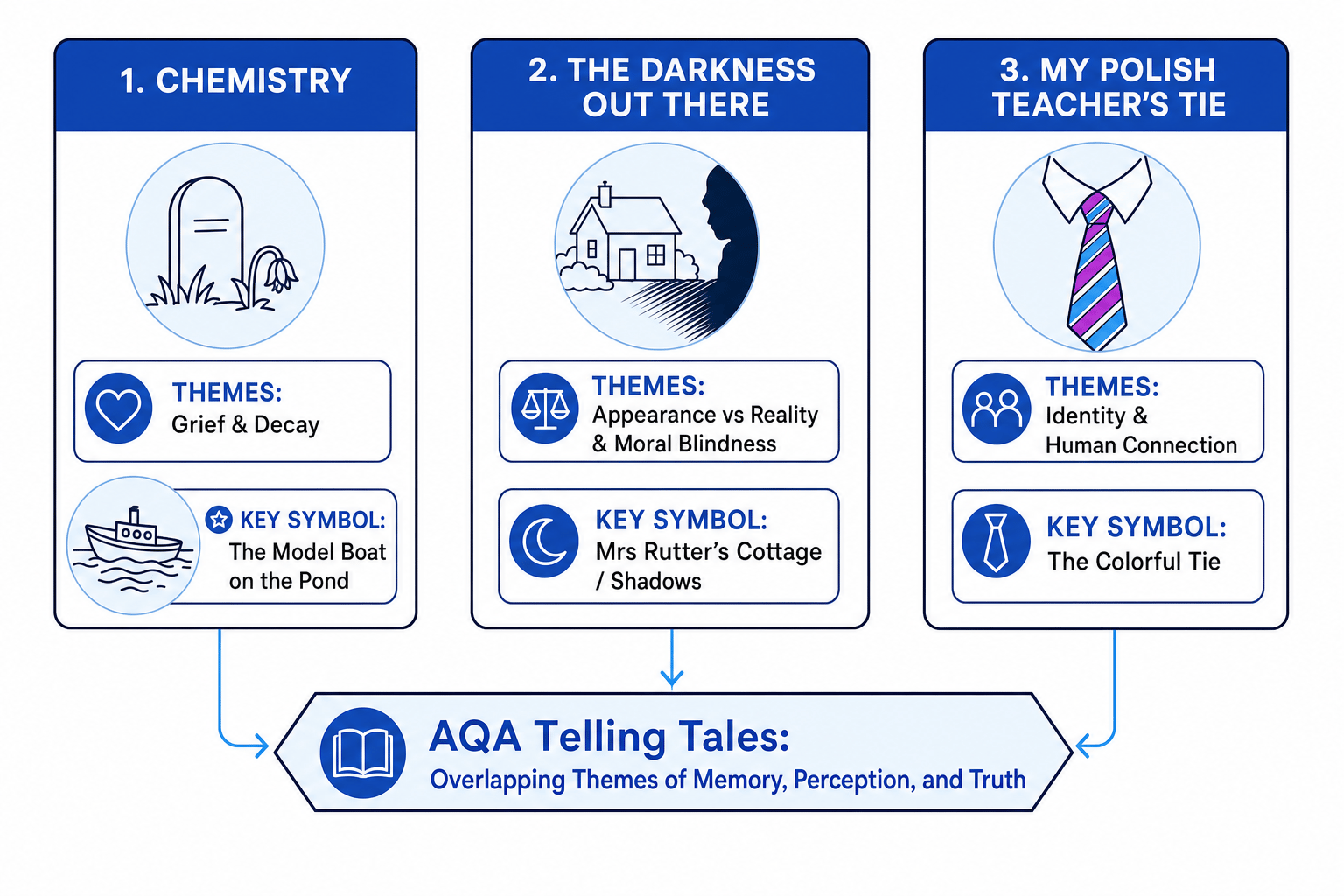
1. Chemistry by Graham Swift
In Chemistry, Graham Swift explores the delicate and volatile nature of family relationships, grief, and the inevitability of change.
Plot and Structural Overview
The story is told from the perspective of a retrospective first-person narrator reflecting on his childhood. After his father dies, the young boy, his mother, and his grandfather form a close, harmonious unit. However, this fragile "chemistry" is disrupted when the mother's new partner, Ralph, enters their lives, bringing an aggressive, overbearing presence.
Key Symbols and Imagery
- The Pond and the Model Boat: The pond in the park represents the boundary between life and death, stability and uncertainty. The model boat, which sailing "always kept a fraction of distance between itself and the shore," symbolizes the fragile control the family tries to maintain. When the boat sinks, it foreshadows the permanent collapse of the family unit.
- Chemistry: Swift uses the literal science of chemistry as a metaphor for human relationships. Chemistry is about elements combining to form something new, but it is also about volatile reactions. The grandfather's work in his shed with chemicals represents his attempt to isolate himself from the painful, chaotic changes occurring in his house.
Quote to Memorize
"People change, chemically, they become different people." This quote from the narrator's mother is excellent for demonstrating your understanding of the story's central metaphor. It links science directly to the inevitability of emotional decay and shifting family dynamics.
2. The Darkness Out There by Penelope Lively
This story exposes the gap between youthful idealism and the dark, historical realities of the adult world. It challenges our assumptions about appearance and reality.
Plot and Structural Overview
Sandra, a young, sheltered girl, walks through a beautiful, sunny English countryside to help an elderly widow, Mrs. Rutter. Accompanying her is Kerry, a working-class boy whom Sandra initially looks down upon. However, when Mrs. Rutter casually reveals her cruel neglect of a dying German pilot during World War II, Sandra's sunny perception of the world—and of Mrs. Rutter—is utterly shattered.
Key Themes and Methods
- Juxtaposition of Setting: Lively contrasts the bright, idyllic, pastoral setting of the "hedgerows" and "fields" with the dark, claustrophobic, and cluttered interior of Mrs. Rutter's cottage. This mirroring reflects the contrast between Mrs. Rutter's sweet, grandmotherly appearance and the "darkness" of her moral actions.
- The Deceptive Nature of Appearances: Mrs. Rutter is introduced with domestic, cozy imagery ("like a cottage in a picture book" and "soft, fat hands"). This makes her subsequent confession about the German pilot even more shocking.
- The Epiphany: At the end of the story, Sandra experiences a profound epiphany. The "darkness" is no longer just a physical place or a bogeyman in the woods; it is a permanent part of human nature.
Misunderstanding Sandra's Epiphany
Do not write that Sandra is simply "scared of Mrs. Rutter." Her realization is much deeper. She realizes that evil does not wear a monstrous face; it can reside inside a seemingly sweet, ordinary old lady. The "darkness" is inside human hearts.
3. My Polish Teacher's Tie by Helen Dunmore
Dunmore's story deals with themes of social class, xenophobia, marginalization, and the search for authentic human connection in a modern institutional setting.
Plot and Structural Overview
Carla Carter, a part-time school caterer, feels invisible and undervalued by the teaching staff. When a Polish teacher named Stefan visits the school, Carla is the only one who takes the time to connect with him, initially through a pen-pal letter where she hides her actual job. The climax of the story occurs when Stefan arrives at the school, wearing a garish, unusual tie, and Carla must choose whether to step out of her comforting obscurity to acknowledge him.
Key Symbols and Methods
- The Tie: Stefan's tie is "bright red with huge, stylized silver roses." It represents his individuality, his pride, and his refusal to conform to the dull, gray expectations of the English school system. It contrasts sharply with the "drab" environment of the school.
- The Uniform: Carla's blue overall acts as a physical barrier that renders her socially invisible to the teachers. It symbolizes class division and the labels society places on us.
- Linguistic Contrast: Dunmore uses simple, direct prose to reflect Carla's internal voice, but when Carla writes to Stefan, her language becomes poetic and expressive. This demonstrates that her intellectual depth is suppressed by her low-status job.
Analytical Application
In your exam, you must construct structured, analytical paragraphs that explore how writers use language and structure to convey these big ideas (AO2), and why they wanted to do so (AO3).
Here is a step-by-step walk-through of how to build an analytical paragraph based on The Darkness Out There.
Analyzing characterization through language and structure
- Formulate an analytical point linking method to theme.
- Drafting: Lively utilizes the stark contrast between Mrs. Rutter's cozy domestic appearance and her dark, cold-hearted memories to expose the deceptive nature of human morality.
- Embed a precise, short quotation containing a clear literary method.
- Drafting: When first introducing Mrs. Rutter, Lively describes her as having a "creamy face" and being "like a cottage in a picture book," using cozy, domestic similes to establish a sense of safety.
- Deconstruct the literary method and its structural effect.
- Drafting: The adjective "creamy" evokes warmth, softness, and purity, aligning Mrs. Rutter with maternal comfort. By framing her surroundings through a fairy-tale "picture book" simile, Lively deliberately misleads both the protagonist, Sandra, and the reader into a false sense of security. This structural setup makes Mrs. Rutter's subsequent confession about leaving the German soldier to die in "the dark" incredibly jarring, shattering the pastoral illusion.
- Connect the analysis to the writer's message and historical context.
- Drafting: Through this shocking juxtaposition, Lively critiques post-war British complacency. Writing in the late 20th century, Lively suggests that wartime atrocities and moral failures cannot be neatly hidden behind a facade of tea-drinking, rural English respectability.
In the exam
- Do not summarize the plot: The examiner knows what happens in the stories. Focus entirely on how the writer creates meaning (methods) and why they wrote it (theme/context).
- Anchor your comparison: If you are comparing two stories, make sure you use comparative transitions (e.g., "Similarly, in Chemistry..." or "Conversely, Dunmore presents...") to keep your argument balanced.
- Analyze the endings: Short stories are defined by their endings. Always dedicate a portion of your essay to analyzing the final lines, as this is where the writer's ultimate message or epiphany is delivered.
Check yourself
- How does the sinking of the model boat in Chemistry act as a turning point for the narrator's family dynamics?
- What does the bright, sunny weather at the beginning of The Darkness Out There symbolize, and how does it contrast with the story's ending?
- Why does Carla in My Polish Teacher's Tie feel a stronger connection to Stefan than to the other teachers in her own school?
