What you'll learn
- What A Christmas Carol is about at the “big picture” level.
- How Dickens uses Scrooge’s transformation to explore social responsibility.
- Why the novella’s five-stave structure matters.
- How to turn overview knowledge into exam-ready analysis.
The text in one sentence
A Christmas Carol is Charles Dickens’s 1843 novella about Ebenezer Scrooge, a selfish miser who is visited by four ghosts and transformed into a generous, compassionate man.
Novella
A novella is a short novel: longer than a short story, but more concentrated than a full-length novel. This matters because Dickens can make the plot feel focused, symbolic, and morally direct.
The story is set in Victorian London at Christmas, a time Dickens presents as a test of people’s kindness, generosity, and responsibility towards others.
Why this text matters
At its heart, A Christmas Carol asks a simple but powerful question:
Can a selfish person change?
Dickens answers: yes — but only if they truly face the damage caused by greed, isolation, and lack of compassion.
The big message
Dickens presents Scrooge’s redemption as proof that social and moral change is possible. The novella encourages readers to become more charitable before it is too late.
Redemption
Redemption means being saved from moral failure through change, repentance, or better actions. Scrooge is “redeemed” because he recognises his cruelty and chooses to live differently.
The central character: Scrooge
Ebenezer Scrooge begins the novella as a cold, isolated businessman. Dickens describes him as a “squeezing, wrenching, grasping, scraping, clutching, covetous, old sinner”, piling up harsh verbs to make his greed feel aggressive and unnatural.
He is not just unpleasant as an individual. He represents a wider social problem: people with money and power who refuse to care about the poor.
Miser
A miser is someone who hoards money and hates spending it, even when spending could help themselves or others.
Scrooge’s famous phrase “Bah! Humbug!” shows his rejection of Christmas, but it also shows his rejection of community, joy, charity, and human connection.
The moral journey
Scrooge’s journey moves from isolation to redemption. Dickens makes this journey clear through the visits of the ghosts, who force Scrooge to look at his past, present, and possible future.
The five staves form a clear moral timeline: Scrooge is first shown what he is, then how he became that way, then what his behaviour does to others, then what will happen if he refuses to change, and finally what redemption looks like.
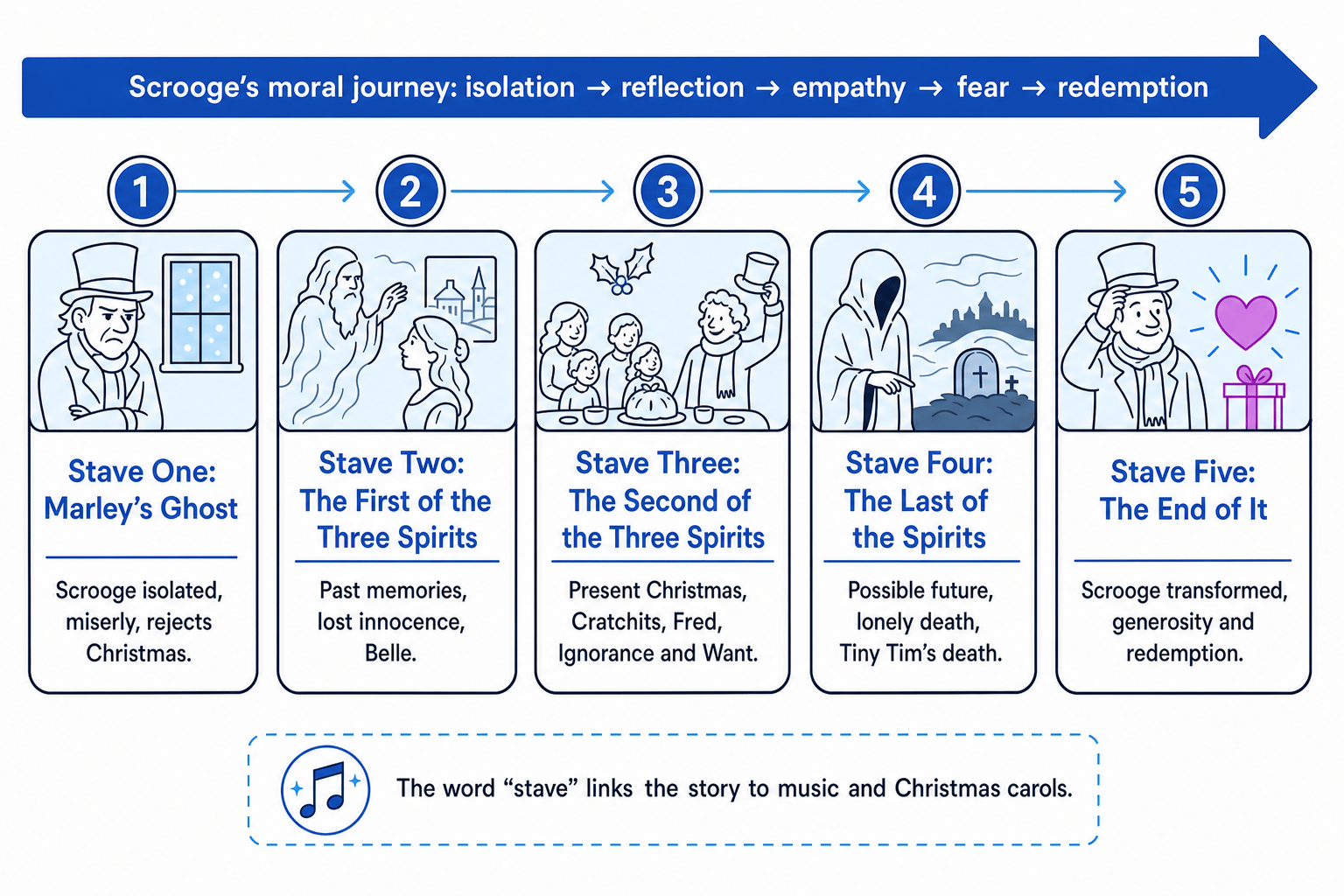
Stave
A stave is a section of a song or piece of music. Dickens calls the chapters “staves” to link the novella to Christmas carols and to make the whole story feel like a moral Christmas song.
Tracing Scrooge’s transformation
-
Start with Scrooge’s first presentation. Dickens introduces him as “solitary as an oyster”, using a simile to suggest that he is emotionally closed off and difficult to reach.
-
Connect the ghosts to stages of change. The Ghost of Christmas Past encourages reflection, the Ghost of Christmas Present builds empathy, and the Ghost of Christmas Yet to Come creates fear of consequences.
-
Link the ending back to the beginning. By Stave Five, Scrooge promises, “I will honour Christmas in my heart”, showing that he now accepts the values he once mocked.
-
Draw out Dickens’s message. The change suggests that even deeply selfish people can reform if they recognise their responsibility to others.
Genre: ghost story, moral tale, and social criticism
A Christmas Carol mixes several genres.
Genre
Genre means a type or category of writing, such as a ghost story, romance, comedy, tragedy, or mystery.
It is a ghost story because supernatural visitors appear and create suspense. It is also a moral tale because it teaches a lesson about how people should live. Finally, it is a form of social criticism, because Dickens attacks real problems in Victorian society, especially poverty and selfish attitudes towards the poor.
The ghosts are frightening, but they are not only there to scare the reader. They are also used to educate Scrooge — and, through him, the reader.
Social criticism
Social criticism is writing that exposes problems in society and encourages readers to question or change them.
Dickens’s purpose
Dickens wrote A Christmas Carol partly because he was angry about poverty, child suffering, and the lack of compassion shown by many wealthy Victorians.
However, the novella is not a political essay. Dickens uses story, emotion, humour, and the supernatural to make readers feel the need for change.
Purpose
Dickens wants readers to see poverty not as an abstract issue, but as a human issue. Characters such as the Cratchits make suffering personal and emotionally powerful.
When Scrooge asks whether the poor should go to prisons or workhouses, Dickens uses him to echo cruel Victorian attitudes. Later, those words are turned back on Scrooge, forcing both him and the reader to recognise their brutality.
Context without analysis
Do not just write “Dickens cared about the poor” and stop there. Explain how Dickens uses characters, structure, or language to make the reader care too.
Form and structure
Form
Form means the type and overall shape of a text: for example, novella, play, poem, letter, or speech.
The form of A Christmas Carol is important because its short length makes Scrooge’s transformation feel intense and urgent. The story happens over one Christmas Eve night and Christmas morning, which gives it a tight, dramatic shape.
Structure
Structure means how a text is organised: the order of events, shifts in time, openings and endings, contrasts, repetitions, and turning points.
Dickens uses a circular structure in some ways: the novella begins and ends at Christmas, but Scrooge’s attitude has completely changed. This makes the transformation easy for the reader to measure.
He also uses contrasts: cold and warmth, darkness and light, isolation and family, greed and generosity.
Narrative voice
Narrative voice
The narrative voice is the “voice” that tells the story. In A Christmas Carol, the narrator is witty, lively, and sometimes directly addresses the reader.
The narrator often uses humour to make the story entertaining, even when the message is serious. This helps Dickens avoid sounding like he is simply lecturing the reader.
For example, the opening insists that “Marley was dead: to begin with.” This blunt statement creates a storytelling tone that is dramatic, memorable, and slightly playful.
A strong overview phrase
You can describe the narrator as engaging and moralising: entertaining the reader while guiding them towards Dickens’s message.
Key methods to notice
Writer’s methods
Writer’s methods are the choices a writer makes to create meaning, such as language, structure, form, symbolism, imagery, contrast, and narrative voice.
In this novella, the most useful methods to track are:
- Simile: “solitary as an oyster” presents Scrooge as closed off but possibly containing value inside.
- Symbolism: Marley’s chain symbolises the moral burden created by greed and selfishness.
- Contrast: the Cratchits’ warmth contrasts with Scrooge’s cold isolation.
- Foreshadowing: early warnings prepare the reader for later consequences.
- Pathetic fallacy: cold, fog, and darkness often reflect Scrooge’s emotional state.
Pathetic fallacy
Pathetic fallacy is when weather or surroundings reflect mood, atmosphere, or character. For example, cold weather can mirror emotional coldness.
Device spotting
Avoid listing techniques without meaning. “Dickens uses a simile” is not enough — explain what the simile suggests and why it matters to the theme or character.
How overview knowledge helps your exam answer
For AQA, you need to write a clear, personal argument about the text and support it with references. Overview knowledge helps you build a strong line of argument rather than just retelling the plot.
A strong overview sentence might sound like this:
Dickens presents Scrooge’s transformation from a “covetous” miser into a generous figure to argue that compassion and social responsibility are essential Christian and human values.
That sentence gives you a direction: character, method, theme, and message.
Turning overview into analysis
-
Make a big argument about Dickens’s message. You might argue that Dickens uses Scrooge to show that greed damages both society and the individual.
-
Choose a short quotation that fits the journey. “Solitary as an oyster” supports the idea that Scrooge is isolated at the start of the novella.
-
Analyse the method. The simile suggests he has built a hard shell around himself, cutting himself off from human warmth.
-
Link to the whole text. Because Scrooge later becomes generous and sociable, Dickens shows that isolation is not permanent: moral change is possible.
The main themes at a glance
You will study themes in more detail elsewhere, but the key overview themes are:
- Redemption — Scrooge changes and is morally saved.
- Social responsibility — people should care for others, especially the poor and vulnerable.
- Poverty and inequality — Dickens exposes suffering in Victorian society.
- Christmas spirit — Christmas represents generosity, family, forgiveness, and joy.
- Memory and regret — the past helps Scrooge understand how he became emotionally hardened.
- Death and legacy — the future forces Scrooge to ask how he will be remembered.
The best overview link
Almost every major idea in the novella connects to Scrooge’s transformation. When in doubt, ask: how does this moment help Dickens move Scrooge from selfishness to compassion?
A careful note on context
Context
Context means the real-world circumstances surrounding a text, such as the writer’s life, historical period, social issues, and beliefs of the time.
For A Christmas Carol, useful context includes Victorian poverty, workhouses, Christian charity, attitudes to the poor, and Dickens’s own concern for social reform.
But context should support your interpretation, not replace it. The exam rewards you for linking context to Dickens’s choices in the novella.
Keep context relevant
Only include context if it helps explain Dickens’s message or methods. A paragraph of historical facts with no link to the question will not score highly.
In the exam
-
Start with a clear argument about Dickens’s message, not a plot summary.
-
Use short, accurate quotations such as “Bah! Humbug!”, “solitary as an oyster”, “I wear the chain I forged in life”, and “I will honour Christmas in my heart”.
-
Analyse methods and effects: explain how Dickens’s language, structure, or symbolism shapes the reader’s view of Scrooge and society.
-
Link moments from the extract to the whole novella, especially Scrooge’s journey from isolation to redemption.
Check yourself
- How does the five-stave structure guide Scrooge’s moral transformation?
- Why is A Christmas Carol more than just a ghost story?
- What is one short quotation that shows Scrooge at the start, and one that shows him after he changes?
