When Charlotte Brontë published Jane Eyre under the pen name Currer Bell in 1847, Victorian readers were captivated and shocked by its intense emotional energy. This energy comes directly from Brontë’s masterly fusion of two distinct literary traditions: the Gothic and the Romance.
By weaving these methods together, Brontë does not just write a thrilling love story; she uses them to expose Jane's psychological trauma, critique the power imbalances of Victorian marriage, and champion a woman's right to emotional and spiritual independence.
What you'll learn:
- How to identify and define Gothic and Romance conventions within the novel.
- How Brontë synthesises these two genres to externalise Jane’s inner feelings.
- How to analyse key motifs, settings, and characters—like the "double" and the Byronic hero—to secure top marks for analysis.
1. Defining the Genres: Gothic vs. Romance
To understand how Brontë manipulates these traditions, we must first understand what each genre brought to nineteenth-century literature.
Gothic Literature
Gothic Literature
Gothic literature is a genre characterized by a dark, gloomy atmosphere, suspense, terror, castles or old ruins, the supernatural (or the threat of it), madness, and extreme emotional distress.
In Jane Eyre, the Gothic is not just there to frighten you. Brontë uses it as a psychological tool to represent Jane's feelings of entrapment, isolation, and terror in a society that seeks to suppress her passionate nature.
Romance Literature
Romance Literature
Romance literature is a genre focused on the growth of a relationship, passionate love, moral development, and the quest for personal fulfillment.
Unlike traditional, highly sentimental romances of the period, the romance in Jane Eyre is grounded in a struggle for spiritual equality. Jane refuses to submit to a relationship where she must sacrifice her integrity, her morals, or her autonomy.
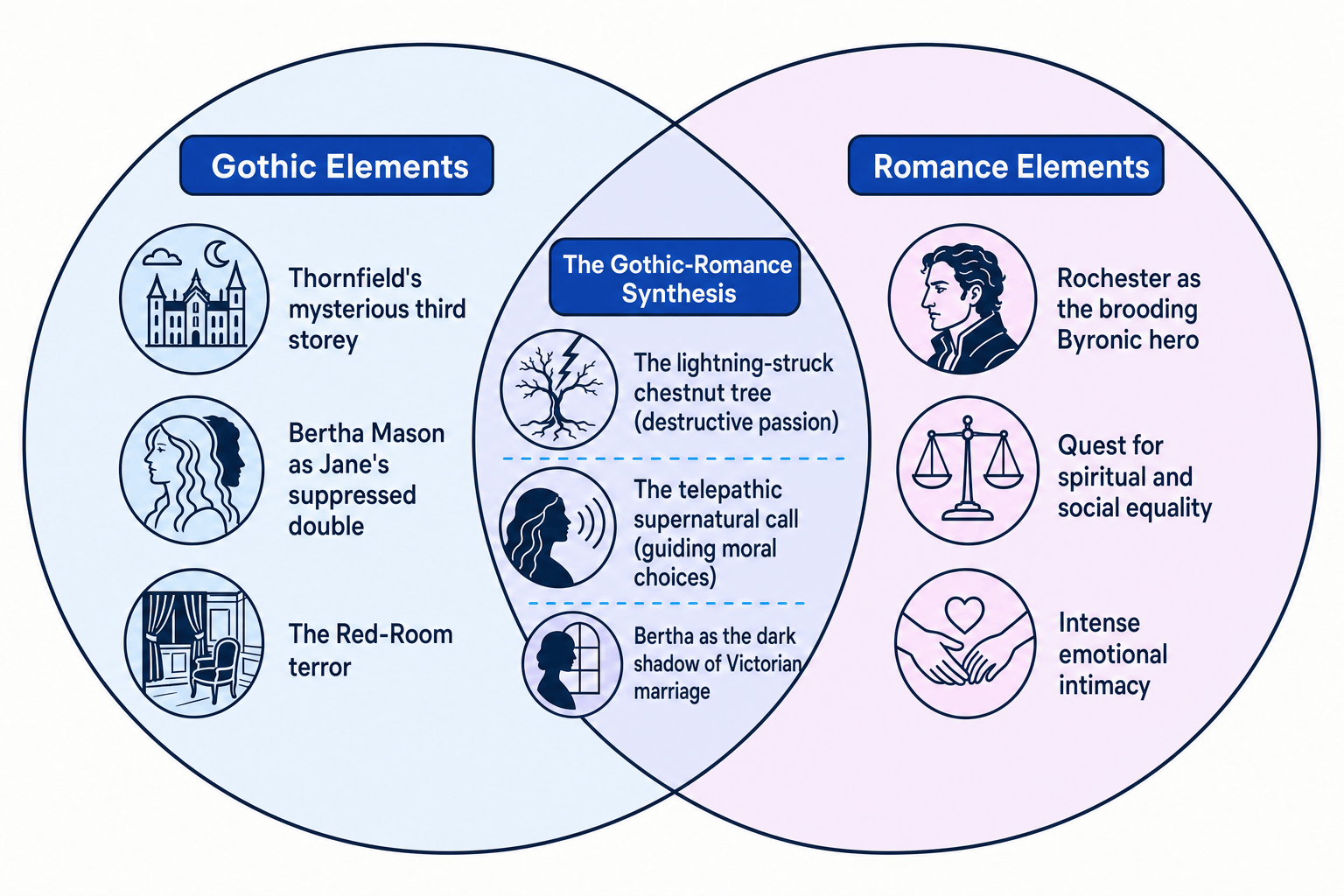
The Gothic-Romance Synthesis
Brontë's genius lies in combining these two genres. She uses Gothic terror to expose the dangers of romance. For Jane, falling in love is not purely joyful; it is terrifying because it threatens her independence. The Gothic elements often act as physical warnings of the psychological dangers Jane faces in her romantic pursuits.
2. Gothic Settings and the Externalisation of Mind
One of Brontë’s primary Gothic methods is using setting to reflect Jane’s psychological state. This is often achieved through pathetic fallacy (giving human emotions to nature or weather) and heavy symbolic imagery.
The Red-Room (Gateshead Hall)
The Red-Room is the ultimate Gothic crucible of Jane's childhood. It is cold, dark, silent, and contains the memory of her deceased Uncle Reed.
- The Method: The colour symbolism of "red" and "deep red damask" evokes blood, anger, and passion. The "cold" and "dark" depict Jane's social isolation.
- The Meaning: When Jane is locked inside, her fear of her uncle's ghost is a physical representation of her extreme mental trauma and her feelings of helplessness against the oppressive Reed family.
Thornfield Hall
Thornfield is the quintessential Gothic manor house. It is vast, old, filled with "long corridors" and "shadowy" spaces, and crucially, contains a hidden secret on the third floor.
- The Method: The eerie "low, slow ha! ha!" of Bertha Mason echoing down the corridors links the physical space directly to madness and mystery.
- The Meaning: Thornfield represents Rochester's dark, burdened mind and the secrets of his past. The physical confinement of Bertha on the third floor mirrors the mental confinement of Rochester’s secret life and the threat of moral ruin that hangs over Jane.
Literal vs. Psychological Gothic
Many students write that the Gothic elements are simply there to create a "scary atmosphere." To gain high marks for analysis, always link the Gothic setting to Jane's internal feelings. For example, don't just say the Red-Room is creepy; explain that its coldness and confinement represent Jane’s lack of warmth, love, and freedom in the Reed household.
3. The Double: Bertha Mason as Jane's Gothic Doppelgänger
A key Gothic device used by Brontë is the Doppelgänger, or the "double."
Doppelgänger (The Double)
A Doppelgänger is a literary archetype where a character is accompanied by a shadow-self or duplicate, representing their repressed desires, hidden fears, or darker impulses.
Bertha Mason—Rochester's concealed, mad first wife—is not merely an obstacle to Jane's marriage; she is Jane’s Gothic double.
- Unchecked Passion: While Jane struggles to keep her passion governed by reason, Bertha represents passion completely unchecked by reason. She is described in animalistic, uncivilized terms ("a strange wild animal," "clothed hyena").
- Physical Rebellion: When Jane is forced to suppress her anger at her submissive position, Bertha acts out. On the night before Jane’s aborted wedding, Bertha tears Jane’s bridal veil in half. This Gothic act physically manifests Jane’s deep, subconscious dread of becoming Rochester's unequal, caged wife.
4. The Byronic Hero: Edward Rochester
To construct her romantic lead, Brontë draws on the Gothic-adjacent archetype of the Byronic hero.
Byronic Hero
A Byronic hero (named after the poet Lord Byron) is a dark, brooding, passionate character who is highly intelligent, emotionally sensitive, but plagued by a troubled past, secret guilt, and a cynical view of society.
Rochester is not a traditional, handsome fairytale prince. He is "ugly" to Jane, harsh, and emotionally volatile.
- The Method: Brontë uses animalistic imagery and dark, stormy descriptions for Rochester. He has a "dark face, with stern features and a heavy brow."
- The Meaning: His dark nature fits the Gothic setting of Thornfield. His relationship with Jane is a struggle of wills. He is drawn to her purity and moral clarity, while she is drawn to his fierce intellect and emotional depth, creating an incredibly intense, unconventional romance.
5. Gothic Omen and Supernatural Romance
Brontë uses supernatural occurrences to guide the romantic narrative and signal moral warnings. These events blur the line between Gothic terror and Romantic destiny.
The Lightning-Struck Chestnut Tree
In Chapter 23, immediately after Rochester proposes to Jane and she accepts, a violent storm occurs.
Analyzing Gothic foreshadowing in Thornfield's setting
Here is how to analyze this crucial moment step-by-step to show how Brontë blends Gothic setting with Romance narrative.
- Identify the literal event and its placement: Right after Jane and Rochester agree to marry, a summer storm rolls in. That night, the great horse-chestnut tree in Thornfield's orchard is struck by lightning and split in two.
- Deconstruct the literary methods: Brontë uses symbolism and pathetic fallacy. The tree represents their union. It is "struck by lightning," a powerful Gothic image of violent disruption and warning from nature. The physical splitting of the tree "half of it split away" foreshadows the literal and emotional rupture of their engagement when Bertha's existence is revealed.
- Analyze the psychological and moral meaning: The Gothic omen warns the reader (and Jane's subconscious) that their proposed union is structurally unsound. It is unequal and morally corrupted because Rochester is already married. The split tree represents how they will be violently torn apart, yet the roots remain connected, suggesting their spiritual bond will survive the trauma.
The Telepathic Call
At the climax of the novel (Chapter 35), when St. John Rivers pressures Jane to marry him, she suddenly hears Rochester's voice calling her name across the moors: "Jane! Jane! Jane!"
- The Method: This is a purely supernatural, telepathic event.
- The Meaning: Rather than being frightening or "ghostly" in a terrifying way, this Gothic event serves a Romance purpose. It is a spiritual, telepathic connection that rescues Jane from a cold, passionless marriage to St. John and redirects her toward her true, equal partner, Rochester.
In the exam
When writing about Gothic and Romance methods in Jane Eyre, remember to structure your analysis to meet your assessment objectives:
- Embed short, accurate quotes: Never quote long blocks of text. Instead of writing out a whole description of Thornfield, use precise terms like "shadowy," "haunted-like," or the "low, slow ha! ha!" to keep your argument tight and focused.
- Link method to meaning (AO2): Always name the specific technique (e.g., pathetic fallacy, Doppelgänger, Byronic hero, Gothic motif) and explain its effect. Avoid "device spotting" (just naming the technique without explaining what it means for the characters).
- Connect to context (AO3): Explain why Brontë used these methods. In Victorian Britain, women were expected to be calm, submissive, and domestic (the "Angel in the House"). By using Gothic madness (Bertha) and passionate Romance (Jane), Brontë was challenging the rigid social and gender expectations of her era.
Check yourself
- Why does Brontë use the Red-Room as a Gothic setting, and how does it represent Jane's psychological state at Gateshead?
- In what ways does Bertha Mason act as Jane’s "double" (Doppelgänger) on the eve of Jane's wedding to Rochester?
- How does the lightning-struck horse-chestnut tree combine both Gothic and Romance conventions in Chapter 23?
