3. How to Analyse a Quote in the Exam
To secure a Grade 7, 8, or 9, you cannot simply drop a quote into your essay and explain what it means. You must perform micro-analysis (zooming in on specific words and naming the writer's methods) and link this to the author’s purpose and historical context.
The Zoom-In Formula
Do not try to explain a whole paragraph at once. Use this three-step formula:
- State your point (link to the question).
- Embed a short, precise quote.
- "Zoom in" on a single word or literary technique, explain its connotations, and link it to Victorian social contexts.
Feature Spotting
Avoid "feature spotting"—naming a device without explaining its effect. For example: "Brontë uses a metaphor when Jane says she is not a bird." This gets very few marks. You must explain why Brontë used that metaphor and how it makes the reader feel or think about Victorian society.
Worked Example: Micro-Analysis
Let us walk through how to construct a high-scoring analytical paragraph using our three-step process.
Question: Explore how Brontë presents Jane’s desire for independence in the novel.
Analyzing Jane's assertion of freedom
- Formulate a clear thematic thesis point: Start by identifying Jane’s core motivation and how it challenges her Victorian environment. State that Jane uses symbolic imagery to assert her equal status and reject the submissive female roles of the 19th century.
- Embed a precise, short quotation: Introduce the quote naturally within your sentence structure. For example: When resisting Rochester’s attempts to control her future, Jane fiercely declares, "I am no bird; and no net ensnares me."
- Execute a close-word zoom (AO2 analysis): Focus on the specific connotations of the word choices. Note that the noun "bird" carries connotations of fragility, song, and beautiful captivity, which Rochester often associates with Jane. By pairing this with the negative contraction "no", Jane actively rejects these patronising gender constructs.
- Examine the structural or physical imagery (AO2 analysis): Zoom in on the noun "net". A "net" is an invisible, trapping device designed to capture prey. This metaphor suggests that Victorian marriage and social class systems are traps designed to restrict female autonomy.
- Contextualise the analysis (AO3 integration): Connect this metaphorical trap to the legal reality of 1847. Explain that Victorian marriage legally stripped women of their independent identity under the laws of coverture. Jane's refusal to be "ensnared" is a radical, proto-feminist rejection of this structural inequality, showing that Brontë advocates for spiritual and legal self-determination.
Memorable Motifs
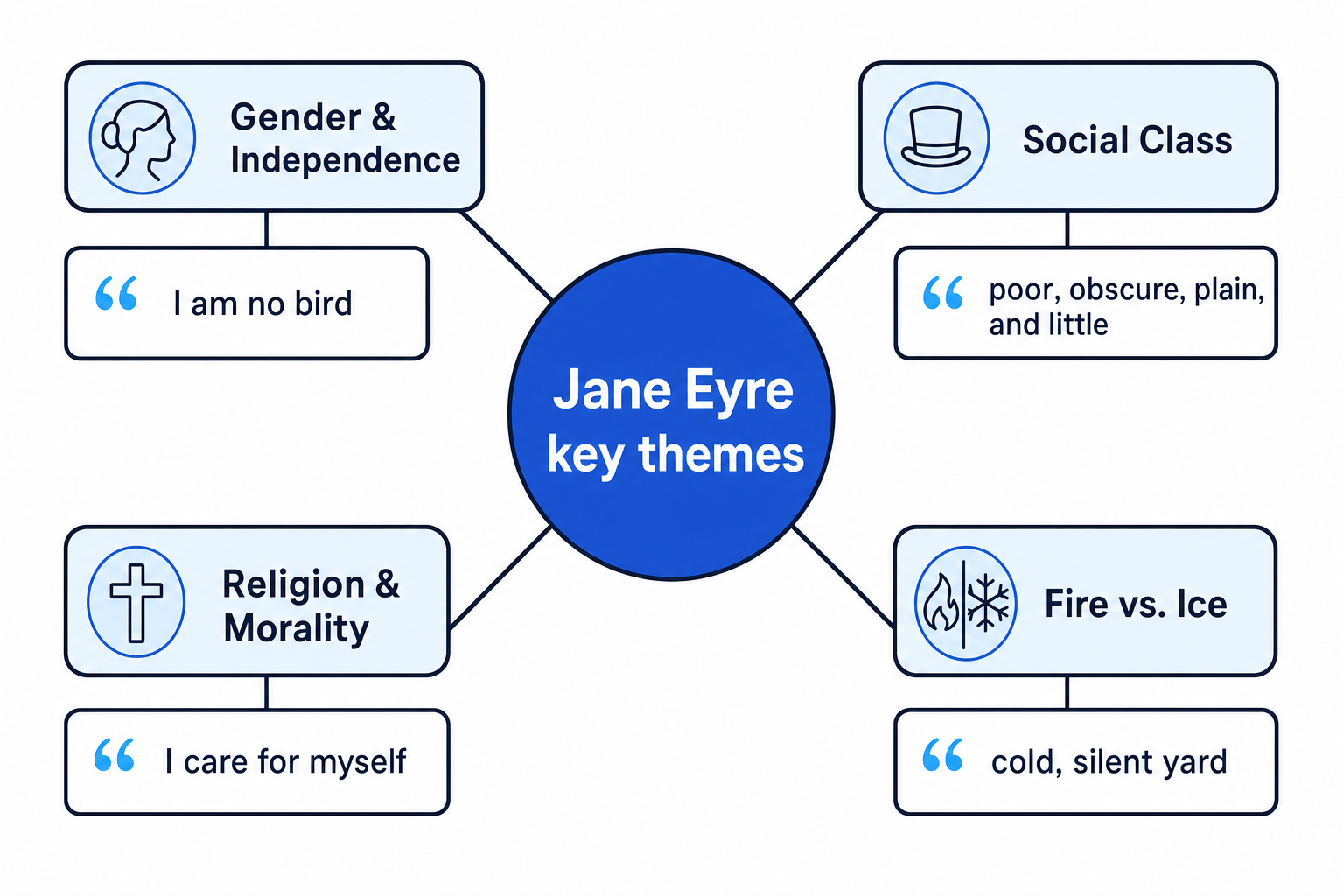
When memorising quotes, remember that Fire and Ice are the most powerful recurring motifs in Jane Eyre.
- Fire represents passion, anger, warmth, and rebellion (Jane, Rochester, Bertha).
- Ice represents cold reason, emotional suppression, and patriarchal control (Lowood, St. John, Brocklehurst). Always look for these elemental words in your quotes!
In the exam
- Plan before you write: Spend 5 minutes mapping out your essay. Jot down 3–4 high-yield quotes per paragraph before you begin writing your full response.
- Keep quotes short: A quote should rarely be longer than 6 words. "Embed" them directly into your sentences (e.g., Jane feels "poor, obscure, plain, and little" when...).
- Double-dip your quotes: If you analyse a quote in your first paragraph, see if you can reference it again in your conclusion to show how a character or theme has changed. For example, contrast the "cold" of Lowood with the "cold" of St. John's Moor House.
- Explain the writer's intent: Always use verbs like Brontë exposes, Brontë critiques, Brontë highlights, or Brontë subverts to show you are treating the novel as a deliberate construct (AO2/AO3).
Check yourself
- Can you name the key metaphor Jane uses in Chapter 23 to refuse to be Rochester's caged pet?
- Which four adjectives does Jane use to describe her social and physical limitations when confronting Rochester about class equality?
- How does the motif of "ice" or "stone" link to the character of St. John Rivers?
