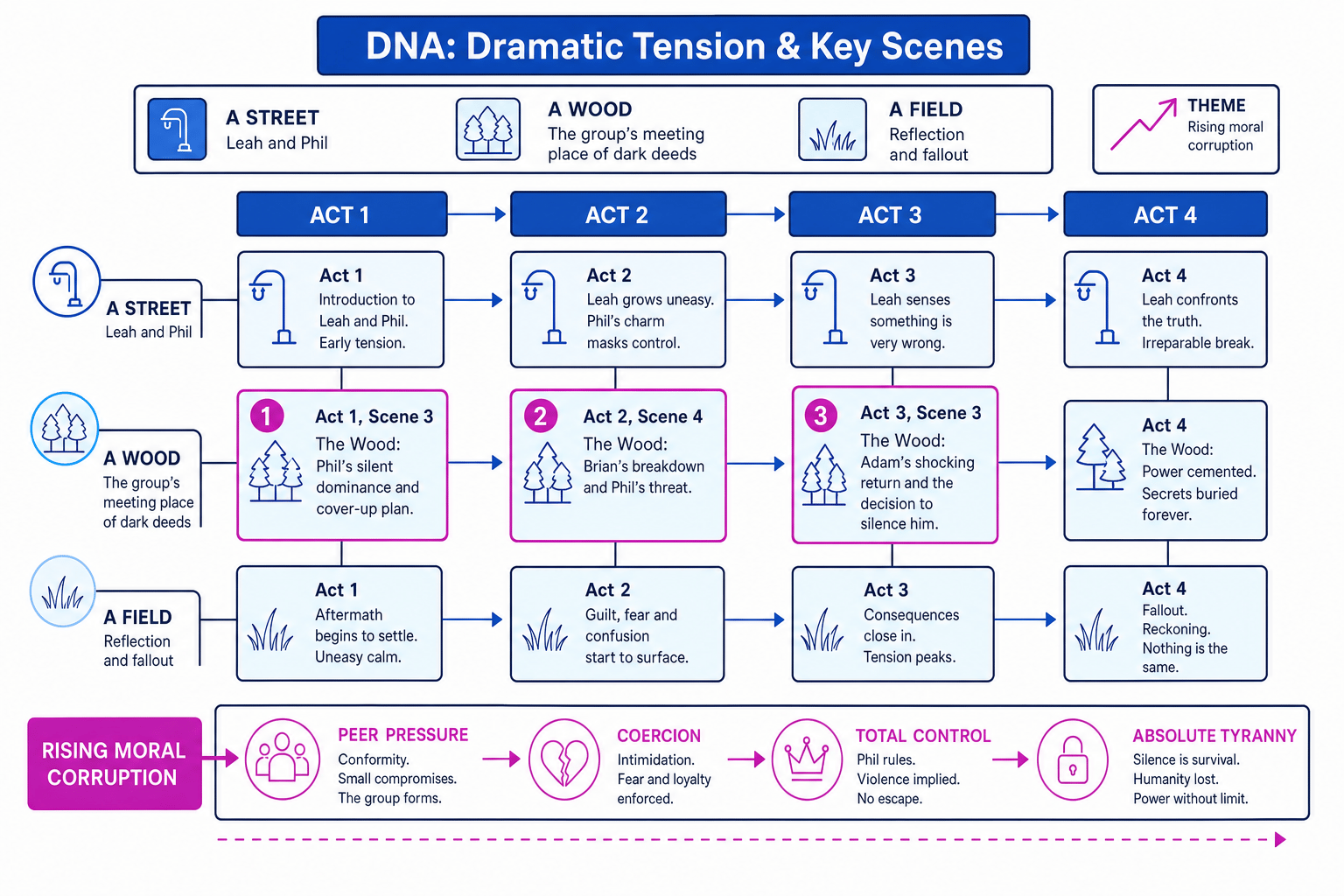
Key Scene 1: Phil's Cover-Up Plan (Act 1, Scene 3)
The Context
The gang has gathered in the wood. Jan and Mark have just revealed that Adam is dead after a "prank" went wrong—they coaxed him to walk along a high grille over a deep shaft, threw stones at him, and watched him fall. The group is in utter chaos, shouting, crying, and panicking about going to prison.
The Action
While the group panics, Phil sits completely silent, eating a waffle. When the hysteria peaks, Phil suddenly puts his food down and delivers a highly calculated, cold-blooded plan to frame an imaginary, middle-aged postman.
Why It Matters
This scene establishes the primary power dynamic of the play. Phil’s silence is not a sign of fear, but of strategic computation.
- Phil’s Method: He uses short, precise, imperative verbs ("You go to the station," "We walk back," "We show nothing").
- The Shift in Leadership: John Tate, the nominal leader in Act 1, is completely sidelined by Phil's cold intelligence.
- The Group's Reaction: They instantly fall into line, illustrating how easily a desperate crowd will submit to authoritarian control to escape personal responsibility.
The Power of Silence
Phil’s authority is built on silence and lack of emotion. By focusing on physical, mundane pleasures (eating waffles, ice cream, or sweets) while others panic about a boy's death, Phil detaches himself from human empathy. This makes his subsequent instructions incredibly chilling and highly effective.
Key Scene 2: Brian’s Breakdown (Act 2, Scene 4)
The Context
The cover-up has spiraled. The police have arrested a man matching the description of the fictional postman Phil invented. Brian, who was forced to lie to the police about finding a tooth, is losing his mind with guilt.
The Action
The group meets again in the wood. Brian is sobbing, rocking, and refusing to play his part anymore. He wants to confess. Phil calmly realizes that if Brian breaks, they all go down.
Why It Matters
This scene shows the transition from a passive cover-up to active, psychological torture and tyranny. Phil uses Brian’s fragile state to blackmail him.
- Phil's Direct Threat: Phil tells Brian that if he does not cooperate, they will take him to "the grille" and "push you in."
- Cathy’s Cruelty: Cathy is revealed as Phil's enforcer. She is excited by the prospect of violence, showing how power is beginning to corrupt the other group members as well.
- Leah’s Desperation: Leah tries to stand up for Brian but is completely ignored by Phil, showing her growing helplessness.
Misunderstanding Phil as a Stereotypical Villain
Do not write that Phil is simply "evil." Kelly presents him as a Machiavellian character—someone who believes the "end justifies the means." Phil acts purely on survival and logic. To him, sacrificing Brian's mental health is a necessary mathematical calculation to keep the rest of the group safe.
Key Scene 3: Adam’s Shocking Return (Act 3, Scene 3)
The Context
Just as the group believes the worst is over, Jan and Mark lead them to a shocking discovery: Adam is alive. He survived the fall but has been living wild in the woods, suffering from severe head trauma and memory loss.
The Action
The gang is confronted with the literal "ghost" of their sins. Adam is dirty, confused, and barely articulate. Leah is overjoyed and wants to take him home immediately. Phil, however, realizes that Adam's return will expose their elaborate lie to the police, meaning they will all be prosecuted for framing an innocent man.
Why It Matters
This is the moral climax of the play. It presents the ultimate test of the group's humanity.
- The Pragmatic Solution: Phil decides that Adam must be killed permanently. He orders Jan, Mark, and Cathy to use a plastic bag to suffocate him.
- Leah's Moral Stand: Leah begs Phil not to do it, screaming "He's alive, Phil, he's standing there!"
- The Final Break: Phil ignores Leah completely, directing his instructions to Cathy, who happily agrees to carry out the murder. This moment shatters Leah and Phil's relationship forever.
The 'Scrapegoat' and the Mob
Think of Adam as the ultimate scapegoat. In ancient times, communities would drive a goat into the wilderness, symbolically laden with all their sins, to cleanse themselves. By forcing Adam back into the dark (this time permanently), the group attempts to bury their guilt. However, as the final scene shows, they only end up burying their own humanity.
Worked Example: Analyzing Phil's Tyranny
Let's look at how to write a high-level analytical paragraph on Key Scene 3, focusing on how Kelly presents Phil’s cold leadership.
Analyzing Phil's response to Adam's return
How does Dennis Kelly use language and structure to present Phil's character in Act 3, Scene 3?
- Point: Kelly presents Phil as a ruthlessly pragmatic leader who prioritizes the survival of the group over basic human morality, highlighting the dangers of utilitarianism.
- Evidence: When faced with the brain-damaged, traumatized Adam, Phil ignores Leah's emotional pleas and tells Jan, "If he comes back our lives are ruined... He's dead. Everyone thinks he's dead."
- Analysis (Methods and Effects): Kelly uses stark, absolute declaratives ("He's dead") to show how Phil detaches himself from reality. By asserting that Adam is already "dead" because "everyone thinks" he is, Phil uses language to manipulate the group's perception, reducing a living human being to a structural inconvenience. The juxtaposition of Leah's frantic emotional appeals with Phil's flat, monosyllabic instructions to Cathy ("You use a plastic bag") creates a chilling dramatic tension, emphasizing his complete lack of empathy.
- Contextual Link (AO3): Here, Kelly is commenting on modern political structures and mob mentalities. Phil represents a totalitarian dictator who maintains power by convincing his followers that extreme acts of cruelty are "necessary" for the common good, revealing how easily human beings can be coerced into violence when they surrender their individual moral agency.
Quotation Memorization
Since the GCSE exam is closed-book, keep your quotes short! For Phil, memorizing three-word commands like "He's dead," "Show nothing," or "I’m in charge" is highly effective and easy to integrate into your sentences.
In the exam
- Track structural shifts: Don't just analyze what characters say; analyze where they say it. A scene in the wood carries a very different moral weight than a scene in the street.
- Address the stage directions: Kelly uses minimal stage directions, but when they appear, they are crucial. Pay close attention to Phil’s physical actions (eating, ignoring Leah) and how they reflect power dynamics.
- Avoid plot summary: Always ask yourself why Kelly wrote this scene. What is he trying to teach the audience about human nature, peer pressure, or youth culture in 21st-century Britain?
Check yourself
- How does Phil's behavior in Act 1, Scene 3 contrast with John Tate's behavior in the same scene?
- What does the transition from using threats (Act 2) to ordering actual murder (Act 3) tell us about the trajectory of the group's moral corruption?
- Why is it significant that Leah finally leaves the group in the field after Adam is murdered, rather than in the wood?
