What you'll learn
- How to read an AQA Shakespeare question and plan without drifting into plot summary.
- How to create a clear argument, not just a list of points.
- How to build flexible plans for common The Tempest topics such as power, Caliban, forgiveness, and magic.
- How to balance the extract with your knowledge of the whole play.
Why essay plans matter
In the exam, you do not need to write everything you know about The Tempest. You need to shape your knowledge so it answers the exact question.
Essay plan
An essay plan is a brief route map for your answer: it decides your overall argument, your paragraph order, your key quotations, and the writer’s methods you will analyse.
A good plan stops your essay becoming a retelling of the plot. It helps you make a thoughtful, organised response — which is exactly what AQA rewards for Shakespeare.
Here is the basic planning process you should practise until it feels automatic.
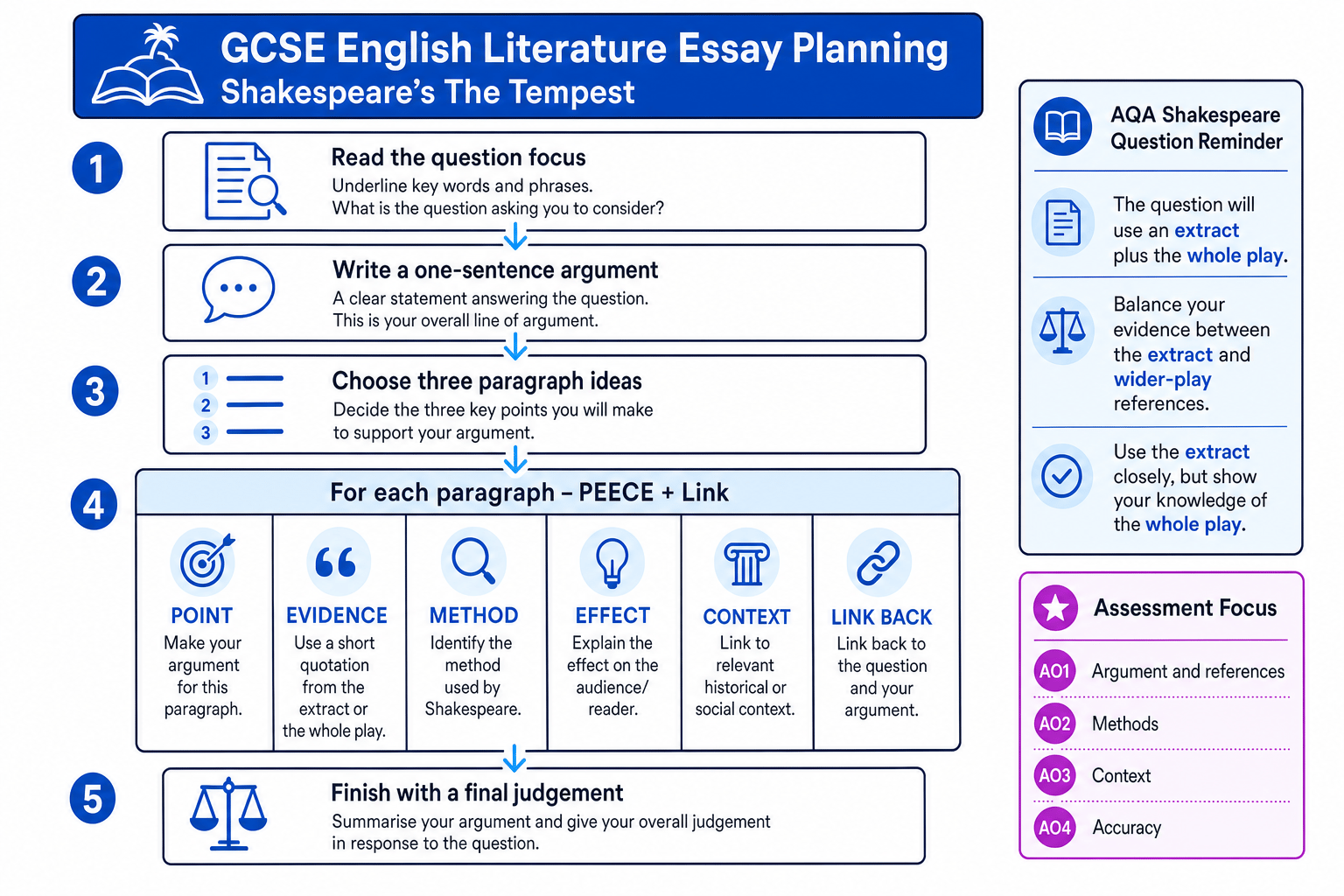
The planning rule
Plan the argument first, then choose the quotations. If you start with random quotations, your essay can become a list instead of a focused answer.
The AQA Shakespeare question
For The Tempest, the question gives you an extract, meaning a short passage from the play, and asks you to write about that extract and the play as a whole.
Because the exam is closed book, you will not have a copy of the whole play. You need a few short quotations you can remember accurately.
Whole-play evidence
Whole-play evidence means references to moments, characters, themes, or quotations from outside the printed extract.
You are being rewarded for a clear personal argument, close analysis of Shakespeare’s methods, relevant context, and accurate writing. On Shakespeare, spelling, punctuation and sentence control also matter.
Breaking down a question about power
Imagine the question is: Starting with this extract, explore how Shakespeare presents Prospero as powerful.
- Decide the focus: the key idea is Prospero’s power, not just Prospero generally.
- Decide the angle: Prospero’s power is not simple. He is a ruler, father, magician, victim of betrayal, and potential revenger.
- Build a whole-play route: begin with his control over Miranda and Ariel in Act 1 Scene 2, develop into his control over enemies through magic, and end with his choice to forgive and give up magic.
- Choose evidence that fits the route: for example, “I have done nothing but in care of thee” in Act 1 Scene 2, “My high charms work” in Act 3 Scene 3, and “I’ll break my staff” in Act 5 Scene 1.
Only writing about the extract
The phrase “Starting with this extract” does not mean “only write about this extract.” Use the extract closely, then widen out to the rest of the play.
Step 1: Create a thesis
Thesis
A thesis is your one-sentence overall argument in answer to the question.
Your thesis should be more interesting than “Shakespeare presents Prospero as powerful.” That just repeats the question. Instead, show development or tension.
A strong thesis often uses words like initially, however, ultimately, or although, because these help you create a line of argument.
Turning a theme into an argument
Question focus: How does Shakespeare present forgiveness in The Tempest?
- Start with the basic idea: Prospero has been wronged by Antonio, Alonso and Sebastian, so he has reasons to seek revenge.
- Add development: through Ariel’s compassion and Prospero’s own moral reflection, revenge becomes less attractive.
- Add Shakespeare’s bigger message: the play suggests that true power lies in mercy and self-control, not punishment.
- Shape the thesis: Shakespeare presents forgiveness as a difficult but morally superior choice, showing Prospero moving from control and revenge towards reconciliation.
Thesis sentence starter
Try: “Shakespeare presents [focus] as…, but also…, ultimately suggesting…” This helps you avoid a flat, one-sided essay.
Step 2: Choose a three-paragraph route
A strong GCSE essay usually needs three developed paragraphs. Each paragraph should make a different part of your argument.
Topic sentence
A topic sentence is the first sentence of a paragraph. It states the paragraph’s main point and links directly to the question.
For The Tempest, it is often helpful to plan in a beginning–middle–end structure, because many ideas change across the play: revenge becomes forgiveness, control becomes release, fear becomes wonder, and suffering becomes reconciliation.
Planning three paragraphs on forgiveness
Question focus: forgiveness and revenge
- Paragraph 1 could argue that Prospero begins in a position of control, using the tempest to bring his enemies to the island. This shows revenge as tempting because he has been politically betrayed.
- Paragraph 2 could show the turning point: Ariel says, “Mine would, sir, were I human” in Act 5 Scene 1, which encourages Prospero to recognise compassion.
- Paragraph 3 could argue that Prospero chooses forgiveness, saying “the rarer action is / In virtue than in vengeance” in Act 5 Scene 1, so Shakespeare presents mercy as the nobler form of power.
Step 3: Build each paragraph
A useful paragraph structure is point → evidence → method → effect → context → link.
Method
A method is a writer’s choice, such as imagery, symbolism, stagecraft, structure, contrast, repetition, or a character’s language.
In a play, you should also think about stagecraft, meaning the theatrical choices an audience would see or hear: entrances, exits, music, storms, magic, costume, silence, and spectacle.
Do not just name a method. Explain how it creates meaning.
Building a paragraph about Caliban
Question focus: How does Shakespeare present Caliban?
- Make the point: Shakespeare presents Caliban as oppressed because he believes Prospero has stolen his island and freedom.
- Choose evidence: Caliban says, “This island’s mine, by Sycorax my mother” in Act 1 Scene 2.
- Analyse method: the possessive pronoun “mine” shows Caliban claiming ownership, while the reference to “mother” gives his claim a personal and inherited basis.
- Explain effect: the audience may see Caliban not only as a “monster” but as someone with a grievance, making Prospero’s authority more morally complicated.
- Link context: early modern audiences were aware of exploration and colonisation, so the island setting raises questions about ownership, rule and exploitation.
- Link back: therefore, Shakespeare presents Caliban as both threatening and wronged, which prevents a simple judgement of him.
Device spotting
Do not write, “This is a metaphor, which makes it effective.” Always explain what idea the method creates and how it affects the audience’s view of the character or theme.
Flexible essay plans
Do not memorise these as full essays. Use them as adaptable routes. In the exam, you should reshape them around the exact wording of the question.
Plan 1: Prospero and power
| Paragraph | Argument | Evidence | Methods and effect |
|---|---|---|---|
| 1 | Prospero’s power begins as paternal and political control. | “I have done nothing but in care of thee” — Prospero, Act 1 Scene 2 | The caring tone suggests he sees control as protection, but he controls Miranda’s knowledge of her own past. |
| 2 | His magic gives him theatrical control over others. | “My high charms work” — Prospero, Act 3 Scene 3 | The noun “charms” and the staging of illusion show Prospero as a director-like figure manipulating events. |
| 3 | His greatest power is choosing mercy. | “I’ll break my staff” — Prospero, Act 5 Scene 1 | The staff symbolises magic; breaking it shows self-control and renunciation. |
Useful thesis: Shakespeare presents Prospero’s power as impressive but morally dangerous, ultimately suggesting that mercy is greater than domination.
Plan 2: Caliban and oppression
| Paragraph | Argument | Evidence | Methods and effect |
|---|---|---|---|
| 1 | Caliban claims a rightful connection to the island. | “This island’s mine” — Caliban, Act 1 Scene 2 | The blunt declarative sentence makes his claim direct and forceful. |
| 2 | Language becomes a symbol of control and resentment. | “You taught me language; and my profit on’t / Is, I know how to curse” — Caliban, Act 1 Scene 2 | The bitter contrast between “taught” and “curse” shows education becoming a weapon. |
| 3 | Shakespeare complicates Caliban through poetic sensitivity. | “the isle is full of noises” — Caliban, Act 3 Scene 2 | The lyrical description of the island challenges the audience’s expectation that Caliban is only savage. |
Useful thesis: Shakespeare presents Caliban as threatening and morally flawed, but also as a dispossessed figure whose language exposes the violence of Prospero’s rule.
Context balance
It is valid to discuss colonial ideas, exploration and ownership, but do not turn the whole essay into a history essay. Keep returning to Shakespeare’s language and stagecraft.
Plan 3: Forgiveness and revenge
| Paragraph | Argument | Evidence | Methods and effect |
|---|---|---|---|
| 1 | Prospero has reasons to seek revenge because he was betrayed. | “my library / Was dukedom large enough” — Prospero, Act 1 Scene 2 | The image shows his earlier withdrawal from politics, helping explain how Antonio seized power. |
| 2 | Ariel’s compassion prompts Prospero’s moral change. | “Mine would, sir, were I human” — Ariel, Act 5 Scene 1 | The irony is that a spirit teaches a human character humanity. |
| 3 | Prospero chooses forgiveness over vengeance. | “the rarer action is / In virtue than in vengeance” — Prospero, Act 5 Scene 1 | The contrast between “virtue” and “vengeance” makes forgiveness seem morally superior. |
Useful thesis: Shakespeare presents revenge as emotionally understandable but spiritually limiting, while forgiveness becomes the action that restores order.
Plan 4: Magic, theatre and illusion
| Paragraph | Argument | Evidence | Methods and effect |
|---|---|---|---|
| 1 | The storm immediately disrupts social order. | “What cares these roarers for the name of king?” — Boatswain, Act 1 Scene 1 | The personification of the waves as “roarers” shows nature, or Prospero’s magic, overpowering human hierarchy. |
| 2 | Prospero uses illusion to educate and control. | “Our revels now are ended” — Prospero, Act 4 Scene 1 | The masque reminds the audience that theatre itself is an illusion. |
| 3 | Prospero gives up magic at the end. | “I’ll drown my book” — Prospero, Act 5 Scene 1 | The book symbolises learned power; drowning it suggests release from control. |
Metatheatre
Metatheatre is when a play draws attention to itself as theatre. In The Tempest, Prospero’s illusions can make him seem like a playwright or director.
Useful thesis: Shakespeare presents magic as both beautiful and dangerous, using theatrical illusion to explore control, art, and the need to let go.
How to adapt a plan to the extract
The extract should usually shape your first paragraph. If the extract is from Act 1 Scene 2, for example, it might push you towards Prospero’s backstory, Miranda’s innocence, Ariel’s service, or Caliban’s anger.
Then your later paragraphs should move outwards to the whole play.
Adapting a Caliban plan to an Act 1 Scene 2 extract
- Use the extract for close detail: if Caliban says “This island’s mine,” focus on ownership, resentment and Prospero’s rule.
- Move to another moment that develops the idea: use “You taught me language” to show how control affects Caliban’s identity and speech.
- Complicate your argument: use “the isle is full of noises” from Act 3 Scene 2 to show that Caliban has poetic depth, not just aggression.
- End with judgement: Shakespeare makes Caliban disturbing, but also uses him to question whether Prospero’s authority is fully just.
Introductions and conclusions
Your introduction should be short. You do not need biography or a general statement like “Shakespeare was a famous writer.” Go straight to the question.
Strong introduction pattern:
Shakespeare presents [focus] as [main idea], developing this through [character or method], and ultimately suggesting [bigger message].
Strong conclusion pattern:
Ultimately, Shakespeare shows that [final judgement]. By the end of the play, [change or final image] reveals [message linked to the question].
Keep conclusions decisive
A conclusion should not introduce a brand-new quotation. It should sharpen your final judgement about the question.
In the exam
- Spend a few minutes planning your thesis, three paragraph focuses, and two or three remembered whole-play quotations.
- Start with the extract, but keep widening your answer to the play as a whole.
- In every paragraph, connect Shakespeare’s method to meaning: language, stagecraft, structure, symbolism, or contrast.
- Add context only where it deepens analysis, such as hierarchy, monarchy, patriarchy, exploration, or Jacobean beliefs about magic.
- Leave time to check expression, punctuation and quotation accuracy, because AO4 is assessed on the Shakespeare question.
Check yourself
- Can you write a one-sentence thesis for a question about Prospero’s power?
- Can you plan three paragraphs on Caliban without simply retelling Act 1 Scene 2?
- Can you explain how one method, such as symbolism or stagecraft, shapes the audience’s view of forgiveness?
