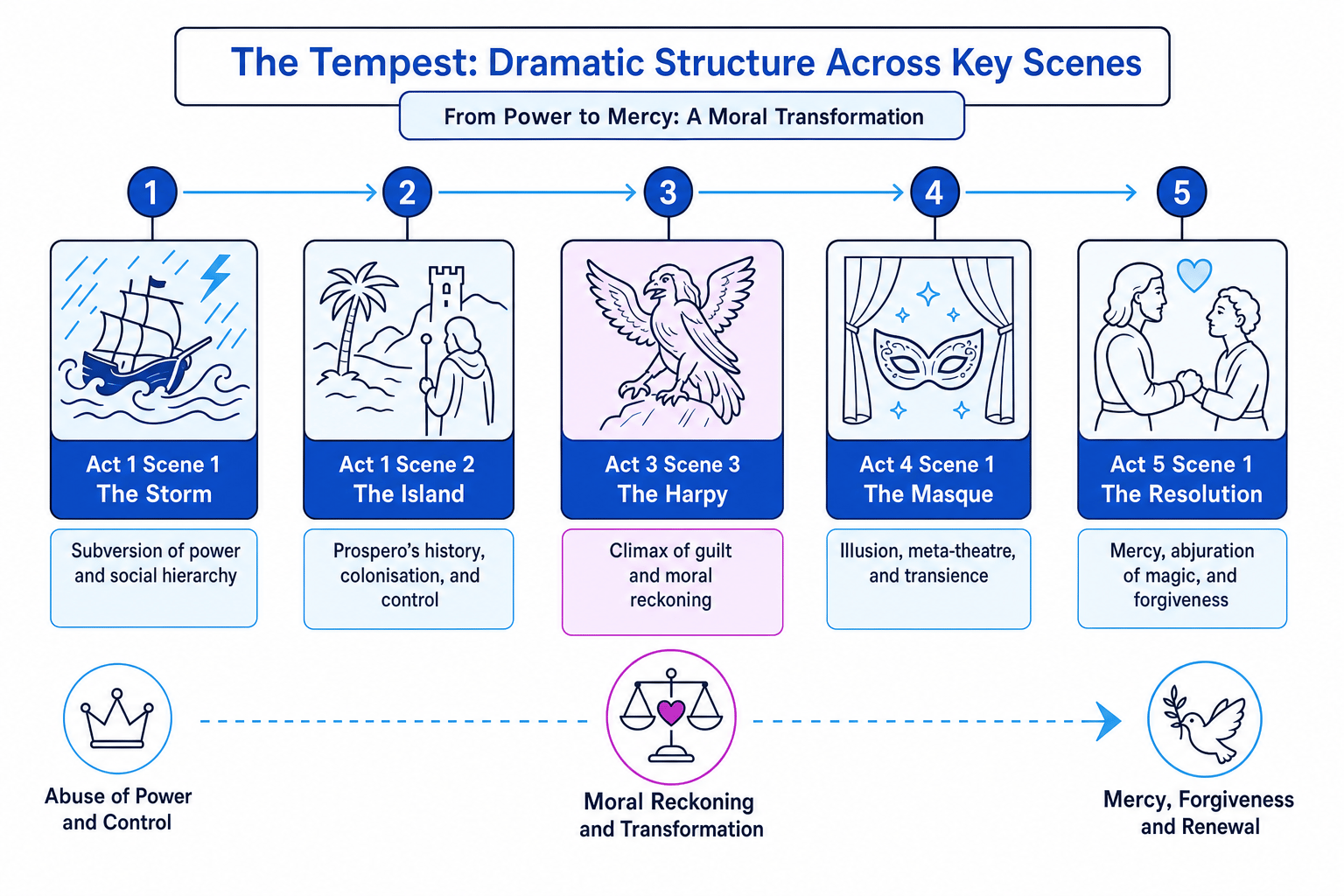
Key Scene 1: Act 1, Scene 1 — The Tempest (The Storm)
What happens?
The play opens mid-storm. A ship carrying Alonso (the King of Naples), Sebastian, Antonio, and Ferdinand is being tossed by a violent tempest. Onboard, the Boatswain takes charge, ordering the aristocrats out of his way so he can save the ship.
Why is it important?
This scene immediately establishes the theme of power and the subversion of social hierarchy.
In the Jacobean era, the Divine Right of Kings dictated that the monarch was chosen by God and sat at the top of the social hierarchy. Yet, in the face of nature’s fury (or Prospero's engineered storm), the King’s authority is utterly useless.
- The Boatswain bluntly challenges the nobles:
"What cares these roarers for the name of king? To cabin! silence! trouble us not."
- The "roarers" (the violent waves) do not care about royal titles. Nature is an egalitarian force that levels all social distinctions.
- This scene also introduces the motif of tempestuous noise and chaos, which contrasts sharply with the "solemn and strange music" that Prospero uses to restore order later in the play.
The Storm as a Political Equaliser
The tempest is not just a special effect; it is a structural device that strips the nobles of their societal power. It forces them to enter the island naked of their titles, leaving them vulnerable to Prospero's moral and psychological re-education.
Key Scene 2: Act 3, Scene 3 — The Banquet and Ariel as a Harpy
What happens?
Alonso, Antonio, and Sebastian (the "three men of sin") are exhausted and starving. Prospero uses his magic to present them with a magical, phantom banquet, only to make it vanish. Ariel then descends as a Harpy (a monstrous creature from classical mythology with a woman's face and bird's body) to pronounce judgment upon them.
Why is it important?
This is the climax of the plot's rising action and the emotional core of Prospero’s revenge plan.
- Ariel’s speech is designed to induce profound guilt and trigger a psychological transformation in the conspirators:
"You are three men of sin, whom Destiny... Hath caused to belch up you."
- Shakespeare uses the Harpy—a symbol of divine vengeance and raw appetite—to show that their past crimes (usurping Prospero and abandoning him and Miranda at sea) have disrupted the natural order.
- Ariel warns them that "lingering perdition" (slow destruction) will follow them unless they show "heart-sorrow" (sincere repentance) and live a "clear life" (pure life) hereafter.
Mistaking Ariel's Agency
Do not write that Ariel is acting out of his own anger here. Ariel is a direct extension of Prospero’s will. Prospero is watching the entire scene from "on high" (the gallery above the stage), acting as the invisible dramatist directing this terrifying moral theater.
Key Scene 3: Act 4, Scene 1 — The Masque and Prospero's Revels Speech
What happens?
To celebrate the betrothal of Ferdinand and Miranda, Prospero commands Ariel to perform a masque (a lavish courtly entertainment featuring song, dance, and mythical figures). Goddesses (Iris, Ceres, and Juno) bless the couple. Suddenly, Prospero remembers Caliban’s conspiracy to murder him. He abruptly cuts the performance short and delivers his most famous soliloquy.
Why is it important?
This scene highlights the theme of illusion vs. reality and the concept of meta-theatre (theatre that comments on its own nature as a play).
- A Jacobean audience would recognize the masque as a highly stylized form of court entertainment popular during the reign of King James I. Prospero uses it to showcase his god-like control over nature and spirits.
- However, Prospero's sudden realization that his magic cannot stop real-world threats (Caliban's plot) shatters the illusion.
- His subsequent speech is deeply melancholic and philosophical:
"Our revels now are ended. These our actors... Were all spirits and / Are melted into air, into thin air... We are such stuff / As dreams are made on, and our little life / Is rounded with a sleep."
- Here, Shakespeare draws a parallel between the fleeting nature of theatrical illusions ("this insubstantial pageant faded") and the temporary nature of human life itself. It foreshadows Prospero's ultimate decision to give up his magic.
Key Scene 4: Act 5, Scene 1 — The Resolution and Abjuration of Magic
What happens?
Ariel tells Prospero that the conspirators are confined, sorrowful, and that if Prospero saw them, his "affections / Would become tender." Prospero realizes that if Ariel—a spirit of air—can feel empathy, he, a fellow human, must show mercy. He resolves to forgive them, abjures (renounces) his magic, breaks his staff, and drowns his book.
Why is it important?
This is the denouement (resolution) of the play. It marks Prospero's transition from a vengeful tyrant to a merciful, human ruler.
- Prospero declares:
"The rarer action is / In virtue than in vengeance."
- The word "rarer" carries a double meaning: it means both more noble and more uncommon.
- To truly heal the political and personal wounds of the past, Prospero must relinquish his absolute control. His magic has isolated him from humanity; to return to Milan as Duke, he must step down from his god-like pedestal.
- He promises to destroy the tools of his magic:
"But this rough magic / I here abjure... I’ll break my staff... I’ll drown my book."
- The adjective "rough" suggests that Prospero now recognizes his magic as violent, unnatural, and ultimately destructive to his own soul.
The Shakespearean Farewell
Many literary critics view Prospero's abjuration of magic as Shakespeare’s personal farewell to the theatre. The Tempest was one of Shakespeare's final plays, and when Prospero "drowns his book," it is easy to imagine Shakespeare laying down his pen. Mentioning this biographical context (AO3) can add real sophistication to your essay!
Worked Example: Analysing a Key Passage
Let's look at how to construct a high-scoring analytical paragraph (AO1, AO2, AO3) based on a key passage.
Suppose you get an exam question asking: How does Shakespeare present Prospero's attitude toward revenge and forgiveness in The Tempest?
Here is a step-by-step walkthrough of how to plan and write your analysis of the transition in Act 5, Scene 1.
Analysing Prospero's transition from vengeance to virtue
-
State a clear thesis point (AO1)
Your opening sentence must directly answer the prompt by identifying the shift in Prospero's mindset.
Drafting your point: In the play's final act, Shakespeare presents Prospero as a ruler who recognizes that true nobility lies in mercy rather than retribution, shifting his pursuit from absolute vengeance to moral reconciliation. -
Embed precise textual evidence (AO1)
Integrate a short, relevant quotation seamlessly into your sentence.
Selecting evidence: Prospero asserts that "the rarer action is / In virtue than in vengeance," showing his conscious decision to choose forgiveness. -
Identify and analyse the writer's methods (AO2)
Examine the language, structural contrast, and sound devices Shakespeare uses.
Analysing the methods: Shakespeare uses the alliterative contrast of "virtue" and "vengeance" to highlight the polar opposites of Prospero's choices. The comparative adjective "rarer" elevates "virtue" as the superior moral path, suggesting that while revenge is a common, base human impulse, showing mercy requires a rarer, more divine strength. -
Link your analysis to context and the play's wider themes (AO3)
Connect the language choices back to Jacobean beliefs and the play's overarching message.
Making the contextual connection: This ethical transformation aligns with the Christian humanism of the Jacobean era, which prized mercy over the cycle of blood-revenge. Furthermore, by choosing "virtue," Prospero restores the natural and social hierarchy that was disrupted by his usurpation, demonstrating that a true prince must rule with justice tempered by Christian charity.
Exam Strategy and Pitfalls
Watch Your Spelling and Grammar (AO4)
The Tempest is your Shakespeare essay, which means AO4 (SPaG) is assessed here. You can lose easy marks if you misspell key terms. Make sure you can spell "Prospero", "Ariel", "Caliban", "soliloquy", "masque", and "usurper" correctly under timed conditions.
Ignoring the Dramatic Context
A common pitfall is treating the play like a novel. Do not write: "This shows Prospero is a bad person..."
Instead, refer to Shakespeare's conscious design: "Shakespeare structures the scene to evoke a sense of..." or "Through the dramatic medium of the masque, Shakespeare explores..." Always remember it is a play written for performance!
In the exam
- Focus on structural relationships: When discussing a key scene, always show how it contrasts with another. For example, contrast the chaotic storm of Act 1, Scene 1 with the harmonious music and forgiveness of Act 5, Scene 1.
- Track the transitions: Examiners love to see you track a character’s development. Show how Prospero's language transitions from harsh commands and threats of torture in Act 1 to soft, lyrical poetry and expressions of empathy in Act 5.
- Integrate context naturally: Never just "dump" historical facts into your essay. Always tie context (such as the Divine Right of Kings or Jacobean colonial anxieties) directly to the specific words and actions of the characters in the scene you are analyzing.
Check yourself
- Can you explain how the classical unity of time heightens the dramatic tension of Prospero's final hours on the island?
- Why does Ariel appear specifically as a Harpy in Act 3, Scene 3, and what impact does this have on Alonso?
- What does Prospero's decision to "drown his book" tell us about his views on the compatibility of magic and human leadership?
