In the GCSE English Literature exam, you are not just assessed on what happens in Dennis Kelly’s DNA (the plot), or who does it (the characters). You are assessed heavily on AO2: your ability to analyse the writer's craft.
Because DNA is a play, Kelly does not write paragraphs of description. Instead, he uses dramatic methods—the tools of playwrighting—to shape the audience's emotional response, construct themes, and reveal character psychology.
What you'll learn
- How Kelly uses a cyclical structure and repeating settings to construct a sense of inevitability and entrapment.
- How to analyse linguistic patterns, such as staccato dialogue, overlapping speech, and Pinteresque pauses.
- How to decode stage directions to reveal hidden power dynamics and psychological distress.
- How to write high-scoring analysis by linking physical actions to broader thematic concepts.
1. Setting and Cyclical Structure
One of Kelly's most powerful dramatic methods is his control of space and time. Unlike traditional plays that feature highly detailed domestic sets, DNA uses a minimalist, starkly repetitive structure.
The play is divided into four acts, and each act cycles through three specific, recurring locations.
Cyclical Structure
A cyclical structure is a narrative or dramatic pattern where events, locations, or themes repeat themselves, returning to the starting point. In DNA, this emphasizes the characters' inability to escape their actions or grow morally.
These three settings are:
- A Street: The gateway. This is where Jan and Mark meet to relay information. It acts as the exposition of each movement of the play.
- A Wood: The dark heart of the play. The woods are isolated, lawless, and removed from adult supervision. This is where the gang's conspiracies are formed and where their violent acts (and choices) occur.
- A Field: The space for contemplation and intimacy. This is where Leah delivers her monologues to Phil, seeking connection and questioning their morality.
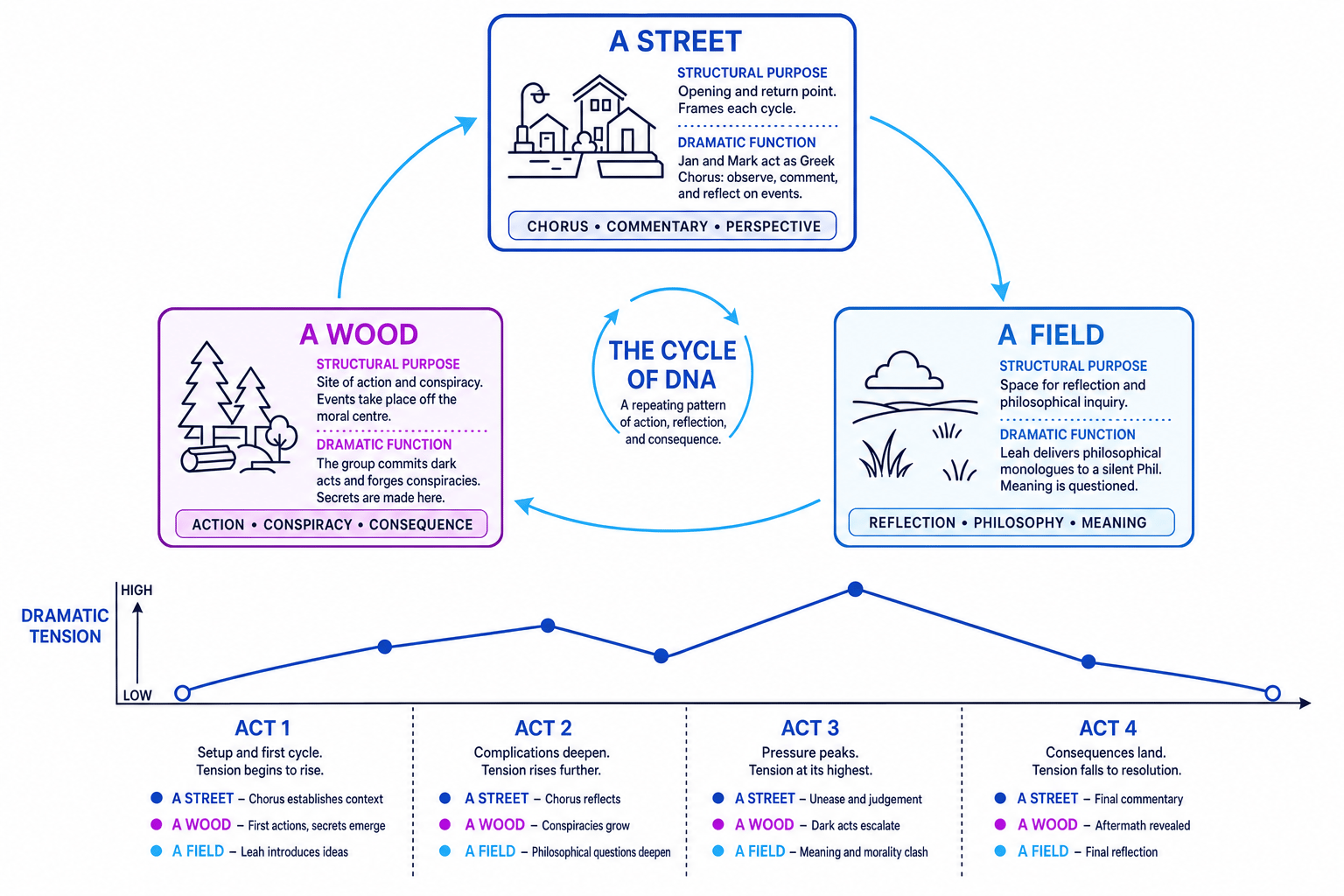
By constantly cycling through these three spaces, Kelly creates a claustrophobic sense of inevitability. The characters are trapped in an endless loop of crime, cover-up, and consequence. They can never truly move forward because their moral choices keep dragging them back to the same spaces.
Setting as Symbol
Don't just view the setting as a physical location. Treat it as a psychological landscape. The wood represents the subconscious, wild, animalistic side of human nature, while the street represents the boundary of the civilized, domestic world.
2. Dialogue and Speech Patterns
Dennis Kelly uses highly realistic, fragmented speech to mirror the anxiety, guilt, and social hierarchies of teenagers under pressure. You must learn to identify and analyse three key dialogue techniques:
A. Staccato Dialogue and Overlapping Speech
Characters in DNA rarely speak in polished, poetic sentences. Instead, they interrupt, hesitate, and repeat themselves.
Staccato Dialogue
Staccato dialogue refers to rapid, short, blunt lines of speech. It mimics natural, panicked conversation and is used to increase dramatic tension.
At the start of the play, Jan and Mark speak in highly fragmented, overlapping lines:
JAN: Dead? MARK: Yeah. JAN: What, dead? MARK: Yeah. JAN: Is he dead? MARK: Yes.
Kelly uses this rapid-fire pacing to pull the audience directly into the group's panic. The stichomythia (alternating single lines of dialogue) conveys their breathless urgency, making the audience feel the sheer speed at which their situation is spiralling out of control.
B. Monologue vs. Silence (Leah and Phil)
The dynamic between Leah and Phil is structured around a stark linguistic contrast: Leah's desperate, intellectual monologues versus Phil's absolute silence.
Leah speaks to fill the empty space, desperate for reassurance, validation, and moral guidance. She jumps from topic to topic—from chimpanzees and bonobos to "the beauty of the planet"—symbolising her frantic search for order and meaning in a chaotic situation.
Phil, on the other hand, says nothing. His silence is a powerful dramatic method. It is not passive; it is an active exercise of power. By withholding speech, he forces Leah to exhaust herself, while he quietly assesses the situation and maintains complete control.
Silence as Power
In drama, the character who speaks the least often holds the most power. Phil's silence acts as an emotional void that Leah tries to fill, demonstrating how intellectual moralizing (Leah) is constantly overpowered by cold, calculated pragmatism (Phil).
3. Stage Directions and Prop Symbolism
Because DNA is written for performance, some of the most critical character insights are hidden inside Kelly's stage directions.
Ignoring the Stage Directions
Many students only quote the spoken lines of dialogue in their essays. To achieve the highest marks (AO2), you must analyse stage directions. They are conscious dramatic choices made by Kelly to convey meaning without words.
Phil's Eating Habits
Throughout Acts 1, 2, and 3, Kelly includes specific, repeating stage directions showing Phil eating junk food while major crises are discussed:
- "(Phil is eating a waffle)"
- "(Phil is eating a bag of crisps)"
- "(Phil is eating ice cream)"
These actions are highly symbolic. Eating is a basic survival instinct. While the rest of the group is vomiting or panicking over Adam's apparent death, Phil is calmly consuming calories. This shows his psychopathic detachment, his absolute lack of empathy, and his primal, animalistic focus on self-preservation.
When Phil finally stops eating in Act 4, it signals to the audience that his control is slipping and the group's hierarchy has collapsed.
Deconstructing Kelly's Stage Directions
Let's look at how to construct a high-level analytical paragraph focusing on Kelly's stage directions.
Task: Analyse how Dennis Kelly uses stage directions to present the character of Phil in Act 2.
- State your point clearly, linking the dramatic method to character and theme: Kelly uses physical, non-verbal stage directions to establish Phil’s cold detachment and sociopathic control over the group during times of extreme crisis.
- Introduce and embed your evidence, referencing the dramatic method: This is evident in Act 2 when the group panics over the framing of an innocent man. While the others spiral, Kelly includes the stage direction: "(Phil is chewing a piece of fruit)".
- Analyse the specific language and structural choice (AO2): The verb "chewing" creates a striking sensory contrast between the frantic, staccato dialogue of the group and Phil’s slow, rhythmic physical consumption. By focusing on a basic physical appetite, Kelly highlights Phil's profound lack of empathy. He is entirely unaffected by the moral weight of their conspiracy, treating their panic with the same mundane indifference as eating a piece of fruit.
- Link the method and its effect to the wider context or theme (AO3): This action emphasizes the theme of animalistic survival. Like the predatory chimpanzees Leah describes, Phil is driven by instinctual dominance rather than human morality. His ability to eat while plotting the destruction of an innocent life cements his status as a cold, calculating leader who values pack order over individual humanity.
4. The Modern "Greek Chorus"
In ancient Greek tragedy, a "Chorus" was a group of actors who commented on the moral themes and plot developments of the play, standing somewhat outside the main action to provide perspective to the audience.
Dennis Kelly adapts this classical dramatic method by using Jan and Mark as a modern, urban Greek Chorus.
Greek Chorus
A Greek Chorus is a dramatic device where characters observe and comment on the central action of a play, helping the audience process the moral and social implications of the narrative.
Jan and Mark open almost every act. They meet on "A Street"—the neutral threshold—to catch the audience up on what has happened off-stage.
Why does Kelly do this?
- To bypass stage limitations: We do not see Adam being pelted with stones, nor do we see him falling down the shaft. Instead, Jan and Mark describe it. This forces the audience to use their imagination, which often makes the violence feel far more chilling.
- To show collective guilt: Jan and Mark speak almost as a single unit, frequently completing each other's sentences. They represent the "group-mind" or collective consciousness. They are complicit but try to distance themselves from the blame by constantly asking, "Are we bad?"
In the exam
When writing about dramatic methods in DNA, use the following strategies to secure top marks:
- Avoid "Device Spotting": Never just name a technique (e.g., "Kelly uses a pause here"). You must always explain the effect of that technique on the audience and how it relates to Kelly’s wider thematic intentions (such as the dangers of conformity or the loss of adolescent innocence).
- Incorporate stage directions as quotes: Write things like "(Phil puts his arm around her)" directly into your essays as evidence of power, intimacy, or manipulation.
- Structure by dynamic, not just chronologically: Show how the relationship between silence and speech shifts. For example, contrast Leah's verbal dominance in Act 1 with her final, devastating silence at the end of Act 3 before she leaves the group permanently.
Check yourself
- Why does Kelly set the conspiratorial scenes in "A Wood" rather than a classroom or a living room?
- What does the transition from Phil's absolute silence in Act 1 to his direct, threatening speech in Act 3 ("If you don't help us we'll kill you") tell us about his character?
- How do Jan and Mark's short, repetitive questions (like "What are we going to do?") prepare the audience for the mood of each act?
