

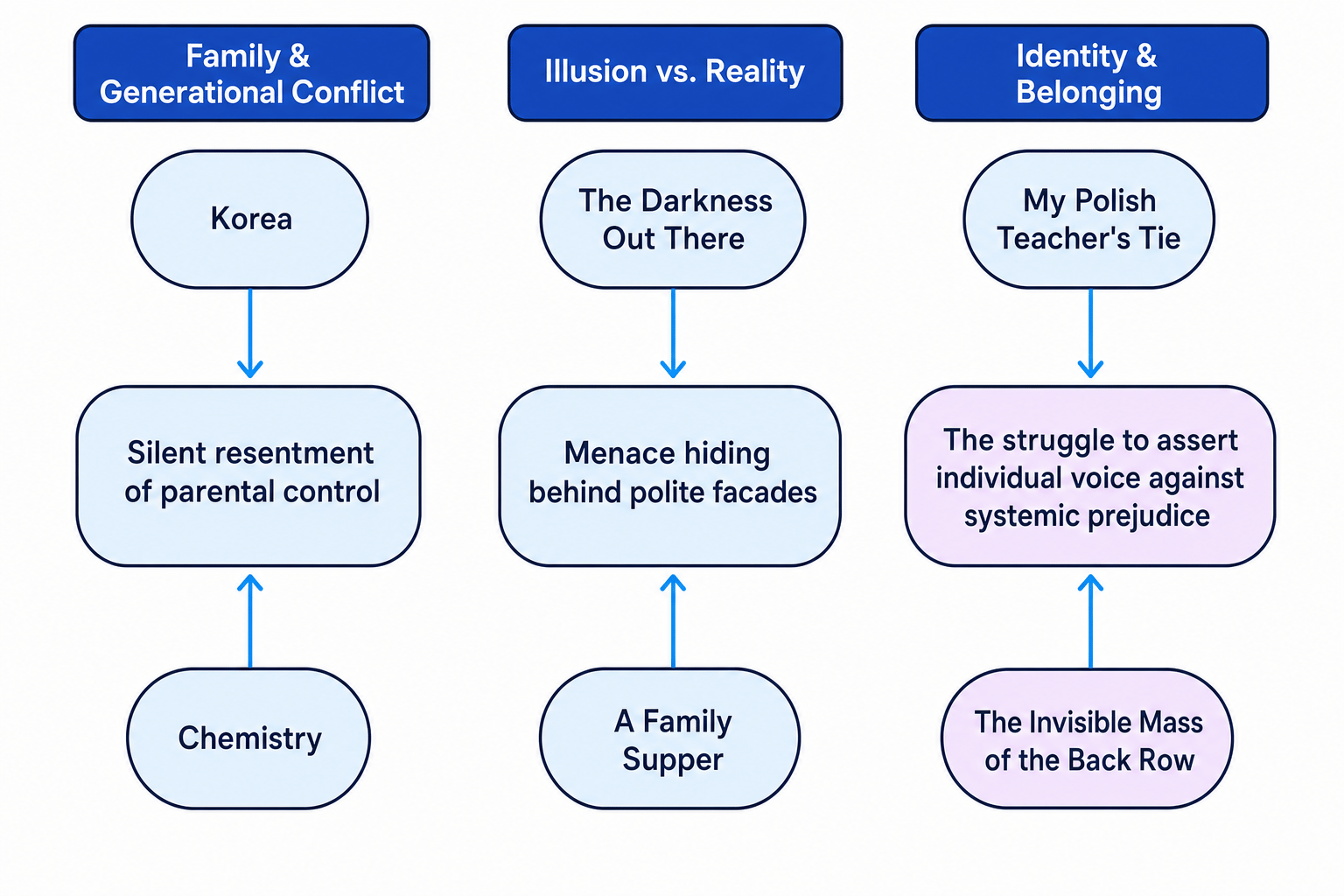
The Art of Synthesising Analytical Points
To write a high-scoring comparative paragraph, you must build a conceptual bridge between your two chosen stories. You do this through a comparative synthesis.
Comparative Synthesis
A comparative synthesis is the process of combining separate details from two different texts into a single, cohesive analytical point that reveals a deeper shared meaning or structural purpose.
Rather than analyzing Story A, stopping, and then analyzing Story B, you should structure your paragraph using an alternating model (often called the "Weave" method).
The Weave Method Structure:
- Comparative Topic Sentence: Introduce a shared thematic concept or structural device present in both texts.
- Analysis of Text A: Detail a key quote, name the writer's method (AO2), and explain the psychological or thematic effect.
- Transition / Comparative Pivot: Use a discourse marker (e.g., similarly, conversely, in contrast, whereas) to pivot to Text B.
- Analysis of Text B: Detail a key quote, analyze the method (AO2), and explain its effect.
- Synthesis / Contextual Conclusion: Bring both texts together by explaining why both writers explored this theme, linking to their respective contexts (AO3).
Guided Practice: Designing a Comparative Paragraph
Let’s walk through the exact intellectual steps required to construct a top-tier comparative paragraph. We will compare the presentation of tension in family relationships in John McGahern's 'Korea' and Graham Swift's 'Chemistry'.
Comparing family conflict in 'Korea' and 'Chemistry'
-
Formulate a unified, conceptual comparative topic sentence.
- Drafting process: Instead of saying "Both stories have family arguments," identify how the writers depict these dynamics. Look for a shared abstract concept. In both 'Korea' and 'Chemistry', family tension is represented not by loud shouting, but by silence, physical distance, and underlying economic or psychological undercurrents.
- Resulting sentence: "Both McGahern in 'Korea' and Swift in 'Chemistry' depict familial relationships fraught with unspoken tension, where silence becomes a tool of emotional distance and control."
-
Select and analyze a precise micro-quotation from Story A ('Korea').
- Evidence: The father and son sit together, but their connection is broken. The father looks at his son and narrows his eyes "in a calculation."
- Analysis: McGahern uses the noun "calculation" to reveal that the father is viewing his son through a cold, financial lens—valuing him for the "draft-money" he would receive if the boy died in the Korean War. This shows how patriarchal authority and poverty corrupt natural parental love.
-
Select a comparative transition word and link to Story B ('Chemistry').
- Transition selection: Because both stories use silence and subtext, we want a comparative marker of similarity, such as "Similarly" or "In a parallel manner".
- Resulting pivot: "Similarly, Swift uses structural geometry to illustrate a parallel sense of calculated emotional distance in 'Chemistry'."
-
Select and analyze a precise micro-quotation from Story B ('Chemistry').
- Evidence: The boy describes his family unit as a "three-way equation" (mother, grandfather, and boy) that is disrupted by the introduction of Ralph.
- Analysis: Swift uses the mathematical metaphor "equation" and the chemical noun "chemistry" to depict a family dynamic that is clinical and fragile. The introduction of Ralph acts as an external catalyst, disrupting the delicate equilibrium. Like the father in 'Korea', the adults here prioritize their own desires over genuine emotional communication with their children.
-
Synthesise both analyses with an overarching contextual conclusion (AO3).
- Context integration: Think about the historical pressures in each story. In 'Korea', it is the legacy of Irish poverty and the shadow of emigration/war. In 'Chemistry', it is the changing landscape of late-20th-century family units and the isolation of the older generation (the grandfather).
- Synthesis conclusion: "Ultimately, both authors suggest that post-war societal pressures warp domestic spaces; while McGahern’s rural Irish father is driven by economic desperation to commodify his son's life, Swift's modern characters retreat into clinical, silent isolation to shield themselves from the pain of change."
Avoid 'Device-Spotting'
Do not simply list techniques. Writing "McGahern uses a metaphor and Swift uses a simile" scores very low. Instead, focus on meaning: "Both writers use scientific or transactional imagery to show that family love has been corrupted." Identify the method, but always anchor it to the characters' psychological realities.
Constructing Comparative Transitions
Your choice of comparative transitions (discourse markers) signals to the examiner that you are actively comparing, not just summarizing. Do not rely solely on "but" and "also". Use sophisticated vocabulary to show deep conceptual awareness.
Transitions of Similarity (for comparing parallel ideas):
- Correspondingly: "Correspondingly, the narrator in 'My Polish Teacher's Tie' also experiences..."
- In a parallel fashion: "In a parallel fashion, the domestic setting in 'A Family Supper' becomes..."
- Mirroring this technique: "Mirroring this structural technique, Swift utilizes..."
- Equally, both writers: "Equally, both writers employ pathetic fallacy to..."
Transitions of Difference (for contrasting contrasting ideas):
- Conversely: "Conversely, while McGahern’s protagonist seeks escape, Williams' character is..."
- Whereas: "Whereas the threat in 'The Darkness Out There' is hidden behind a sugary, domestic facade, the menace in 'A Family Supper' is..."
- This diverges from: "This overt prejudice diverges sharply from the subtle, institutionalized marginalization seen in..."
- On the other hand, a crucial distinction lies in: "On the other hand, a crucial distinction lies in how the two narrators resolve their identity crises..."
The 50/50 Split Trap
A common mistake is writing way too much about the first story (usually the one named in the exam paper) and running out of time to write anything substantial about the second story. Aim for a balanced 50/50 split in your analysis. If you write three detailed paragraphs about Story A, you must write three equally detailed paragraphs about Story B.
Do Not Force False Comparisons
While you must find links, do not ignore the massive differences between the texts. Sometimes, the most sophisticated comparative analysis highlights a contrast. For example, both 'My Polish Teacher's Tie' and 'The Invisible Mass of the Back Row' deal with cultural identity, but while Carla finds a sense of connection and hope through Stefan's tie, Hortense remains isolated and silenced by her colonial education. Acknowledging these nuances shows high-level critical thinking (AO1).
In the exam
If you choose to write on Telling Tales, follow this strategy on exam day:
- Deconstruct the prompt immediately: Identify the named story and the central theme (e.g., "Compare how writers present outsiders in 'My Polish Teacher's Tie' and one other story").
- Select your second story strategically: Do not just choose your "favorite" story. Choose the one that has the most direct thematic overlap or contrast with the named story.
- Draft a quick comparative grid: Take 3 minutes to jot down a three-step plan:
- Point 1 (Similarities in character motivation/feelings)
- Point 2 (Similarities or differences in key methods/symbols used)
- Point 3 (Differences in the final messages or resolutions)
- Write a comparative thesis statement: Your introduction must mention both stories and outline your overarching argument about the specified theme.
- Keep your quotes short: Because the exam is closed-book, rely on memorable 1-to-3-word micro-quotations (like "cold chemistry" or "calculation") that you can easily weave into your sentence structures.
Check yourself
Before sitting your mock exams, make sure you can answer these questions:
- Can you list three distinct comparative discourse markers that express contrast, and three that express similarity?
- If the exam prompt names 'The Darkness Out There' and asks you to compare how "appearances can be deceptive," which second story from the anthology would you pair it with, and why?
- What is the danger of writing about your first selected story entirely in the first half of your essay, and your second story entirely in the second half?
