

In Anita and Me, Meera Syal paints a vibrant, semi-autobiographical picture of growing up in the 1970s. While the novel is full of humour and warmth, it tackles complex social, political, and personal ideas. To secure a top grade in your GCSE, you must look beyond the plot and understand how Syal uses her characters and settings to explore deep thematic questions.
What you'll learn:
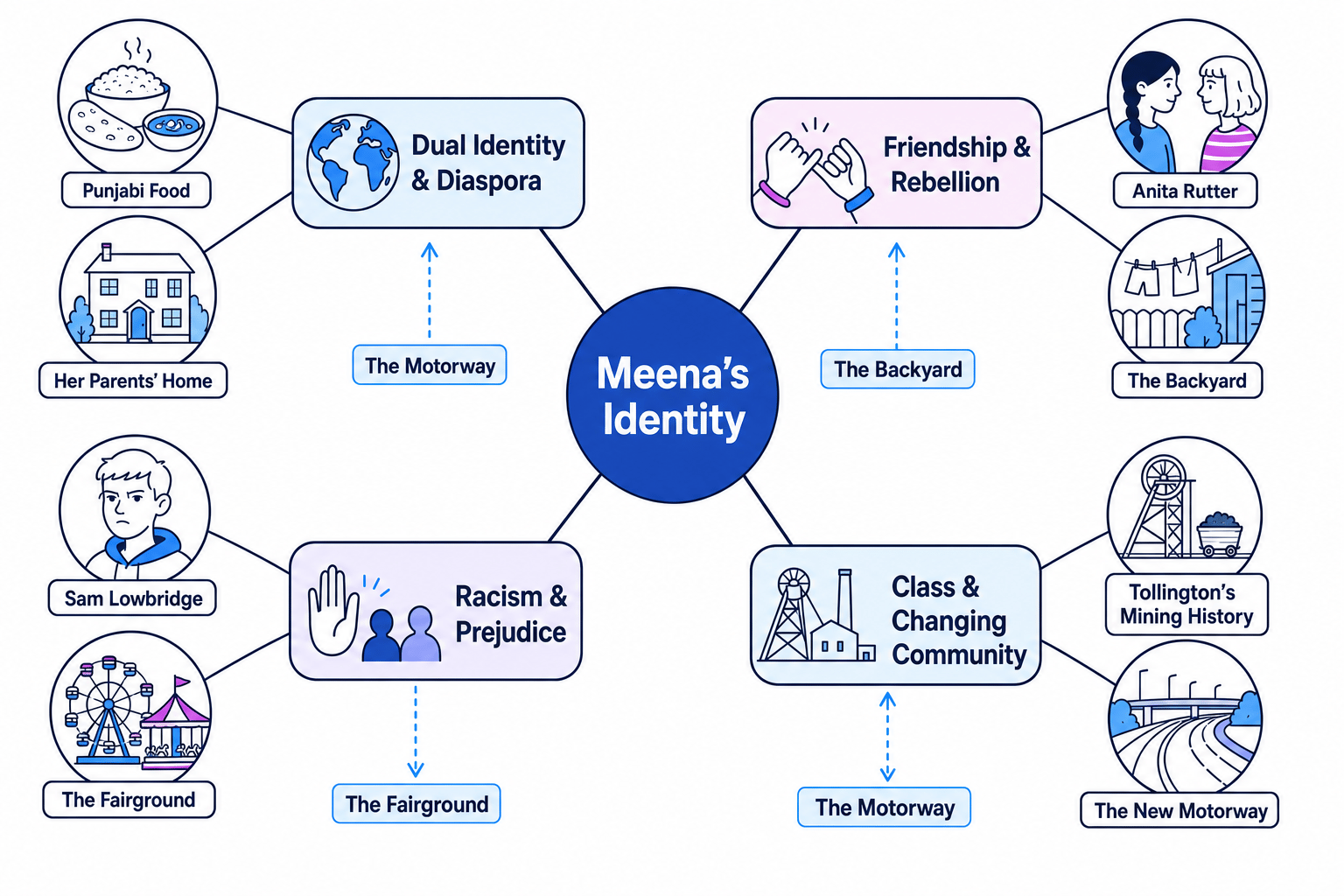
- How Meena navigates the complexities of her dual Punjabi and British identity.
- How Syal exposes both casual and systemic racism in 1970s working-class Britain.
- Why the toxic friendship between Meena and Anita is essential to Meena's coming-of-age journey.
- How the physical transformation of Tollington reflects wider shifts in class and community.
Identity and Belonging
At the heart of the novel is Meena’s struggle to understand who she is. As the daughter of first-generation Indian immigrants living in a working-class Midlands mining village, Meena is constantly caught between two different worlds.
Diaspora
The diaspora refers to a dispersion of people from their original homeland. In the novel, Meena's family is part of the Punjabi diaspora, maintaining their cultural traditions, food, and language while living in England.
Meena's internal conflict is what we call a struggle with dual identity. Inside her home, she is surrounded by Punjabi warmth, traditional food, and the high educational aspirations of her parents, Shyam and Daljit. Outside her home, she desperately wants to fit in with the local Tollington kids, particularly Anita Rutter, who represents a world of independence, rebellion, and working-class English grit.
Syal uses food as a powerful sensory motif to highlight this cultural divide:
- Punjabi food (samosas, parathas) represents comfort, family, and her parents' heritage.
- English food (fish and chips, jam ring biscuits) represents her desire for assimilation and "fitting in" with the locals.
At the start of the novel, Meena views these two identities as mutually exclusive. She often feels like an outsider in both settings, describing herself as a "fictional character" she has invented to survive. However, as she matures, she begins to realize that she does not have to choose one over the other; she can forge a unique identity that blends both.
The hyphenated identity
Meena's journey is not about choosing between being Indian or British. It is about accepting her position as a British-Asian—a unique identity that allows her to look at both cultures with a critical and appreciative eye.
Racism and Prejudice in 1970s Britain
Syal does not shy away from the harsh realities of racism in 1970s Britain. The novel is set in a period of economic decline, where xenophobic political rhetoric (such as Enoch Powell's "Rivers of Blood" speech) was actively dividing communities.
Casual Racism
Casual racism refers to everyday expressions of racial prejudice, stereotypes, or off-hand discrimination that are normalized in daily life, often disguised as "jokes" or harmless remarks.
In the novel, racism is depicted across a spectrum, from the casual to the violently overt:
- Casual prejudice: Characters like Meg and the local shopkeepers make offensive comments without even realizing they are being hurtful. They see Meena's family as "different" but "the good ones," which highlights how deeply ingrained racial hierarchies were.
- Overt and systemic racism: This peaks with the character of Sam Lowbridge. Sam, who Meena initially views as a romanticized rebel, becomes the mouthpiece for far-right, anti-immigrant sentiment. His speech at the spring fair—where he tells immigrants to "go back to where you came from"—shatters Meena's illusion of safety in Tollington.
Syal shows how racism acts as a catalyst for Meena’s loss of innocence. The most painful realization for Meena is that her "best friend" Anita complicitly accepts, and even mimics, this racism. Anita’s casual use of racial slurs forces Meena to recognize that her friendship cannot survive if her very existence is denigrated by the community she tried so hard to belong to.
Friendship, Rebellion, and Growing Up
Anita and Me is a classic example of a Bildungsroman.
Bildungsroman
A Bildungsroman is a literary genre that focuses on the psychological and moral growth of the protagonist from youth to adulthood (a "coming-of-age" novel).
The engine of Meena's maturation is her friendship with Anita Rutter. At the beginning of the novel, Meena is infatuated with Anita. To Meena, Anita is the "leader of the pack"—effortlessly cool, defiant, and free from the strict parental boundaries that Meena chafes against. Meena romanticizes Anita's neglectful upbringing, mistaking a lack of parental care for freedom.
However, as Meena grows, her perspective shifts. She begins to see the cracks in Anita's life:
- Anita's mother, Deirdre, is distant and eventually abandons her family.
- Anita's bravado is a shield for deep-seated insecurity, poverty, and a lack of future prospects.
- Anita's world is narrow and ultimately destructive.
The turning point occurs when Meena breaks her leg and is physically separated from Tollington. During her hospital stay and subsequent recovery, she discovers the joy of reading, academic ambition, and her own creative voice. When she returns, she has outgrown Anita. The friendship ends not with a dramatic fight, but with a quiet realization that their paths have diverged permanently.
Anita as a mirror
Think of Anita as a funfair mirror. Early on, Meena looks into her and sees a exciting, distorted version of who she wants to be. By the end of the novel, Meena sees through the glass to the sad, limited reality of Anita's life, realizing she no longer needs that distortion to define herself.
Class and the Changing Community
Tollington is a working-class mining village undergoing a massive physical and economic transition. The decline of the coal mines represents the death of an old way of life.
Social Mobility
Social mobility is the movement of individuals or families between different social strata or classes. It is often achieved through education and professional advancement.
Syal contrasts two different social trajectories in the novel:
- The Kumar Family (Upwardly Mobile): Shyam and Daljit are highly educated. Despite facing professional barriers due to racism, they value education as the key to success. By the end of the novel, they move away from Tollington to a leafy, middle-class suburb, symbolizing their successful social mobility.
- The Tollington Residents (Stagnant/Declining): Families like the Rutters are trapped in a cycle of poverty. The closure of the mines leaves young men like Sam Lowbridge with no jobs and no hope, making them vulnerable to extremist, racist scapegoating.
The physical construction of the motorway through Tollington is a vital structural symbol. It literally carves up the village, slicing through the fields where the children played. It represents the unstoppable march of modernity and the destruction of the close-knit, traditional working-class community.
Analyzing racism and belonging in the fairground scene
In your exam, you might be asked to show how Syal presents the theme of racism or belonging. Let's walk through how to construct a high-scoring analytical paragraph using a key moment from Chapter 9: the Tollington Spring Fair.
-
Establish a clear, thesis-driven point (AO1): Begin by directly answering the prompt. State how Syal uses the scene to expose the ugliness of prejudice and its devastating impact on Meena's sense of belonging. Draft: "Syal uses the climax of the spring fair to expose the deep-seated xenophobia in Tollington, shattering Meena's illusion of belonging through the betrayal of characters she trusted."
-
Introduce a precise, embedded quotation (AO1): Integrate your evidence naturally into your sentence structure. Do not drop a quotation in as a standalone sentence. Draft: "During his speech, Sam Lowbridge addresses the crowd, claiming that 'our country' is being 'taken over' by outsiders, declaring that they should 'give us back our share.'"
-
Analyse the writer's methods and language choices (AO2): Deconstruct the language of the quotation. Name the technique (e.g., possessive pronouns, political rhetoric) and explain the specific effect on the reader. Draft: "Syal uses the collective possessive pronouns 'our' and 'us' to construct an 'us versus them' binary. This linguistic division deliberately excludes families like the Kumars, labeling them as invaders. The noun 'share' taps into the economic anxieties of the declining working-class village, falsely scapegoating immigrants for Tollington's poverty."
-
Link your analysis to the wider theme and socio-historical context (AO3): Explain why Syal wrote this. Connect the character's actions to 1970s British history and Meena's coming-of-age journey. Draft: "This moment directly reflects the toxic influence of far-right political parties like the National Front in 1970s Britain, which preyed on vulnerable working-class communities. For Meena, this is a painful moment of disillusionment; she realizes that despite her efforts to assimilate, to Sam and the cheering crowd, she will always be viewed as an unwelcome outsider."
Villainizing Anita or Sam
Do not write about Anita or Sam as purely evil, one-dimensional villains. Syal writes with empathy. While their racist actions and words are indefensible, Syal provides context for why they act this way: Anita's severe parental neglect and Sam's lack of economic future. Acknowledging this complexity shows the examiner you are thinking like a literary critic (AO1).
The symbol of the 'Yard'
Remember that the physical spaces in the novel reflect thematic ideas. The "yard" behind Meena's house is a liminal space—a boundary between her safe Punjabi home and the wild, unpredictable world of Tollington. Keep an eye out for scenes set in the yard, as they often deal with Meena transitioning between her two identities.
In the exam
- Focus on the 'Why': Do not just list themes and where they happen in the plot. Always ask yourself: Why did Meera Syal want to show this to her readers? What is her message about 1970s Britain or human nature?
- Weave context (AO3) into your analysis: Never dump a paragraph of historical facts at the end of your essay. Instead, blend context with language analysis. For example, connect Sam's racist comments directly to the rise of the National Front and the economic decline of mining towns.
- Use precise terms for structure: Track how a theme develops. If writing about friendship, contrast Meena's idealised view of Anita in Chapter 1 with her realistic, detached view of her by Chapter 13. This shows you understand the novel's structure as a Bildungsroman.
Check yourself
- Why does Meena lie so frequently at the start of the novel, and how does this relate to her search for identity?
- How does the arrival of Baby Sunil affect Meena's relationship with her heritage and her parents?
- In what ways does the physical demolition of Tollington parallel Meena’s transition from childhood to adolescence?
