

Welcome to your study guide on the plot of Meera Syal’s Anita and Me. Knowing the timeline of events is useful, but the real magic in GCSE English Literature happens when you understand how and why Syal structures the narrative the way she does.
In this guide, we will break down the plot of Anita and Me from a structural perspective, preparing you to write essays that analyse the text as a crafted piece of art, rather than just a sequence of events.
What you'll learn
- The structural arc of Anita and Me as a modern Bildungsroman.
- How the shifting dynamics of Meena's relationships track her personal maturity.
- How to link key plot points directly to the central themes of identity, racism, and belonging.
Understanding the Narrative Structure
Before diving into the chronological sequence of events, we need to understand the genre of the novel. This will help you comment on the writer's craft, which is highly rewarded under Assessment Objective 2 (AO2).
Bildungsroman
A Bildungsroman is a novel that traces the spiritual, moral, psychological, or social development of a protagonist from youth to maturity. The term comes from the German words Bildung (education/formation) and Roman (novel).
Syal uses this genre to frame Meena’s journey of growing up in Toll End, a fictional Midlands mining village, during the late 1960s and early 1970s. The plot is not just a collection of random childhood escapades; it is a carefully structured trajectory from childhood self-delusion to mature self-acceptance.
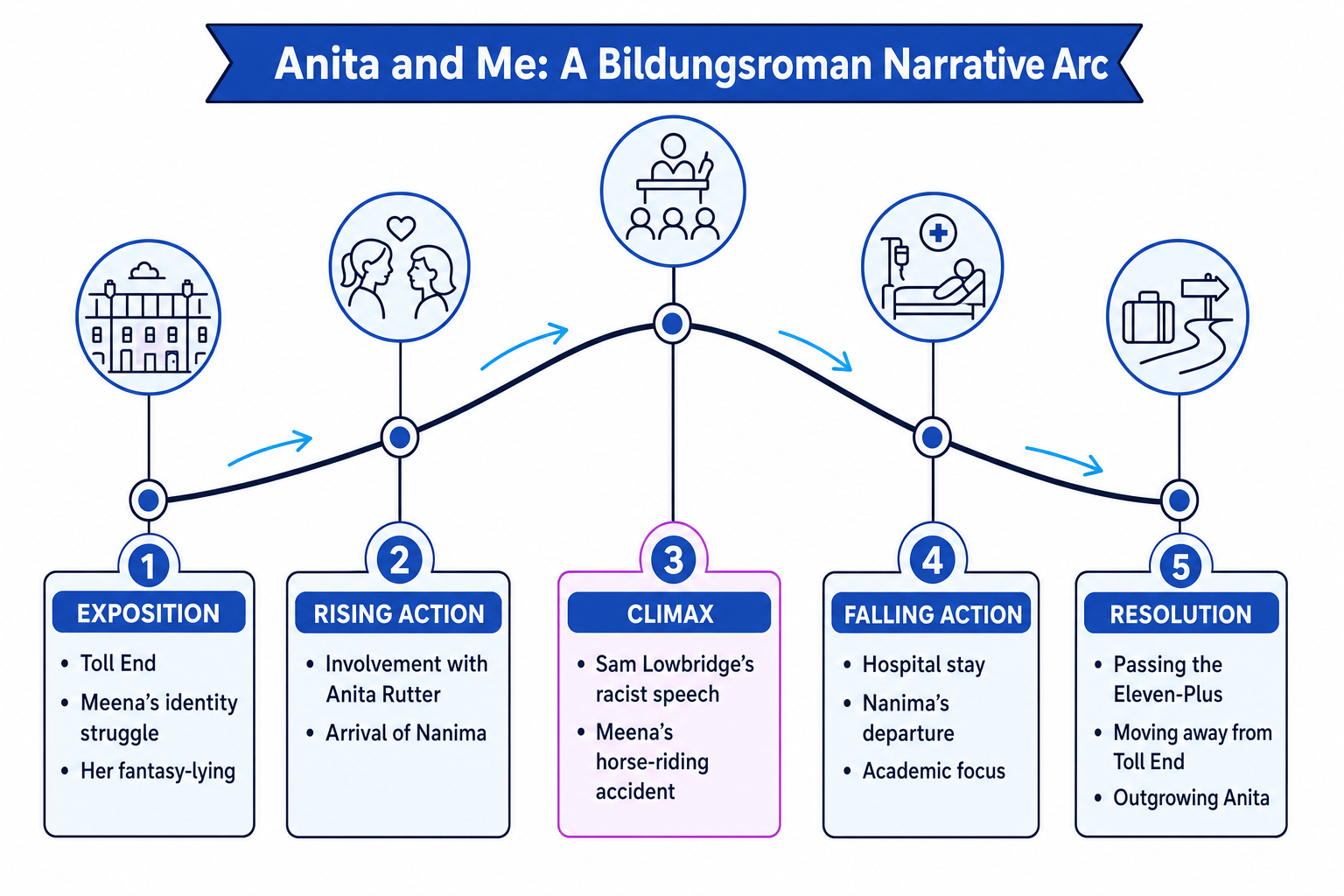
The Five Stages of the Plot
Let's explore how Syal shapes the narrative arc across five distinct stages.
1. Exposition: Toll End and Meena's Fantasies
The novel opens by introducing us to nine-year-old Meena Kumar, the daughter of Punjabi immigrants, living in Toll End. Meena is caught between two worlds: the rich, warm, and culturally distinct home life of her parents, and the gritty, working-class English environment of her peers.
To cope with her feelings of exclusion and her desire for excitement, Meena becomes a compulsive liar, or "fablist".
- The Conflict: Meena feels she does not fit anywhere. She resists her family’s expectations (embodied by the visits of the "Aunties and Uncles") and longs for a dramatic, rebellious lifestyle.
- Key Event: The introduction of Anita Rutter, the cool, aloof, older leader of the local "yard pack". Anita represents the ultimate symbol of local, working-class rebellion and independence.
2. Rising Action: The Allure of Anita and the Arrival of Nanima
Meena is drawn into Anita’s orbit, desperate to be her best friend. During this phase, Meena mimics Anita’s bad behaviour, tells more lies, and begins to distance herself from her family.
- The Birth of Sunil: Meena’s mother, Daljit, gives birth to a baby brother, Sunil. Meena feels displaced and pushed out of her mother’s affections, which accelerates her flight toward Anita.
- The Arrival of Nanima: Meena's grandmother, Nanima, arrives from India. Rather than driving Meena further away, Nanima’s warmth, storytelling, and unconditional love anchor Meena. For the first time, Meena begins to appreciate the beauty and history of her Indian heritage.
Tracking parallel developments
Notice how Syal balances Meena's domestic life against her social life. As Meena drifts further into Anita's chaotic world, her home life becomes more stable and grounded due to Nanima. This structural contrast highlights Meena's internal conflict.
3. Climax: Facing the Ugly Reality
The rising action culminates in a series of dark events that shatter Meena's romanticized view of both Anita and the village of Toll End.
- The Racist Attack: An elderly Indian man is attacked locally. While the village reacts with shock, the subtle undertones of racism begin to surface.
- The Spring Fair: Sam Lowbridge, a local disaffected youth whom Meena once admired, delivers a venomous racist speech on stage, declaring that the village is being taken over by outsiders. Meena is horrified to see Anita standing next to him, laughing.
- The Betrayal and the Accident: Meena witnesses Anita and Sam behaving intimately. Realising that Anita is complicit in the racism directed at families like the Kumars, Meena attempts to ride a horse to escape the situation. She suffers a terrible fall, breaking her leg.
Climax
The climax is the turning point of a narrative where the rising action reaches its peak of tension, and the protagonist is forced to confront the central conflict directly.
4. Falling Action: Isolation, Hospitalization, and Reflection
Meena's physical confinement in the hospital with a broken leg serves as a vital structural period of forced reflection.
- Distance from Anita: Isolated from the "yard pack", Meena begins to study for her Eleven-Plus exam. She meets Robert, a fellow patient who introduces her to intellectual, quiet companionship.
- The Loss of Nanima: Nanima returns to India, and later, the family receives news of her death. This loss devastates Meena but acts as a major catalyst for her maturity; she realizes she must hold onto her heritage herself.
- Seeing Anita Clearly: When Anita visits Meena, the power dynamic has shifted. Anita seems small, insecure, and limited by her bleak circumstances, while Meena's horizons are expanding.
5. Resolution: Moving On
The novel ends on a bittersweet note of hope and growth.
- Passing the Eleven-Plus: Meena passes her exam, securing a place at a grammar school and a ticket out of the cycle of poverty that traps Anita.
- Leaving Toll End: The Kumar family prepares to move to a new, more affluent area.
- The Final Goodbye: Meena meets Anita one last time but chooses not to say a grand farewell. She leaves a gift for Anita, realizing she no longer needs Anita's approval. Meena has integrated her dual identity as a proud British-Punjabi young woman.
Moving away as a symbol of growth
The physical relocation of the Kumars at the end of the novel matches Meena's emotional relocation. Leaving Toll End is not a betrayal of her roots, but a structural symbol of her outgrowing her childhood limitations.
Analysing Structural Transitions
When writing about structure in the exam, you must show how a transition in the plot shifts the characters' development or highlights a theme. Let's look at how to construct an analytical response to a key structural turning point.
Summarising instead of analysing
Do not simply retell the story. Saying "First Meena broke her leg, then she went to the hospital, and then she studied" is simple plot summary (AO1). To get top marks, you must explain why Syal chose to break Meena's leg at that precise point in the novel, and how this structural device develops the themes (AO2).
Analyzing the structural shift of Meena's accident
How does Syal use Meena’s horse-riding accident to develop the theme of maturation?
-
Identify the structural function of the event.
Recognize that the accident acts as the literal and metaphorical "break" between Meena's chaotic childhood and her reflective adolescence. It brings the rising action to a sudden halt, isolating Meena from the toxic influence of Toll End's peer culture. -
Contrast the "before" and "after" states of the protagonist.
Before the accident, Meena is hyperactive, easily influenced by Anita, and desperate to fit in, stating she wanted to be "the local rebel". After the accident, she is physically immobilized, which forces her to look inward. Use the contrast to show that her physical confinement leads to intellectual and emotional liberation. -
Analyse the writer's language and symbolic choices in this shift.
Look at how Syal describes Meena's focus shifting to her books and her studies for the Eleven-Plus. The hospital bed becomes a sanctuary rather than a prison: "I had never felt so safe". This irony demonstrates that losing her physical freedom allows Meena to gain her mental and cultural independence. -
Connect the structural transition to the novel's wider context (AO3).
Link her academic focus and her recovery to her family's immigrant work ethic and dreams of social mobility. Passing the Eleven-Plus represents Meena choosing her family's path of progress over the stagnant, dead-end future that awaits Anita in the post-industrial Midlands.
In the exam
- Focus on the 'Why': Always ask yourself: Why does this event happen here, and not earlier or later? For example, Nanima arrives after Meena has begun to rebel, acting as a timely corrective to Anita's influence.
- Use structural terms: Weave terms like exposition, catalyst, turning point, climax, and resolution into your essays to show the examiner you are analyzing the text as a construct.
- Track character trajectories: Compare Meena’s growth with Anita’s lack of growth. Their paths cross in the middle of the novel, but by the end, they are moving in opposite directions.
Check yourself
- Why is the arrival of Nanima structurally placed in the middle of Meena's growing rebellion with Anita?
- How does Sam Lowbridge's speech at the spring fair alter the direction of the plot?
- In what ways does Meena's success in the Eleven-Plus exam symbolise the resolution of her internal conflict?
