

Welcome to your study guide for Meera Syal’s modern novel, Anita and Me. Published in 1996, this vivid, funny, and sometimes painful novel tells the story of Meena Kumar, a nine-year-old girl of Punjabi descent growing up in the fictional Midlands mining village of Tollington in the early 1970s.
To succeed in your GCSE exam, you must understand not just what happens to Meena, but how Syal uses her experiences to comment on the broader social, cultural, and political changes in 1970s Britain. This overview will lay the groundwork for your study, helping you connect the plot to the writer's methods and key contexts.
What you'll learn:
- The structure and genre of Anita and Me as a coming-of-age story.
- How Meena’s identity is split between her family’s Punjabi heritage and her Tollington surroundings.
- The key assessment objectives (AOs) you need to hit to achieve top marks.
The Genre: A Story of Growing Up
At its heart, Anita and Me belongs to a classic literary tradition: the coming-of-age novel.
Bildungsroman
A Bildungsroman is a novel that traces the psychological, moral, and social development of a protagonist from youth to adulthood. In these novels, the main character usually undergoes a transition marked by a loss of innocence, a clash with society, and a final step toward self-awareness.
Meena begins the novel as a naive, occasionally self-centred nine-year-old who feels out of place in her family. She tells lies, craves excitement, and is desperate to fit in with the local village children—especially the cool, rebellious Anita Rutter.
By the end of the novel, Meena has witnessed racism, experienced betrayal, lost her beloved grandmother, and recognized the value of her family's heritage. Her journey is not just about growing older, but about learning who she truly is.
Confusing narrator with author
Because Anita and Me is semi-autobiographical (drawing on Meera Syal's real childhood in Shropshire), it is easy to refer to the narrator as "Syal." Always refer to the protagonist as Meena and the creator as Syal. This keeps your analysis focused on the writer's deliberate choices (AO2).
The Setting: Tollington vs. The Punjabi Home
The novel's conflicts are mirrored in its physical geography. Meena is constantly navigating two distinct worlds, each with its own set of rules, languages, and values.
1. The Punjabi Family Home
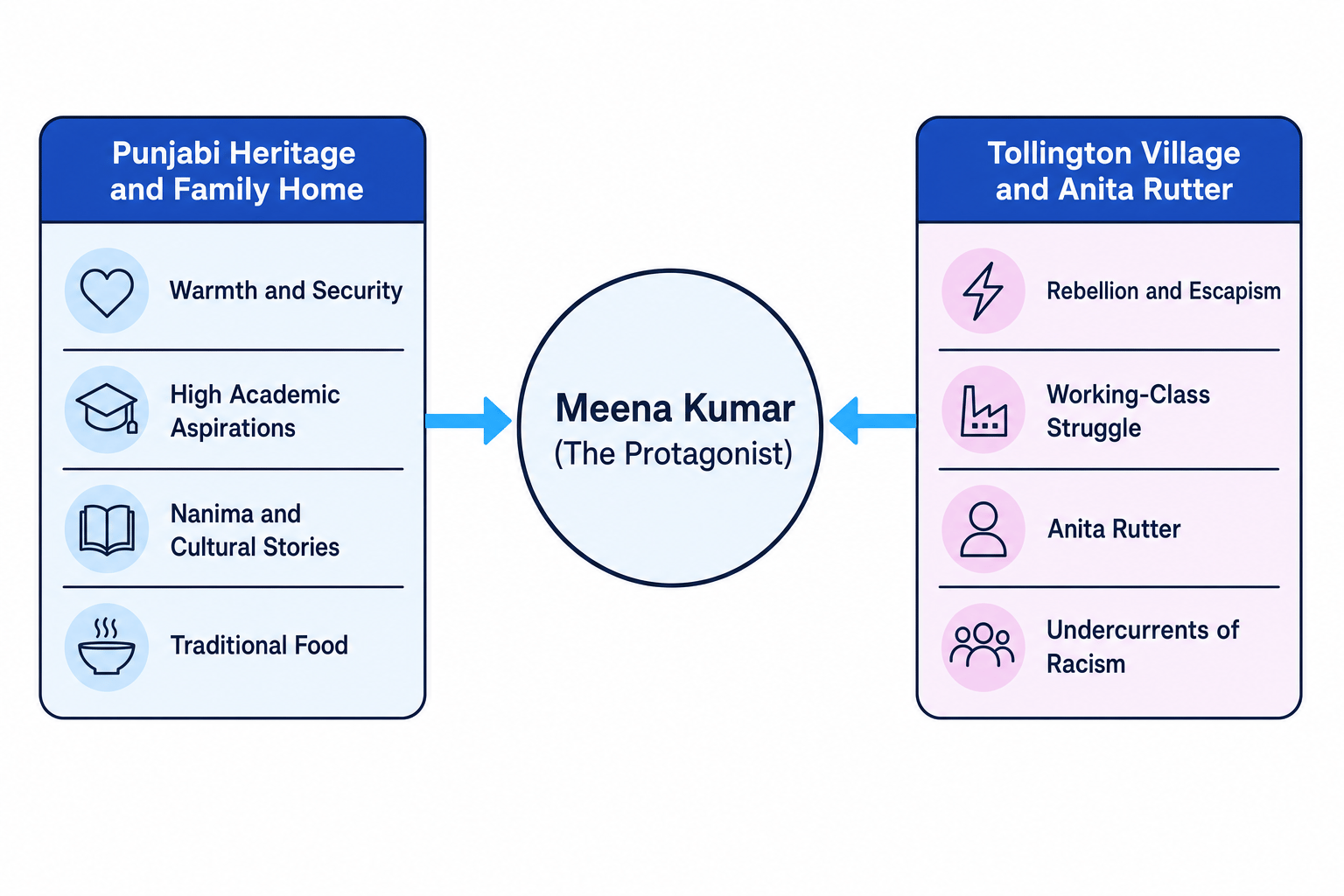
Inside the Kumars' house, Meena is surrounded by warmth, safety, high academic expectations, and a tight-knit community of "aunties" and "uncles" (close family friends). Food is a central symbol of love and cultural pride, and the arrival of Nanima (Meena's maternal grandmother) grounds Meena in her ancestral history.
2. Tollington Village
Outside her front door lies Tollington, a working-class mining village experiencing industrial decline. It is a place of physical freedom, dirty lanes, outdoor play, and economic struggle. It is also a place where Meena is visibly "different." While the village is initially welcoming, the economic hardship of the 1970s feeds an undercurrent of xenophobia and racism, culminating in the behavior of local teenagers like Sam Lowbridge.
Cultural Hybridity
Cultural hybridity refers to the blending of two or more diverse cultures to form a new, unique cultural identity. In the novel, Meena does not have to choose between being purely Indian or purely British; instead, she learns to navigate and inhabit a space that is uniquely British-Asian.
Here is a visual breakdown of how Meena's identity is pulled between these two spheres:
Key Themes to Watch For
As you read the novel, you should keep track of how Syal weaves these core thematic concerns into Meena's everyday life:
- Identity and Belonging: Meena’s struggle to find her place as a second-generation immigrant in a predominantly white, working-class village.
- Female Friendship: The toxic, unequal dynamic between the insecure Meena and the neglected, manipulative Anita.
- Class and Deprivation: The contrast between the Kumars' middle-class aspirations and the cycle of poverty and lack of opportunity that traps Anita and her family.
- Racism and Tolerance: The transition from casual, thoughtless prejudice to violent, overt xenophobia, reflecting the rise of the far-right in 1970s Britain.
Syal's Authorial Purpose
Syal does not write Anita and Me simply to evoke nostalgia. She uses Meena's childhood to expose the structural inequities of class and the painful reality of racism in Britain, whilst ultimately celebrating the resilience and richness of cultural diversity.
Structuring Your GCSE Analysis
For AQA Paper 2, Section A, you will write an essay on Anita and Me. Because this is a closed-book exam, you must memorize key quotations and understand how to construct a strong, thesis-driven argument.
To get top marks, you must integrate three things in every paragraph:
- Your Argument (AO1): A clear answer to the essay prompt, supported by memorable references.
- Analysis of Methods (AO2): Explaining how Syal uses language, structure, or symbols to convey her message.
- Context (AO3): Linking the text to historical and social realities (e.g., immigration post-Empire, 1970s economic decline, gender expectations).
Here is a step-by-step example of how to construct a sophisticated introductory thesis statement that combines these three elements.
Constructing a thesis statement on dual identity
-
Decode the prompt: Suppose the exam asks you: Explore how Syal presents Meena’s search for identity in the novel. Avoid a simple list sentence (e.g., "Syal shows Meena has an identity crisis because of her family and Anita"). Instead, think about Syal's larger message.
-
Identify the core contrast: Recognize that Meena's identity is split between her family's aspirations and Tollington's realities. Her search for identity is a journey from rejecting her culture to embracing it.
-
Integrate context (AO3): Ground this in the 1970s post-colonial landscape, where second-generation British-Asians had to carve out a new space for themselves amidst rising racial tensions.
-
Formulate the final thesis: Combine these elements into a cohesive statement:
"In Anita and Me, Syal utilizes the Bildungsroman genre to present Meena's search for identity not as a rejection of her heritage, but as a painful journey toward cultural hybridity. Initially seduced by the rebellious freedom of Anita and the local culture of Tollington, Meena eventually recognizes that her dual heritage is a source of strength, enabling her to transcend the narrow prejudices of her 1970s Midlands setting."
In the exam
When preparing for your Paper 2 exam on Anita and Me, keep these strategic tips in mind:
- Focus on character arcs: You will often get a question about a specific character (Meena, Anita, Sherrie, Nanima, Papa). Always ask yourself: How does this character change from the start of the novel to the end, and what does their journey teach the reader?
- Do not ignore minor characters: Characters like Robert, the pink-eyed boy, or the local shopkeepers are often used by Syal to highlight key themes like isolation, community, or casual prejudice.
- Vary your vocabulary: Use precise literary terms. Instead of saying "Meena wants to be like Anita," write about Meena's "desire for assimilation" or her "idealisation of working-class rebellion."
Check yourself
Before moving on to the detailed Plot and Character sections, ensure you can answer these basic questions:
- What are the defining characteristics of a Bildungsroman?
- How does the character of Nanima act as a turning point for Meena's sense of cultural identity?
- Why is the setting of 1970s Tollington critical to the novel's themes of class and race?
