What you'll learn
- The main events of Jane Eyre in the order they happen.
- How each setting — Gateshead, Lowood, Thornfield, Moor House and Ferndean — changes Jane.
- Which turning points matter most for GCSE essays.
- How to avoid retelling the story and instead use plot knowledge analytically.
Why plot summary matters
In the AQA 19th-century novel question, you do not need to retell Jane Eyre from start to finish. You need to know the plot well enough to choose relevant moments, explain how Jane changes, and connect events to Brontë’s ideas about love, independence, morality and social class.
Plot and structure
Plot means the events of a story and how they cause one another. Structure means how the writer arranges those events — for example, where turning points, contrasts, secrets and resolutions are placed.
A strong plot summary answers three questions:
- What happens?
- Why does it happen next?
- How does it change Jane?
Retelling instead of analysing
A plot summary becomes weak in an essay if it turns into “and then… and then… and then…”. Use plot details as evidence, then explain what Brontë is showing about Jane, society or morality.
Turning summary into analysis
- Start with the plot event: Jane’s wedding to Rochester is interrupted when it is revealed that Bertha Mason, Rochester’s wife, is still alive.
- Identify the pressure on Jane: she loves Rochester, but staying with him would mean living outside the moral and legal marriage structure of the novel.
- Connect the event to Jane’s character: Jane chooses principle over desire, saying, “Laws and principles are not for the times when there is no temptation.”
- Turn this into analysis: Brontë makes Jane’s independence convincing because Jane obeys her conscience when it costs her happiness.
The novel’s big shape: five places, five tests
Jane Eyre is built around Jane moving from place to place. Each setting gives her a different kind of test.
Bildungsroman
A bildungsroman is a coming-of-age novel: it follows a character’s growth from childhood towards maturity, self-knowledge and independence.
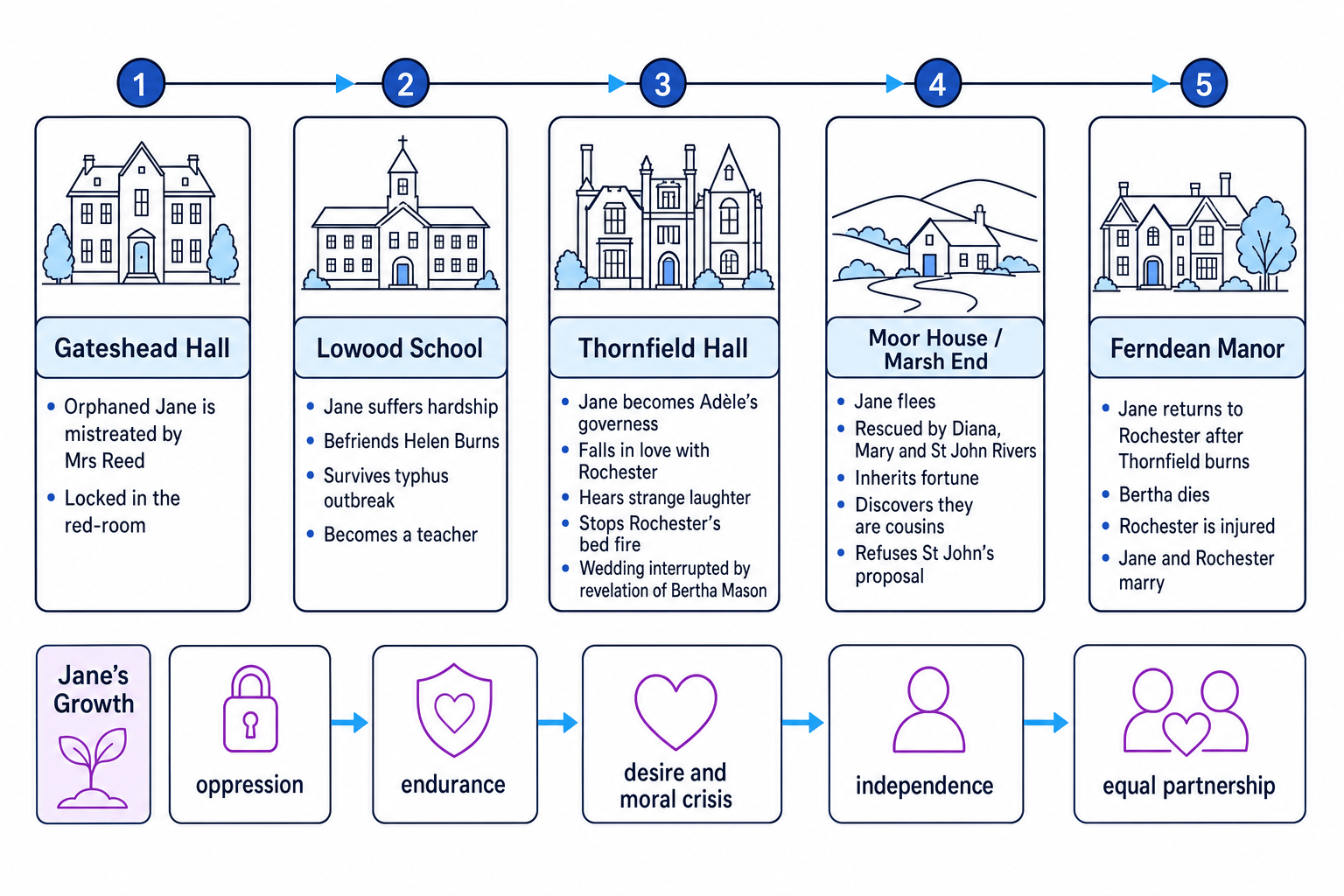
The diagram below shows the main plot journey. Notice that Jane’s physical movement also marks her emotional growth: she moves from oppression, to education, to temptation, to independence, and finally to equal love.
Memory shortcut
Remember the five main settings as G-L-T-M-F: Gateshead, Lowood, Thornfield, Moor House, Ferndean. In each place, ask: what does Jane learn, lose or refuse?
1. Gateshead Hall: childhood injustice
Jane begins as an orphan living with her aunt, Mrs Reed, and her cruel cousins. She is treated as an outsider in the family home. John Reed bullies her, and after Jane fights back, she is locked in the red-room, where her dead uncle had died.
This episode is important because it shows Jane’s first experience of injustice. She is frightened, isolated and powerless, but she is not passive. The short quotation “I resisted all the way” captures her instinctive refusal to accept cruelty silently.
After the red-room, Mr Lloyd suggests that Jane might be happier at school. Mrs Reed sends her to Lowood, but before Jane leaves, she confronts her aunt and rejects the false accusation that she is deceitful: “I am not deceitful.”
Why Gateshead matters
Gateshead establishes Jane’s need for:
- love and belonging;
- fairness and truth;
- independence from people who misuse power.
It also sets up a pattern for the whole novel: Jane is often placed under someone else’s control, but she keeps asserting her own moral worth.
2. Lowood School: suffering, discipline and friendship
Lowood is a charity school for girls. It is harsh, cold and underfunded. Mr Brocklehurst presents himself as religious, but Brontë exposes his hypocrisy: he preaches humility to poor girls while his own family appears wealthy and comfortable.
At Lowood, Jane meets Helen Burns and Miss Temple. Helen teaches Jane patience and forgiveness, saying, “Life appears to me too short to be spent in nursing animosity.” Miss Temple gives Jane kindness, education and moral example.
A typhus outbreak kills many pupils, including Helen. After public attention exposes the school’s neglect, Lowood improves. Jane stays for eight years: six as a pupil and two as a teacher. Eventually, she wants a wider life and advertises for work as a governess.
Why Lowood matters
Lowood gives Jane education and self-control. She does not lose her passionate sense of justice, but she learns discipline. This balance matters later: Jane’s decisions are emotional, but they are also principled.
3. Thornfield Hall: love and moral crisis
Jane becomes governess to Adèle Varens at Thornfield Hall. She meets Mrs Fairfax and then Edward Rochester, the master of the house. Jane and Rochester develop a deep emotional connection, partly because he treats her as intellectually equal.
Thornfield also contains mystery. Jane hears strange laughter, Rochester’s bed is set on fire, Richard Mason is attacked, and Jane’s wedding veil is torn. These gothic events foreshadow the hidden truth: Rochester’s wife, Bertha Mason, is locked in the attic.
Foreshadowing
Foreshadowing is when a writer plants hints about events that will happen later. At Thornfield, the strange laughter and attacks prepare the reader for the revelation of Bertha Mason.
Rochester proposes to Jane, and she insists on her equality: “I am no bird; and no net ensnares me.” However, the wedding is stopped when Mason and Mr Briggs reveal that Rochester is already married. Rochester asks Jane to stay with him anyway, but she refuses and leaves Thornfield.
Treating Bertha as a random twist
Bertha’s revelation is shocking, but it is not random. Brontë prepares it through repeated clues at Thornfield, so the interruption of the wedding feels like both a surprise and a structural turning point.
Why Thornfield matters
Thornfield is the emotional centre of the novel. Jane finds love, but that love becomes a moral test. The plot forces her to choose between Rochester and her own conscience. Her flight proves that her independence is not just something she says — it is something she acts on.
4. Moor House / Marsh End: independence and another temptation
After leaving Thornfield, Jane becomes homeless and nearly dies. She is rescued by Diana, Mary and St John Rivers. At first, they do not know they are related to her. Jane later works as a village teacher at Morton.
Jane then discovers that her uncle John Eyre has died and left her a fortune. She also learns that Diana, Mary and St John are her cousins. Instead of keeping the inheritance for herself, she shares it with them. This gives her both financial independence and family connection.
St John proposes to Jane, but not because he loves her romantically. He wants her to become a missionary’s wife in India, claiming, “God and nature intended you for a missionary’s wife.” Jane refuses because his version of duty would crush her emotional self.
Then Jane hears Rochester’s voice calling her name. She returns to find out what has happened to him.
Why Moor House matters
Moor House gives Jane the independence she needs before the ending. She gains money, family and social security. This is crucial: when she returns to Rochester, she does not return as a helpless dependent.
Jane must be free before she can choose love
Brontë delays Jane’s reunion with Rochester until Jane has gained independence. This makes the final marriage feel more equal, not simply romantic.
5. Ferndean Manor: return and resolution
Jane returns to Thornfield and finds it burned down. Bertha set fire to the house and died after jumping from the roof. Rochester tried to save everyone but was injured: he loses a hand and becomes blind.
Jane finds Rochester living at Ferndean, a more secluded and humbled setting. She still loves him, and now their relationship is more balanced. Jane has money, family and freedom; Rochester has lost some of his former power and pride.
The famous sentence “Reader, I married him” is important because Jane makes herself the active subject. She does not say “he married me.” Brontë presents the ending as Jane’s chosen union.
Why Ferndean matters
Ferndean resolves the plot by bringing together love and independence. Jane does not have to choose between being loved and being free. By the end, she has both.
Key turning points to remember
Turning point
A turning point is an event or decision that changes the direction of the plot. In essays, turning points are useful because they show character development clearly.
The most important turning points in Jane Eyre are:
- Jane being locked in the red-room.
- Jane leaving Gateshead for Lowood.
- Helen Burns’s death.
- Jane advertising for work and moving to Thornfield.
- Rochester’s proposal.
- The interrupted wedding.
- Jane’s decision to leave Thornfield.
- Jane’s inheritance and discovery of her cousins.
- Jane’s refusal of St John.
- Jane’s return to Rochester at Ferndean.
Tracing cause and consequence
- Choose a turning point: Jane is locked in the red-room after resisting John Reed.
- Follow the practical consequence: Mr Lloyd visits Jane and suggests that school might be better for her, which leads to Lowood.
- Follow the emotional consequence: Jane becomes more aware of injustice and more determined to defend her own truth.
- Link it to the whole novel: later, Jane again resists unfair power — Mrs Reed, Rochester’s attempted deception, and St John’s loveless proposal.
The plot as a repeated choice
Brontë structures the novel around choices. Jane is repeatedly offered a form of security that would cost her self-respect.
At Gateshead, she could stay silent, but she speaks back. At Thornfield, she could stay with Rochester, but she leaves. At Moor House, she could marry St John and become socially useful, but she refuses a loveless life.
This repeated structure makes Jane’s final happiness feel earned. She does not simply receive a happy ending; she reaches it through painful moral choices.
Using plot to answer a theme question
- If the question is about independence, select moments from across the novel rather than only one scene.
- Begin with Gateshead: “I resisted all the way” shows Jane’s early refusal to accept oppression.
- Move to Thornfield: “I am no bird; and no net ensnares me” shows Jane openly claiming equality.
- End with Ferndean: “Reader, I married him” shows Jane entering marriage as an active, independent chooser.
Quick chapter-journey recap
Gateshead
Jane is abused by the Reeds, locked in the red-room, and sent away to school.
Lowood
Jane suffers hardship, forms important friendships, loses Helen Burns, gains education, and becomes a teacher.
Thornfield
Jane works as a governess, falls in love with Rochester, discovers the secret of Bertha Mason, and leaves to protect her conscience.
Moor House / Marsh End
Jane is rescued, finds cousins and inheritance, refuses St John’s proposal, and becomes truly independent.
Ferndean
Jane returns to Rochester after Thornfield’s destruction, and they marry on more equal terms.
In the exam
- Use plot references selectively: choose the moment that best proves your point, not every event you can remember.
- Move quickly from event to meaning: explain how the plot moment changes Jane or reveals Brontë’s ideas.
- Use short, accurate quotations from memory, such as “I resisted all the way,” “I am no bird,” and “Reader, I married him.”
- Track development across the novel when possible: examiners reward answers that understand the whole text, not just the printed extract.
Check yourself
- Can you explain how each of the five main settings changes Jane?
- Which plot event is the biggest test of Jane’s conscience, and why?
- How does the ending show both love and independence?
