What you'll learn
- How to understand Jane Eyre as a whole-text journey, not just a sequence of events.
- The main genres Brontë blends: coming-of-age, Gothic, romance and social criticism.
- Why Jane’s first-person voice matters so much.
- How to turn overview knowledge into strong GCSE Literature analysis.
The big picture
Jane Eyre is a novel by Charlotte Brontë, published in 1847 under the male-sounding pen name Currer Bell. It follows Jane from childhood neglect and cruelty to adulthood, love, moral testing and independence.
For AQA GCSE English Literature, it is one of the 19th-century novel options on Paper 1. The exam is closed book, so your overview needs to help you remember the novel’s direction, key conflicts and a few short, flexible quotations.
19th-century novel
A 19th-century novel is a long prose fiction text written between 1800 and 1899. For GCSE, you are expected to analyse the story, characters, writer’s methods and relevant historical context.
The core idea
At its simplest, Jane Eyre is about a poor, powerless girl growing into a woman who refuses to give up her self-respect, even for love.
Jane’s journey through five main settings
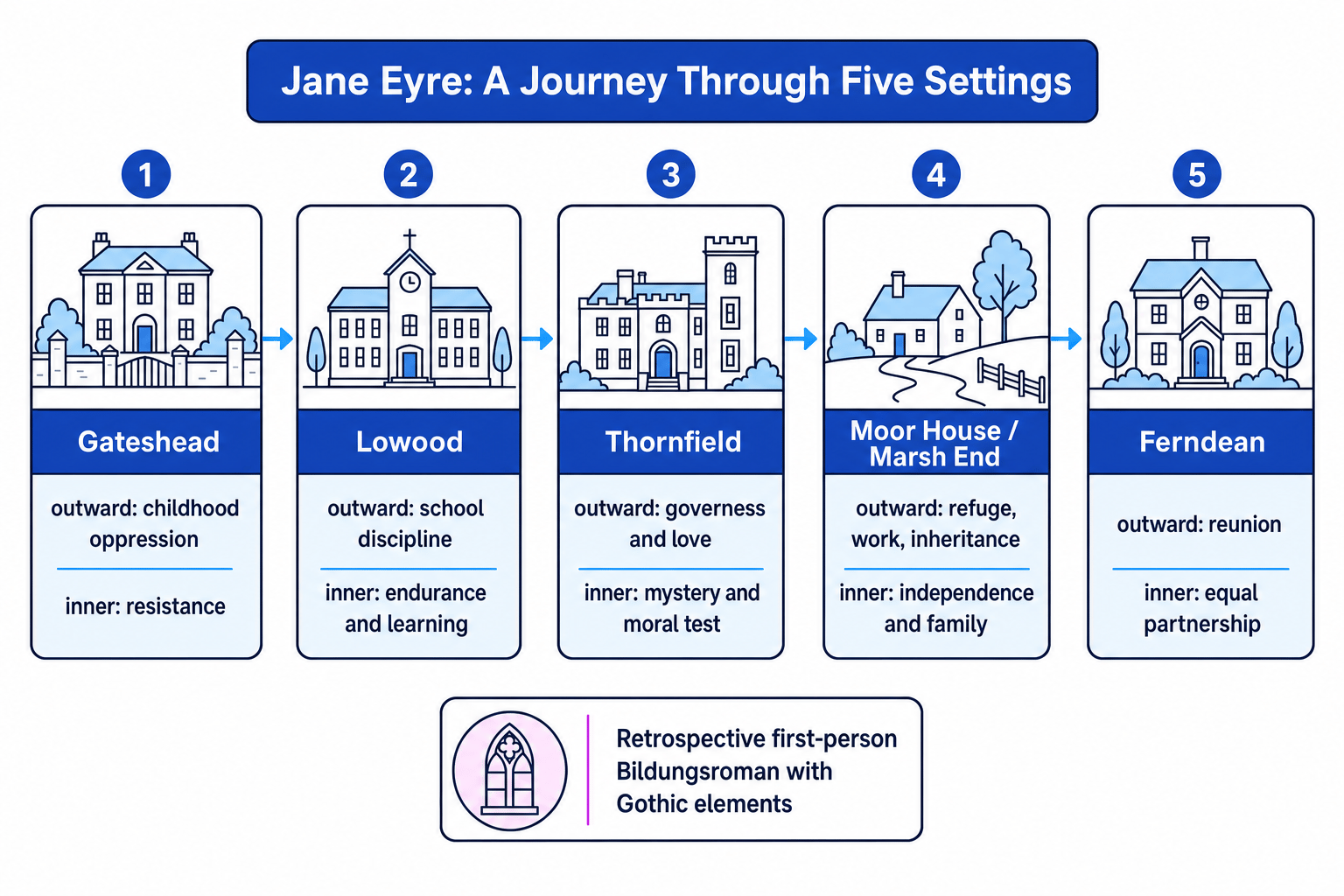
Brontë structures the novel around Jane moving through different places. Each setting tests her in a new way.
Structure
Structure means how a writer organises a text: the order of events, the shifts between settings, the pace of revelations and the way the ending connects to the beginning.
The five main stages are:
- Gateshead — Jane is an unwanted orphan in the Reed household. She learns that authority can be cruel and unjust.
- Lowood — Jane is sent to a harsh charity school. She experiences suffering, discipline, friendship and education.
- Thornfield — Jane becomes a governess and falls in love with Mr Rochester. This stage introduces romance, mystery and moral danger.
- Moor House / Marsh End — Jane finds refuge, work, family and financial independence.
- Ferndean — Jane returns to Rochester, but only when she can meet him as a more equal partner.
Tracking Jane’s growth through structure
-
At Gateshead, Jane’s powerlessness is shown when her sense of injustice breaks out in the red-room: “Unjust!—unjust!” The repeated word makes her moral anger feel instinctive and urgent.
-
At Thornfield, Jane’s language becomes more openly assertive: “I am no bird; and no net ensnares me.” The metaphor rejects the idea that she can be trapped, owned or controlled.
-
At the end, Jane says, “Reader, I married him.” The sentence places Jane as the active subject, suggesting that the final relationship is chosen by her, not forced upon her.
The narrative voice: Jane tells her own story
Jane is both the protagonist and the narrator.
Protagonist and narrator
The protagonist is the main character in a story. The narrator is the voice that tells the story to the reader.
Jane Eyre is written in the first person, meaning Jane uses “I” to tell the story. It is also retrospective, meaning the older Jane looks back on her younger self. This matters because the narration often combines the emotions of young Jane with the judgement of adult Jane.
The famous opening, “There was no possibility of taking a walk that day,” seems simple, but it immediately places us inside Jane’s restricted world. Even before the major conflicts begin, Brontë presents Jane as shut in, controlled and separated from freedom.
Retrospective first-person narration
Retrospective first-person narration means a character tells their own past story from a later point in time, using “I”.
Why this helps in essays
When you analyse Jane’s voice, you can write about both emotion and control: she feels intensely, but the older narrator shapes those feelings into a thoughtful moral argument.
Genre: more than one kind of novel
A genre is a type or category of writing. Jane Eyre is powerful because it blends several genres at once.
Bildungsroman
Bildungsroman
A Bildungsroman is a coming-of-age novel that follows a character’s moral, emotional and psychological development.
Jane grows from an isolated child into an adult who understands her own worth. The novel is not only about what happens to her; it is about how she learns to define herself.
Gothic fiction
Gothic fiction
Gothic fiction uses mystery, fear, secrets, isolated buildings and sometimes supernatural-sounding events to create tension.
Thornfield has many Gothic features: strange laughter, hidden rooms, fire, night-time disturbance and secrets from the past. These elements make Jane’s emotional life feel dangerous and uncertain.
Romance
The novel is also a romance because Jane and Rochester’s relationship is central. However, Brontë does not present love as simple escape. Jane loves Rochester deeply, but she will not sacrifice her conscience or identity for him.
Social criticism
Social criticism
Social criticism means a writer exposes or challenges problems in society, such as inequality, injustice or prejudice.
Brontë criticises the treatment of poor children, the limited options for women, the vulnerability of governesses and the way class can shape people’s lives.
Calling it only a love story
Do not reduce Jane Eyre to “Jane falls in love with Rochester”. The romance matters, but the deeper story is Jane’s struggle for equality, morality and self-respect.
The central conflict: love versus self-respect
A conflict is a struggle between opposing forces. In Jane Eyre, some conflicts are external: Jane against the Reeds, Brocklehurst or social expectations. Others are internal: Jane’s desire for love against her need to obey her conscience.
One of the most important moments comes when Jane chooses to leave Rochester after discovering the truth about his existing marriage. She says, “I care for myself,” followed by “the more solitary, the more friendless, the more unsustained I am, the more I will respect myself.”
Reading Jane’s moral independence
-
The phrase “I care for myself” sounds simple, but it is radical because Jane has often been treated as unimportant by others.
-
The repeated comparative pattern — “the more solitary, the more friendless, the more unsustained” — builds pressure and shows how extreme her isolation is.
-
The final phrase, “the more I will respect myself,” reveals the principle guiding her choice: self-respect matters more than comfort, security or romantic desire.
Jane’s real victory
Jane’s victory is not just marrying Rochester. It is reaching a position where love does not require her to surrender her moral independence.
Context: what you need for an overview
Context means the real-world background that shapes how a text was written and received. For Jane Eyre, useful context includes:
- Victorian gender expectations: women were often expected to be obedient, modest and dependent.
- Work and class: as a governess, Jane is educated but not wealthy, so she does not fully belong upstairs or downstairs.
- Religion and morality: Brontë presents different versions of Christianity, including cruelty, endurance, forgiveness and self-denial.
- Publication context: Brontë first published as “Currer Bell”, showing how difficult it could be for women writers to be taken seriously.
Bolting on context
Avoid adding context as a separate sentence that does not affect your argument. Instead of saying “women had fewer rights in Victorian times,” connect it to Jane’s words, choices or situation.
For example, when Jane says, “Do you think I am an automaton?—a machine without feelings?” she challenges the idea that a poor governess should be emotionally invisible. The metaphor of a “machine” shows how society can treat women and servants as useful but not fully human.
Methods to notice from the start
A method is any deliberate choice made by the writer. In GCSE Literature, you are rewarded for analysing how Brontë creates meaning, not just for spotting techniques.
Useful methods in Jane Eyre include:
| Method | What it means | Example in Jane Eyre |
|---|---|---|
| First-person narration | Jane tells her own story using “I” | Creates intimacy and lets the reader follow her moral reasoning |
| Symbolism | An object, place or image represents a bigger idea | Birds and cages often suggest freedom or entrapment |
| Gothic imagery | Dark, mysterious or frightening description | Thornfield’s secrets create suspense |
| Setting | The place where events happen | Each home or institution tests Jane differently |
| Structural contrast | Differences between parts of the text | Gateshead’s oppression contrasts with Ferndean’s chosen partnership |
Symbolism
Symbolism is when a person, object, place or image represents a larger idea beyond its literal meaning.
How the overview helps your exam answer
In the exam, you will usually need to write about both the printed extract and the wider novel. Your overview helps you avoid getting stuck on the extract alone.
A strong answer should move between:
- the specific moment in the extract;
- the whole-text journey Jane is on;
- Brontë’s methods, such as narration, symbolism, setting or structure;
- relevant context, only where it deepens your point.
In the exam
-
Begin with a clear argument about Jane’s journey, conflict or development, rather than retelling the plot.
-
Use short, accurate quotations you can remember, such as “I am no bird”, “I care for myself” and “Reader, I married him”.
-
Link the extract to another moment elsewhere in the novel to show you understand the text as a whole.
Check yourself
- Can you explain why Jane Eyre is a Bildungsroman?
- How does first-person narration shape our view of Jane?
- Why is Jane’s ending about equality, not just romance?
