

When writing about Meera Syal’s Anita and Me for your GCSE English Literature exam, you are not just analyzing what happens to Meena, but how her story is told. Syal uses specific narrative methods to shape our understanding of Meena’s dual identity, her relationship with Anita, and her transition from childhood to adolescence.
By mastering these methods, you will be able to write analytical essays that directly address the examiner's focus on the writer's craft (AO2).
What you'll learn
- How to analyze the dual narrative perspective of Meena as both a child protagonist and an adult narrator.
- How the novel operates as a Bildungsroman and how its episodic structure mirrors Meena's psychological growth.
- How Syal uses distinctive linguistic devices, such as hyperbole and sensory imagery, to contrast the romanticized world of childhood with the stark realities of adult life.
1. The Retrospective Narrative Voice
The most important narrative method to understand in Anita and Me is the perspective from which the story is told.
Retrospective Narrator
A retrospective narrator is a storyteller who looks back on past events of their own life from a point of maturity in the future.
Syal writes the novel in the first person ("I"), but there is a crucial division within this voice. We are presented with two Meenas:
- Meena the Child (the Protagonist): She lives the events in real-time. She is often naive, dramatic, desperate to fit in, and prone to telling tall tales (or "lies") to get attention.
- Meena the Adult (the Narrator): She is looking back on her 1960s childhood in Tollington from a position of mature adulthood. She possesses a sophisticated vocabulary, emotional distance, and a deep understanding of the social, cultural, and racial dynamics that her younger self did not fully comprehend.
The Impact of the Dual Perspective
By employing this dual perspective, Syal achieves several key literary effects:
- Dramatic Irony: The adult narrator often drops hints or uses sophisticated language that allows the reader to understand a situation better than the young Meena does. For example, when Meena desperately tries to impress Anita, the adult narrator's voice subtly exposes Anita’s cruelty or vulnerability.
- Humour and Pathos: The adult Meena can laugh at her childhood melodrama (humour) while simultaneously feeling deep sympathy for her younger self's isolation and confusion (pathos).
- Cultural Contextualization: The adult narrator can explain the political and social backdrop of the late 1960s and early 1970s—such as Enoch Powell's "Rivers of Blood" speech and the decline of the mining industry—which the young Meena experienced only as vague, unsettling background noise.
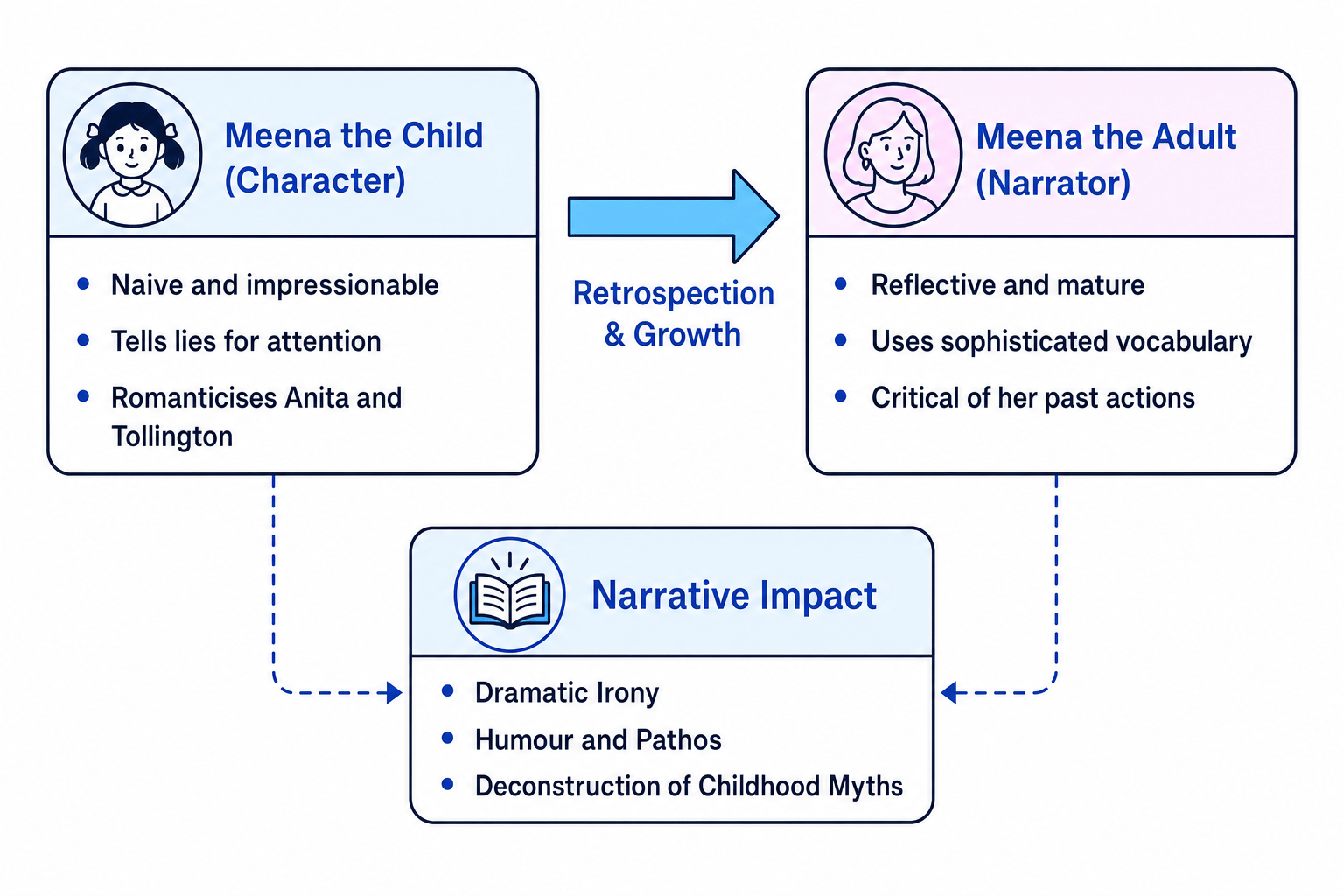
The Dual Voice
Always distinguish between "young Meena" and the "adult narrator" in your essays. Do not write: "Meena uses sophisticated vocabulary to describe her childhood." Instead, write: "Syal uses the mature, retrospective voice of adult Meena to analyze the naivety of her younger self."
2. Genre and Structure: The Bildungsroman
The structural framework of Anita and Me is highly deliberate. Rather than a fast-paced thriller, the novel is character-driven and follows a classic literary tradition.
Bildungsroman
A Bildungsroman is a "coming-of-age" novel that focuses on the psychological, moral, and social growth of the protagonist from youth to adulthood.
The Episodic Structure
The novel is structured episodically. This means the narrative is made up of a series of loosely connected incidents—such as the arrival of Nanima, the charity bazaar, the accident at the yard, and the horse-riding incident—rather than a single, tightly wound plotline.
This episodic structure mirrors the natural way childhood memories are recalled. Each episode acts as a milestone, offering Meena a crucial lesson about:
- Class and Poverty: Realised through her interactions with the underfunded, struggling local families like the Rutter family.
- Racism and Xenophobia: Realised through the shocking behavior of Sam Lowbridge and the casual racism of her neighbors.
- The Reality of Anita: Moving from blind worship to recognizing Anita’s emotional neglect and eventual betrayal.
The Linear Transition
Although episodic, the overall narrative trajectory is linear, moving Meena from innocence to experience. The climax of her transition occurs when she passes her Eleven-Plus exam and prepares to leave Tollington. Her physical departure from the village symbolizes her mental and emotional departure from childhood.
3. Narrative Tone and Language
Syal's language matches Meena’s vibrant, overactive imagination. To capture Meena's internal world, Syal uses distinct stylistic devices.
Hyperbole and Storytelling
Young Meena is an outsider who feels invisible, so she uses hyperbole (exaggeration) and fabrication to construct an exciting identity.
Hyperbole
Hyperbole is an extreme exaggeration used to make a point or create emphasis, not meant to be taken literally.
When Meena describes her "lies"—such as claiming she was run over by a tractor or that she has a physical deformity—the adult narrator explains these as her early attempts at becoming a writer. Her narrative voice is filled with rich, cinematic language because Meena views her life as a movie in which she is the tragic heroine.
Contrast of Language Styles
Syal contrasts Meena's poetic, middle-class, and highly educated internal thoughts with the colloquial dialect of the Tollington locals.
- Meena's Family (The Bhatias): Use standard English mixed with Punjabi terms of affection and cultural references (e.g., yar, beti, dal). This highlights their education and preservation of cultural heritage.
- The Tollington Locals (e.g., Anita, Sam Lowbridge): Use the Black Country dialect (e.g., "bostin", "owt", "yow").
This linguistic barrier is a key narrative device. It visually and aurally demonstrates that Meena exists between two distinct worlds: her warm, intellectual Indian home life, and the raw, working-class English village she desperately wants to belong to.
Confusing Author and Narrator
Avoid referring to Meera Syal and Meena interchangeably. While Anita and Me is semi-autobiographical, it is still a work of fiction. Meena is a constructed character, and Syal is the author. Always refer to Syal's choices in constructing Meena's voice.
4. Analytical Worked Example
Let's look at how to analyze a passage where the narrative methods are at work.
Imagine you are answering this essay question: How does Syal use narrative methods to present Meena’s changing relationship with Anita?
Here is a key quote from Chapter 9, where adult Meena reflects on Anita's character:
"I had witnessed her perform this transformation so many times... she was a girl who, I now realized, had never been taught the difference between a threat and a promise."
Here is how you build a high-grade analytical response.
Analyzing the retrospective narrator's insight
-
Identify the narrative method and formulate your point (AO1 & AO2): Start by identifying that Syal is using the retrospective narrative voice to provide hindsight and emotional maturity that the young Meena lacked at the time.
Drafting: "Syal utilizes her retrospective first-person narrator to highlight the emotional distance and mature understanding that Meena eventually gains regarding Anita's volatile character."
-
Embed your evidence smoothly (AO1): Integrate the quote naturally into your sentence, ensuring you don't just "drop" it in.
Drafting: "Looking back on their childhood, the adult Meena reflects on Anita's defensive and manipulative behavior, noting she was a girl who 'had never been taught the difference between a threat and a promise.'"
-
Analyze the language, tone, and specific word choices (AO2): Examine the contrast in the nouns "threat" and "promise". Explain how this stylistic choice reveals the psychological depth of the characters.
Drafting: "The antithesis between the nouns 'threat' and 'promise' perfectly encapsulates Anita's unstable upbringing. A promise implies love, security, and hope, whereas a threat implies fear and danger. By stating Anita cannot distinguish between the two, the adult narrator diagnoses Anita's cruelty not as innate malice, but as a tragic coping mechanism stemming from maternal neglect. The phrase 'I now realized' highlights the gap between Meena the naive child—who was easily intimidated and charmed by Anita—and Meena the empathetic adult, who can look back with compassion."
-
Link your analysis to context and the theme of the Bildungsroman (AO3 & AO1): Connect this specific linguistic analysis back to the wider structural journey of Meena growing up.
Drafting: "This moment of narrative hindsight is a key marker of Meena’s growth within this Bildungsroman structure. She moves away from romanticizing Anita as a rebellious, powerful leader, and instead recognizes her as a vulnerable victim of her social circumstances. This shift reflects Meena's own growing maturity and her eventual emotional independence from Tollington."
5. Key Structural Motifs to Track
As you read and revise the novel, keep an eye out for these recurring structural devices (motifs) that Syal uses to mark transitions in Meena's development:
- The Yard: Symbolizes danger, transition, and the industrial reality of Tollington. It is where Meena gets hurt, representing her literal and metaphorical fall from innocence.
- The Boundary Wall (of Meena's garden): Symbolizes the division between Meena’s secure, warm home life (her Punjabi heritage) and the wild, unpredictable English world of Tollington. Her physical movement over this wall marks her attempts to cross cultural boundaries.
- Letters and Writing: Meena’s transition from a teller of "lies" to a writer of diaries and creative stories symbolizes her finding her authentic voice. This is how she learns to control her own narrative rather than letting others define her.
<tip title="Use "Voice" as a structural tool">
When discussing structure, talk about how Meena's voice changes across the novel. In the early chapters, her narrative is frantic, hyperbolic, and obsessed with Anita. By the final chapters, her voice is calmer, more reflective, and increasingly focused on her family, her future, and her education.
In the exam
- Differentiate the two Meenas: Whenever you quote the narrative voice, state whether this is the immediate, naive perspective of Meena the child, or the wise, analytical commentary of Meena the adult.
- Track the structure: Don't just analyze isolated quotes. Explain where in the novel the quote occurs. Is it before or after Nanima's arrival? Is it before or after Sam Lowbridge's racist outburst at the bazaar? Showing how Meena's perspective changes over time is crucial for high marks in structure (AO2).
- Link methods to themes: Never identify a narrative method without explaining its effect. If you point out Syal's use of Black Country dialect, immediately link it to the themes of social class, belonging, or cultural division.
Check yourself
- Why does Meera Syal use a retrospective narrator instead of writing the novel from the perspective of an actual nine-year-old child?
- What is a Bildungsroman, and how does the ending of Anita and Me fit this genre?
- How does the contrast between Standard English and the Black Country dialect help to construct Meena’s sense of dual identity?
