

Writing a high-scoring essay on Meera Syal’s Anita and Me requires more than just retelling the plot or describing characters as if they are real people. The examiner wants to see a conceptual, analytical argument that treats the novel as a deliberate literary construct. Because Section A of AQA Paper 2 is closed-book, you must rely on a bank of memorable, versatile quotations and a reliable structural framework.
What you'll learn
- How to decode an exam prompt and formulate a sharp, cohesive thesis statement.
- How to build a high-scoring paragraph using the "Analytical Chain" method.
- How to weave historical and social context (AO3) naturally into your analysis without "context-dumping".
Deconstructing the Exam Essay
In your GCSE Paper 2 exam, Section A offers you a choice of two questions on Anita and Me. Usually, one focuses on a character (e.g., Anita, Meena, or Papa) and the other on a theme (e.g., racism, growing up, or belonging). There is no printed extract; you must write a whole-text essay based on your memory of the novel.
Conceptual Reading
A conceptual reading is an interpretation that views characters and events not as real people, but as symbolic constructs designed by the author to explore wider social, historical, or philosophical issues.
To achieve the highest marks, your essay must be driven by a clear, overriding argument rather than a chronological summary of the plot.
The Core Pillars of a Grade 9 Essay
A high-scoring essay relies on three main components:
- A Clear Thesis Statement: A 2–3 sentence introduction that directly answers the question by outlining your main argument. It acts as a road map for the examiner.
- Topic Sentences (Conceptual Claims): The first sentence of each paragraph must make an analytical point about the writer's ideas, rather than stating a plot fact.
- The Analytical Chain: A logical flow within every body paragraph that connects language analysis to the novel's wider context and Syal's authorial intention.
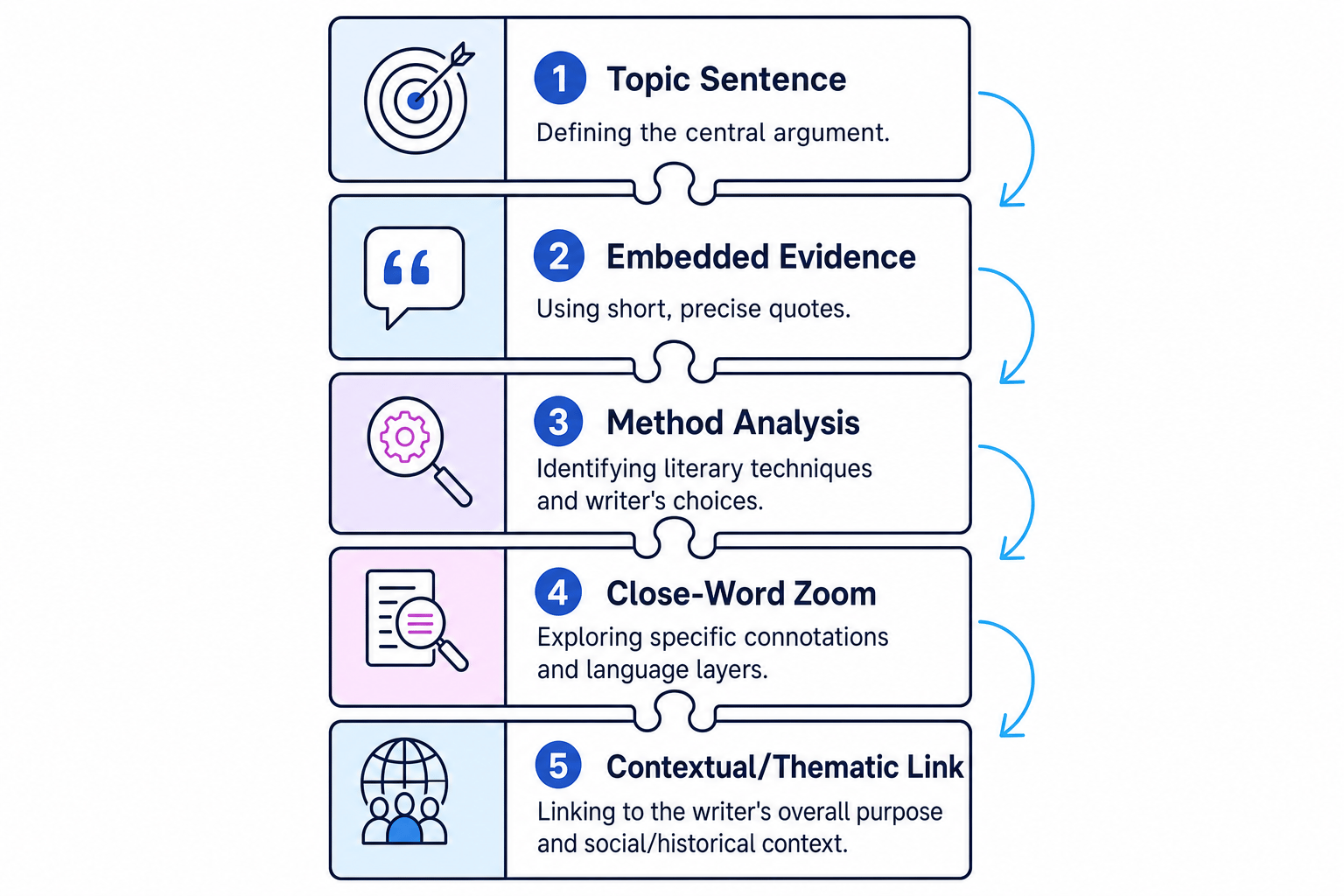
Mastering the Analytical Chain
To secure top marks in your analysis, your paragraphs should follow a structured sequence. This ensures you satisfy all Assessment Objectives in a balanced, fluid way.
The Golden Rule of AO3 Context
Never paste historical facts onto the end of a paragraph. Context must always explain why Syal made a specific literary choice. Ask yourself: how does this reflect the realities of 1970s working-class Britain, the immigrant diaspora, or the politics of the era?
Instead of writing a paragraph that lists a quotation and names a technique, aim to create a cohesive chain. Let's look at how to build this step-by-step.
Constructing an analytical paragraph on Meena's dual identity
This walkthrough demonstrates how to construct a paragraph answering the question: "How does Syal present Meena’s struggle to find her identity in Anita and Me?"
- Formulate a conceptual topic sentence (The Claim): Start by identifying Syal's broad thematic intention rather than a plot point. Instead of writing "Meena feels caught between her parents and Anita," argue that Meena's identity crisis is symbolic of a deeper cultural division. Write: Syal presents Meena’s search for identity as a turbulent negotiation between the warm, communal security of her Punjabi heritage and the seductive, individualistic freedom represented by Anita and working-class Tollington.
- Embed a precise, short quotation naturally (The Evidence): Integrate your chosen quote directly into your own sentence so that it flows grammatically. Do not write: "This is shown in the quote..." Instead, blend it: Meena’s initial dissatisfaction with her family's cultural expectations manifests in her desire to escape, viewing Anita as the "gateway to a cool, adult world" where she can shed her childhood innocence.
- Identify the writer's method and analyze its direct effect (The Analysis): Identify the literary device (e.g., metaphor, motif, semantic field) and explain its connotations. For example: The metaphor of Anita acting as a "gateway" positions her not just as a friend, but as a symbolic threshold between Meena's protected, traditional upbringing and an alluring, uncharted English working-class identity. The adjective "cool" highlights Meena's naive romanticisation of Anita's neglectful lifestyle, showing how desperately she craves autonomy.
- Zoom in on a specific word or image to deepen the analysis (The Zoom-In): Select a specific word from your quotation or a closely related moment to analyze in greater detail. For example: This desperation is further illustrated when Meena confesses she was "a liar, but only because I wanted to be someone else." The stark, self-deprecating noun "liar" underscores the psychological friction Meena experiences; her fabrications are not malicious, but are survival strategies designed to construct a fictional self that fits into a dominant white British culture.
- Contextualize the analysis and link it to authorial intent (The Context & Link): Connect your language analysis to the historical context of the 1970s and Syal's purpose in writing this semi-autobiographical novel. For example: Through Meena’s internal conflict, Syal reflects the lived experience of the second-generation British Asian diaspora in 1970s Britain, a period marked by rising racial tensions, Powellism, and the National Front. By depicting Meena's exhausting performative identities, Syal critiques a monocultural society that forces ethnic minority children to compromise their heritage to achieve a basic sense of belonging.
Using 'Syal uses...' repeatedly
Avoid starting every analysis sentence with "Syal uses [method] to show...". It makes your writing sound repetitive and mechanical. Instead, use active, analytical verbs: Syal constructs..., The motif of the 'grey' village reinforces..., Syal evokes..., or This encapsulates....
Integrating Theme and Character
A common mistake in essays is treating themes and characters as entirely separate issues. In Anita and Me, characters are the vessels for the themes.
Character as a Thematic Construct
When writing an essay about a character, structure your paragraphs around what that character symbolizes in relation to Syal's wider social message.
- Anita Rutter: Anita is not just a rebellious teenager. She represents the neglect and limited horizons of the post-industrial white working class in Tollington. She is a symbol of superficial freedom that masks a lack of real parental love and systemic educational neglect.
- Papa (Shyam Kumar): Papa represents cultural integrity, dignity, and the quiet pain of partition and exile. His beautiful singing voice symbolizes a rich, deep-rooted heritage that Meena initially overlooks in favor of Tollington’s superficial glamour.
- The Kumar Household: The home functions as a physical sanctuary of Punjabi culture, hospitality, and warmth ("apna" culture), contrasting sharply with the cold, physically decaying environment of Tollington (represented by the "slag heap").
The 'Contrast' Method
A highly effective analytical technique is to compare how characters react to the same social conditions. For example, contrast Meena's parents' resilient, dignified response to casual racism with Meena's internalized confusion and anger. This highlights the generational divide in the immigrant experience.
Sample Essay Paragraph: Analyzing the Slag Heap Motif
Below is a complete, high-grade analytical paragraph demonstrating how to pull all these skills together. It focuses on the setting of Tollington and how Syal uses it to reflect Meena's internal development.
Motif
A recurring image, object, or idea in a literary work that possesses symbolic significance and helps to develop the theme.
Syal utilizes the physical landscape of Tollington, specifically the recurring motif of the "slag heap," to mirror the moral and psychological decay of Meena’s childhood environment. Early in the novel, the slag heap is romanticized by the local children as an adventurous playground, representing the rugged, unfiltered freedom of Meena’s youth. However, as Meena matures and witnesses the underlying xenophobia of the village—particularly during the racist assault on the Indian man at the charity dance—the landscape shifts in her perception. The slag heap becomes a threatening, physical manifestation of social neglect, described as a "sleeping grey beast" looming over the village. The personification of the heap as a "beast" suggests a latent, monstrous hostility inherent in Tollington's community, one that is built on the ruins of a dying mining industry. Syal uses this setting to contextualize the rise of casual racism in 1970s working-class Britain. The economic decline of the Midlands left communities like Tollington feeling abandoned, creating a breeding ground for displacement and scapegoating. By linking the physical decay of the landscape to the moral decay of its inhabitants, Syal demonstrates that Meena's eventual departure from Tollington is not merely a geographic transition, but a necessary escape from a toxic social environment that threatens to stifle her identity.
In the exam
Follow these five steps when tackling the Anita and Me question in the exam hall:
- Spend 5 minutes planning: Do not start writing immediately. Read both questions, choose the one you have the strongest quotes for, and write down a brief 3-point essay outline.
- Draft a sharp, conceptual thesis statement: Ensure your introduction directly answers the question by stating why Syal presents a character or theme in a certain way, rather than just how.
- Select 2-3 versatile quotations per paragraph: Choose short, high-yield quotes (no more than 4-6 words) that you can unpack for techniques, word-level connotations, and context.
- Weave context into your analysis: Ensure every point about the 1970s, racism, or cultural dualism is tied directly to the words in your quote and Syal's authorial purpose.
- Track the character arc: Structure your essay chronologically through the novel (beginning →\rightarrow→ middle →\rightarrow→ end) to show the examiner that you understand how Meena's development (as a Bildungsroman protagonist) progresses over time.
Check yourself
Use these questions to test your readiness to write a Grade 9 essay on Anita and Me:
- Can you write a thesis statement for a question on "The presentation of friendship in the novel" that goes beyond simply saying "Meena and Anita are friends"?
- What are three short, versatile quotations for Anita that reveal her vulnerability rather than just her rebellious exterior?
- How would you link the physical presence of the "M6 motorway construction" in the novel to the themes of social change and transition in 1970s Britain?
