What you'll learn
- How to turn a Jane Eyre question into a clear argument.
- How to plan paragraphs that cover the extract and the whole novel.
- How to use short quotations, methods and context without writing a plot summary.
- Ready-to-adapt plan skeletons for common Jane Eyre essay topics.
Why essay plans matter
In the AQA 19th-century novel question, you are usually given an extract and asked to write about that focus in the extract and in the novel as a whole. Because the exam is closed book, a plan helps you avoid panic: you decide your argument, choose your best moments, and stop yourself retelling the story.
Essay plan
An essay plan is a brief structure for your answer: your main argument, your paragraph points, the evidence you will use, and the writer’s methods you will analyse.
A good plan does not need to be long. It needs to be purposeful. Every paragraph should answer the question, not just mention a character or scene.
The basic shape of a strong plan
Most Jane Eyre essays work well with this structure:
- A short introduction with a clear argument.
- One paragraph on the extract, using close language analysis.
- Two or three paragraphs on the wider novel.
- A concise conclusion that gives a final judgement.
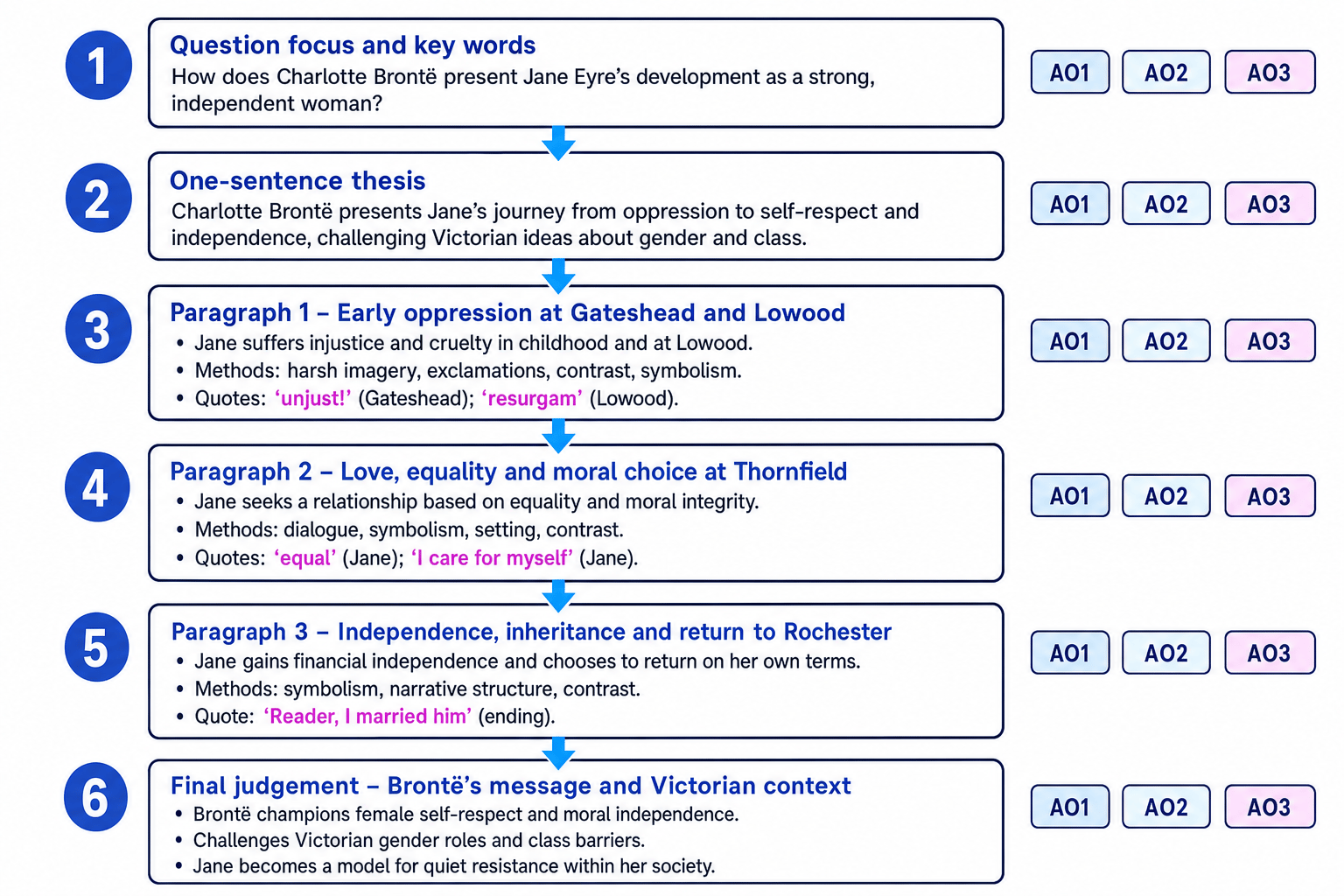
The diagram below shows a useful route for planning a whole-text argument about Jane’s independence.
The golden rule
Do not plan “what happens next”. Plan how Brontë presents an idea, and how that presentation develops across the novel.
Step 1: Unpack the question
Before choosing quotations, work out exactly what the question wants.
Question focus
The question focus is the character, theme or idea the question asks you to explore, such as independence, love, suffering, social class, religion or gender.
For example, if the question asks how Brontë presents Jane as “strong”, you need to decide what “strong” means in this novel. It rarely means physical strength. It usually means moral courage, self-respect, emotional honesty and resistance to injustice.
Unpacking a question about strength
Question: How does Brontë present Jane as a strong female character?
- Identify the key word: “strong” suggests Jane’s resilience, independence and moral courage.
- Narrow the meaning: Jane is not socially powerful at first; she is an orphan, a child and later a governess. So her strength must come from inner self-respect rather than status.
- Choose a direction: Brontë presents Jane’s strength as something that develops from childhood rebellion into adult moral independence.
- Turn that into a possible argument: Brontë presents Jane as strong because she learns to defend her own worth, even when love, class and gender expectations pressure her to submit.
Step 2: Build a thesis
Thesis
A thesis is your one-sentence answer to the question. It tells the examiner your overall interpretation before the detailed paragraphs begin.
A weak thesis is vague: “Brontë presents Jane as strong in many ways.”
A stronger thesis makes a judgement: “Brontë presents Jane’s strength as moral and emotional independence, using her journey from abused orphan to self-possessed wife to challenge Victorian expectations of female obedience.”
That second version gives you a route through the essay.
Line of argument
A line of argument is the logical thread that connects your paragraphs, so the essay feels like one developing answer rather than separate mini-responses.
Thesis shortcut
Use this pattern: Brontë presents [focus] as [main idea], developing it from [early stage] to [later stage] in order to [writer’s message].
Step 3: Choose anchor moments
Anchor moment
An anchor moment is a key scene, chapter or turning point you can use to support your argument.
For Jane Eyre, it is often useful to choose moments from different stages of Jane’s life: Gateshead, Lowood, Thornfield, Moor House and Ferndean. This helps you show development across the whole novel.
Useful anchor moments include:
- Gateshead: Jane resists John Reed and later protests against Mrs Reed’s cruelty.
- The Red-Room: Brontë links childhood oppression with Gothic fear and injustice.
- Lowood: Jane learns endurance from Helen Burns but also sees the danger of religious hypocrisy through Mr Brocklehurst.
- Thornfield: Jane demands equality with Rochester: “I am no bird; and no net ensnares me.”
- After the interrupted wedding: Jane says, “I care for myself,” choosing moral self-respect over desire.
- Moor House: Jane refuses St John’s loveless proposal.
- Ferndean: Jane returns with independence: “Reader, I married him.”
Plot summary planning
Do not plan paragraphs like “First Jane lives at Gateshead, then she goes to Lowood, then she meets Rochester.” That tells the story, but it does not answer the question. Each paragraph must make a point about Brontë’s presentation of the question focus.
Step 4: Plan analytical paragraphs
A strong paragraph usually follows this route:
Point → Evidence → Method → Effect → Link
Method
A method is a writer’s choice, such as metaphor, symbolism, first-person narration, contrast, Gothic setting, dialogue, structure or motif.
You do not get credit for simply naming a method. You need to explain how it creates meaning.
Planning a paragraph on equality
Focus: Jane’s independence in the Thornfield proposal scene.
- Make a point: Brontë presents Jane’s independence through her refusal to let love become ownership.
- Choose evidence: Jane declares, “I am no bird; and no net ensnares me,” and calls herself “a free human being with an independent will.”
- Analyse the method: The bird and net metaphor presents unequal love as imprisonment, while the declarative sentence “I am” gives Jane’s voice certainty and authority.
- Connect to meaning: The reader sees Jane reject the Victorian assumption that a poor governess should be grateful for male protection.
- Link to the question: Therefore, Brontë presents independence not as loneliness, but as the condition for genuine love.
Step 5: Use context naturally
Context
Context means the relevant social, historical or literary ideas surrounding the text, such as Victorian gender roles, class hierarchy, Christianity, the position of governesses, or Gothic fiction.
Context should support your argument. It should not be a random fact dropped into the paragraph.
Instead of writing, “In Victorian times women had fewer rights,” connect it to the scene: Jane is a poor governess with limited social power, so her insistence that she is Rochester’s spiritual “equal” becomes more radical.
Context sentence starter
Try: For a Victorian reader, this would be striking because… or Brontë uses Jane’s position as a governess to expose…
Plan skeletons you can adapt
Plan A: Jane as independent
Possible thesis: Brontë presents Jane’s independence as a hard-won moral strength, developing from childhood resistance into adult self-respect and equal love.
- Paragraph 1: Gateshead and the Red-Room show Jane’s early powerlessness, but “Unjust!—unjust!” reveals her instinctive resistance to cruelty.
- Paragraph 2: At Thornfield, Jane demands emotional equality: “I am no bird; and no net ensnares me.”
- Paragraph 3: After the failed wedding, “I care for myself” shows that Jane chooses conscience over passion.
- Paragraph 4: The ending, “Reader, I married him,” gives Jane grammatical control of the sentence, making her the active decision-maker.
Plan B: Love and relationships
Possible thesis: Brontë presents true love as impossible without equality, honesty and moral freedom.
- Paragraph 1: Gateshead shows loveless family relationships, making Jane’s hunger for affection understandable.
- Paragraph 2: Rochester and Jane’s relationship is passionate, but Jane repeatedly insists on equality: “equal,—as we are!”
- Paragraph 3: Bertha’s existence exposes the danger of secrecy and male control within marriage.
- Paragraph 4: St John offers duty without love, so Jane’s refusal shows Brontë rejecting emotionally oppressive religion.
- Conclusion idea: Ferndean offers a changed relationship because Jane returns freely, financially independent and morally secure.
Plan C: Social class and gender
Possible thesis: Brontë uses Jane’s position as an orphan and governess to criticise a society that measures women by wealth, beauty and rank.
- Paragraph 1: At Gateshead, Jane is treated as socially inferior within her own family.
- Paragraph 2: As a governess, Jane occupies an uncomfortable class position: educated but not equal to the upper classes.
- Paragraph 3: Blanche Ingram represents the marriage market, where beauty, rank and wealth are valued.
- Paragraph 4: Jane’s inheritance changes her social power, but Brontë makes her independence moral as well as financial: “I am my own mistress.”
Plan D: Religion and morality
Possible thesis: Brontë presents Christianity as valuable when linked to compassion and conscience, but dangerous when it becomes hypocrisy or emotional repression.
- Paragraph 1: Mr Brocklehurst’s harsh religion at Lowood exposes hypocrisy and cruelty.
- Paragraph 2: Helen Burns teaches forgiveness and endurance, symbolised by “Resurgam,” meaning “I shall rise again.”
- Paragraph 3: Jane’s decision to leave Rochester shows moral conscience, even though it causes suffering.
- Paragraph 4: St John’s proposal shows duty without love; Jane rejects a form of religion that would destroy her identity.
Planning introductions and conclusions
Your introduction should be short. Do not begin with a biography of Charlotte Brontë. Start by answering the question.
A useful introduction pattern is:
Brontë presents [question focus] as [main argument]. Through Jane’s journey from [early moment] to [later moment], Brontë suggests [message].
Your conclusion should not repeat every paragraph. It should give a final judgement about Brontë’s purpose.
Bolted-on context
Avoid ending every paragraph with a vague sentence like “This shows Victorian society was unfair.” Instead, link context to the precise moment: Jane’s gender, class and lack of money make her self-assertion more significant.
In the exam
- Spend a few minutes planning: write your thesis, then three or four anchor moments with short quotations.
- Use the extract closely: analyse Brontë’s language in the printed passage before moving confidently to the wider novel.
- Keep linking back to the question focus, especially at the end of each paragraph.
Check yourself
- Can you write a one-sentence thesis for a question on Jane’s independence?
- Which three anchor moments would you use for a question about love?
- Can you explain one method Brontë uses without simply naming it?
