

For your AQA GCSE English Literature Paper 2 exam, Anita and Me is a modern prose text. Because this is a closed-book exam, you will not have a copy of the novel with you in the examination room. Therefore, memorising a small bank of highly versatile, short quotations is one of the most effective ways to secure high marks.
This guide will walk you through the most powerful quotations in the novel, teaching you how to deconstruct their literary methods (AO2) and connect them deeply to the historical and social context of 1970s Britain (AO3).
What you'll learn
- How to select and memorise short, flexible quotations that can be used for multiple essay questions.
- How to analyze the structural and linguistic devices Meera Syal uses to explore identity, racism, and growing up.
- How to link key quotations directly to the social context of the 1970s West Midlands.
The Art of the "Flexible Quote"
In the exam, you want to avoid trying to remember long, winding sentences. Instead, focus on micro-quotations: phrases of three to six words that pack a significant thematic punch.
A flexible quote is one that can be used to answer a question on character (such as Meena, Anita, or Nanima) and a question on theme (such as identity, racism, or community).
Micro-analysis
Micro-analysis is the practice of zooming in on a single, highly significant word or brief phrase within a quotation to explore its structural, emotional, and thematic connotations in detail.
By focusing on micro-analysis, you show the examiner that you are engaged in close, precise reading (AO2), rather than simply retelling the plot.
Quote 1: The Paradox of Belonging
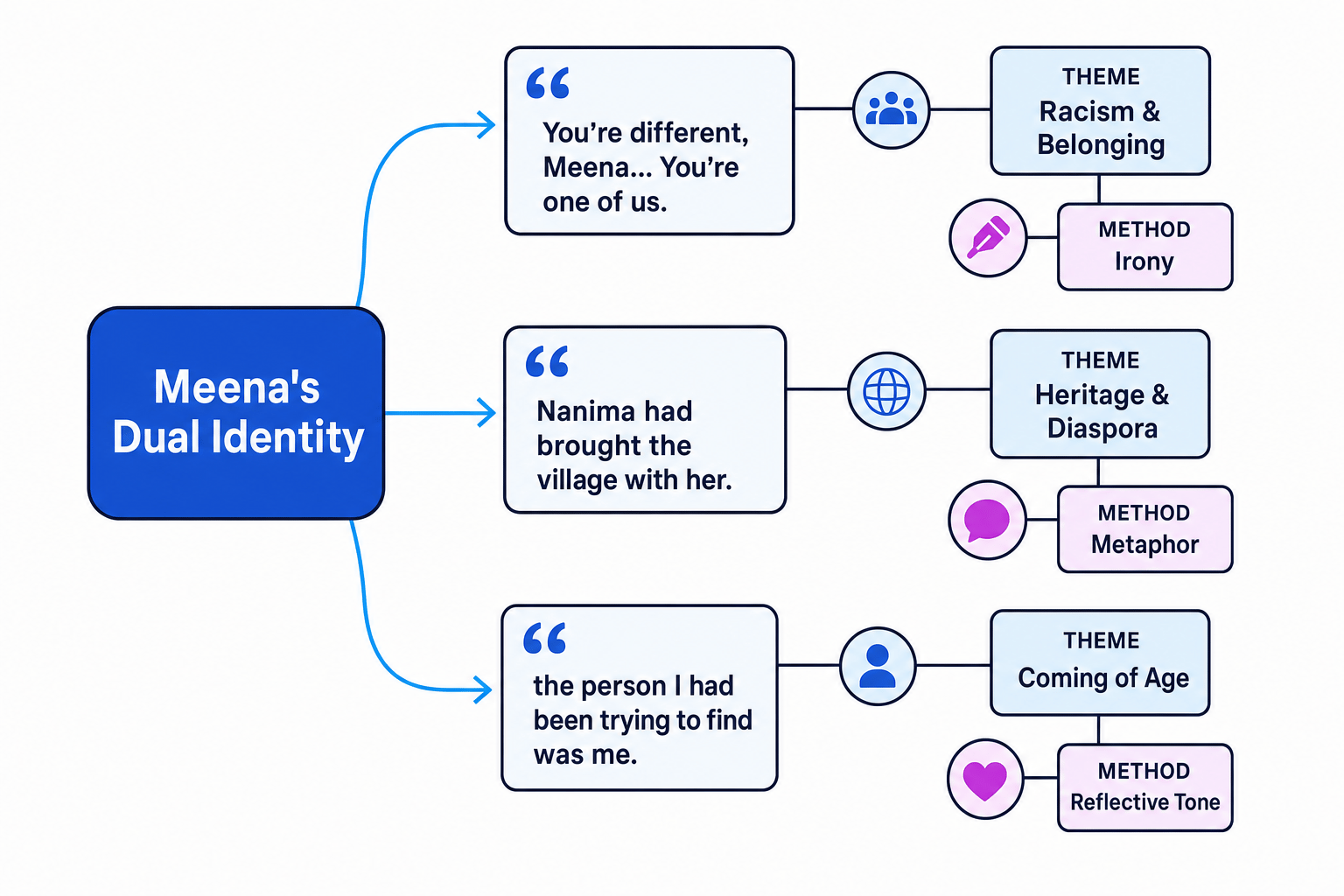
"You’re different, Meena. You’re one of us."
Who says it?
This is said to Meena by her white Tollington peers—most notably Anita Rutter and her friend Sherrie.
Why is it important?
This is a defining quote for the themes of racism, belonging, and identity. On the surface, it sounds like an acceptance of Meena into the local Tollington gang. However, Syal uses it to expose the insidious nature of casual racism and selective exclusion in 1970s working-class Britain.
The 'Different' Trap
When Anita tells Meena she is "different," she is not celebrating Meena's individuality. Instead, she is "othering" Meena’s family and the wider British-Asian community. To accept Meena, Anita feels she must strip Meena of her cultural heritage and declare her "one of us" (meaning white and working-class).
Literary Methods to Analyze (AO2)
- Juxtaposition: There is a sharp contrast between the word "different" (implying exclusion) and the phrase "one of us" (implying inclusion). This structural tension shows how unstable Meena's social position is.
- Pronoun Analysis: The plural pronoun "us" establishes an insular, defensive community. Tollington is a village left behind by the industrial decline of the 1970s; its residents cling to a rigid, exclusive sense of British identity.
Quote 2: The Warmth of Heritage
"Nanima had brought the village with her."
Who says it?
Meena, reflecting on the arrival of her maternal grandmother (Nanima) from India.
Why is it important?
This quote is highly versatile. It can be used in essays about family, cultural heritage, home, or Meena's personal growth.
Prior to Nanima’s arrival, Meena feels caught between two worlds: the grey, decaying landscape of Tollington and the distant, romanticised "back home" of her parents’ stories. Nanima represents a physical, living bridge to Meena’s Punjabi roots.
Literary Methods to Analyze (AO2)
- Metaphor: Nanima cannot literally pack up a Punjabi village and carry it in her suitcase. This metaphor suggests that culture is not just a geographic location, but a portable state of mind, kept alive through stories, language, warmth, and food.
- Contrast: The vibrant, communal "village" that Nanima brings contrasts sharply with the physical isolation and emotional distance growing in Tollington as the 1970s progress.
Quote 3: The Resolution of Identity
"...the person I had been trying to find was me."
Who says it?
Meena, in the final chapter of the novel, as she prepares to leave Tollington.
Why is it important?
This quotation marks the climax of Meena's emotional and psychological journey. Anita and Me is a classic Bildungsroman.
Bildungsroman
A Bildungsroman is a literary genre that focuses on the psychological and moral growth of the protagonist from youth to adulthood (a "coming-of-age" novel).
Throughout the novel, Meena tries on different identities like costumes: she lies, she mimics Anita's rebellious nature, and she tries to fit into the white Tollington community. Here, she finally accepts her dual identity as a British-Punjabi young woman without needing to compromise either half of herself.
Literary Methods to Analyze (AO2)
- Reflective Tone: The syntax is simple and self-assured. The search ("trying to find") is spoken of in the past tense, showing that her identity crisis has resolved.
- Thematic Resolution: This quote contrasts with Meena's earlier feelings of being an "imposter." It shows that true maturity comes from self-acceptance, not from seeking validation from toxic influences like Anita.
The Power of the First Person
Remember that because Anita and Me is written in the first person, Meena is an unreliable narrator when she is young. The older, wiser Meena is reflecting back on her childhood. When analyzing quotes like this, distinguish between the immature Meena experiencing the event and the mature Meena looking back.
How to Analyze a Quote step-by-step
To secure Level 5 and 6 marks on the AQA marking grid, your essay paragraphs must move seamlessly from a point about a character/theme, into a quote, and then into a deep language analysis that connects back to the historical context (AO3).
Let's look at how to construct an analytical paragraph using a structured approach.
Analyzing a quotation for AO2 and AO3
Analyze how Syal uses the character of Nanima to explore Meena's connection to her cultural identity.
- State your analytical point clearly (AO1): Syal uses the arrival of Nanima to ground Meena in her cultural heritage, showing that identity is nurtured through ancestral connections rather than peer validation.
- Embed your quotation naturally (AO1): Upon her grandmother's arrival, Meena observes that "Nanima had brought the village with her."
- Analyze the literary methods and zoom in on key words (AO2): The metaphor of bringing the "village" suggests that heritage is a living, breathing community spirit that transcends national borders. The noun "village" carries connotations of warmth, collective responsibility, and ancient tradition, which contrasts with the industrial decay and social alienation of Tollington.
- Connect the analysis to the historical/social context (AO3): This reflects the experience of the post-partition South Asian diaspora in 1970s Britain. For families like Meena's, who felt isolated in predominantly white suburbs, elder relatives acted as vital cultural anchors, preserving oral histories and Punjabi customs in a rapidly changing Western world.
Feature Spotting
Do not just list literary terms. Writing "Syal uses a metaphor when Meena says Nanima brought the village" will not get you high marks. You must explain how that metaphor creates meaning for the reader and why Syal chose that specific image.
In the exam
- Choose short, precise quotes: In a closed-book exam, trying to recall long passages leads to misquoting. Stick to 3–6 words that you can quote perfectly.
- Explode your quotes: When planning your essay, jot down your chosen quote on your scrap paper and draw arrows off individual words. Show the examiner you can write three sentences of analysis on just one word.
- Pivot to context: Always use your quote analysis as a bridge to historical context. If you quote Anita’s casual racism, pivot immediately to explaining the rise of the National Front and working-class economic anxiety in the 1970s.
Check yourself
- Can you identify two separate themes that the quote "You’re different, Meena. You’re one of us" could be used to answer?
- What literary genre is Anita and Me, and which quote best proves that the novel fits this genre?
- Why is Meena's older narrative voice crucial when analyzing her quotes about childhood lies and exaggerations?
