To master Charlotte Brontë’s Jane Eyre for your GCSE, you must look beyond the plot and analyze how the novel's structure develops its central themes. Brontë structures the novel around five physical settings, each representing a distinct phase of Jane's emotional, spiritual, and psychological growth.
This guide explores the structural architecture of the novel and focuses on three critical chapters that frequently appear in exam questions.
What you'll learn
- How to trace Jane’s psychological journey across the novel's five settings.
- How to analyze the structural and thematic significance of Chapter 2 (The Red Room), Chapter 23 (The Proposal), and Chapter 35 (The Call).
- How to identify and analyze Gothic and Victorian structural methods in these chapters.
The Structural Journey: Five Settings
Jane Eyre is structured as a Bildungsroman, a literary genre that focuses on the psychological and moral growth of the protagonist from youth to adulthood.
Bildungsroman
A Bildungsroman is a novel of formation or education. It depicts the development of the protagonist's mind and character through passage from childhood through varied experiences—often involving spiritual crises and trial—into maturity and acceptance of their social role.
Jane's growth is plotted geographically. She moves through five physical locations, and her arrival and departure from each location mark the major structural divisions of the novel:
- Gateshead Hall: Childhood, oppression, and early rebellion.
- Lowood School: Education, self-control, spiritual guidance, and physical deprivation.
- Thornfield Hall: Passion, romantic temptation, moral trial, and the Gothic.
- Moor House (Marsh End): Independence, female autonomy, familial love, and cold duty.
- Ferndean: True equality, physical and spiritual reunion.
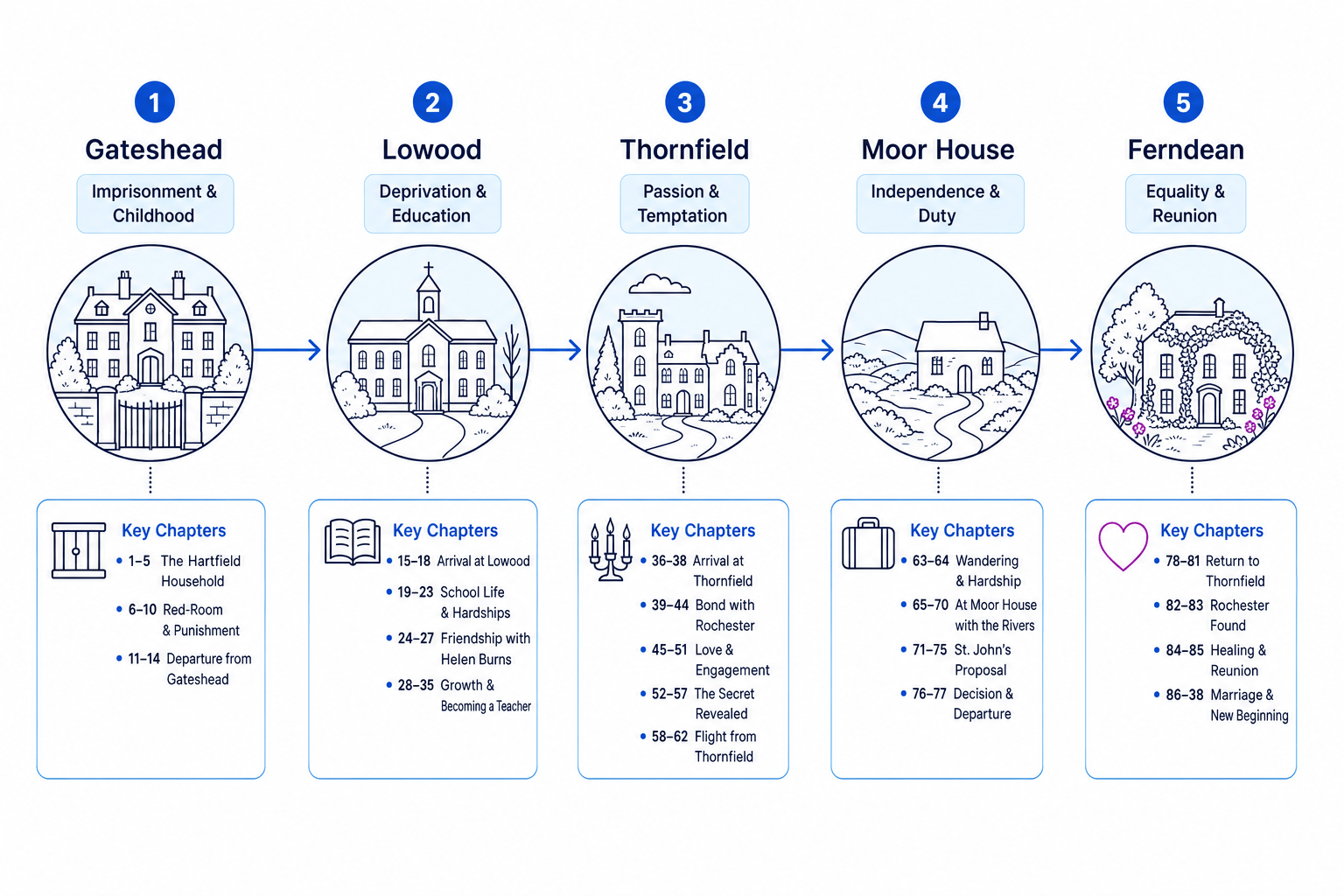
Structure Reflects Mind
Every time Jane changes location, she undergoes a psychological transition. If you are writing an essay about Jane's independence, you must discuss how her physical moves reflect her internal choices to protect her integrity.
Chapter 2: Gateshead & The Red Room (Imprisonment)
Chapter 2 is the catalyst for Jane's lifelong struggle against unjust authority. After fighting back against her abusive cousin John Reed, Jane is locked in the "Red Room"—the room where her uncle, Mr. Reed, died.
Key Methods and Analysis
- Gothic Conventions: Brontë uses Gothic elements to project Jane’s inner trauma onto her surroundings. The room is "cold," "silent," and dominated by "curtains of deep red damask."
- Color Symbolism: The red of the room symbolizes passion, anger, blood, and rebellion, while the "cold, white" bed represents the repressive, icy emotional climate of Gateshead. This tension between fire (passion) and ice (reason/control) is a structural motif that runs through the entire novel.
- The Rebel Slave Motif: Jane describes herself as "like a rebel slave, when confronted by the force of tyrannical power." This immediate political imagery establishes Jane's resistance to oppressive Victorian social structures.
Ignoring the Supernatural Context
Students often write that Jane actually sees a ghost in the Red Room. In fact, Brontë is more subtle: Jane's terror is psychological. The "gleam" of light she sees is a lantern outside, but her heightened, traumatized imagination interprets it as a spirit. Focus your analysis on how Brontë uses Gothic atmosphere to show Jane's psychological vulnerability.
Chapter 23: Thornfield & The Proposal (Equality and Foreshadowing)
Chapter 23 is the emotional climax of Jane's time at Thornfield. Sitting in the orchard under a great horse-chestnut tree, Rochester proposes to Jane. This chapter contains some of the most famous declarations of spiritual equality in English literature.
Key Methods and Analysis
- The Voice of Equality: When Jane believes Rochester intends to marry Blanche Ingram, she passionately asserts her human worth:
"I am no bird; and no net ensnares me; I am a free human being with an independent will, which I now exert to leave you."
- Spiritual Equality: Jane bypasses Victorian class systems by speaking directly to Rochester’s soul:
"it is my spirit that addresses your spirit; just as if both had passed through the grave, and we stood at God’s feet, equal,—as we are!"
- Pathetic Fallacy and Foreshadowing:
Pathetic Fallacy
The pathetic fallacy is a literary device where the writer attributes human emotions or traits to nature and inanimate objects, reflecting the inner mood of the characters or foreshadowing plot developments.
Before the proposal, the weather is warm and idyllic. However, immediately after Jane accepts, "the weather broke" and a storm begins. The chapter concludes with a powerful, ominous image: the great horse-chestnut tree in the orchard is "struck by lightning in the night, and half of it split away." This foreshadows the ruin of Thornfield and the splitting apart of Jane and Rochester on their aborted wedding day (Chapter 26).
Chapter 35: Moor House & The Call (Spiritual Autonomy)
In Chapter 35, Jane is at Moor House under intense pressure from St. John Rivers, who wants her to marry him and accompany him to India as a missionary. This chapter is the ultimate structural turning point of the novel.
Key Methods and Analysis
- Duty vs. Love: St. John offers Jane a life of cold, religious duty. He demands her "service," but he does not love her. Jane realizes that marrying him would "kill" her spirit: "if I join St. John, I abandon half myself."
- The Supernatural "Call": As Jane is on the verge of submitting to St. John's powerful, icy will, she suddenly hears a telepathic voice crying: "Jane! Jane! Jane!" It is Rochester’s voice, speaking to her across the moors.
- Structural Resolution: This voice is not presented as dark witchcraft, but as a "work of nature." It provides Jane with the spiritual clarity she needs to reject St. John and return to Rochester on her own terms—now an financially independent woman who has inherited her uncle's fortune.
Worked Example: Analyzing a Key Chapter Extract
Let's look at how to analyze a passage from a key chapter, integrating structural understanding, language analysis, and Victorian context.
Analyzing Pathetic Fallacy in Chapter 23
Extract from Chapter 23:
"But what had befallen the night? The moon was yet obscured; we were quite in darkness... A livid, vivid spark leapt out of a cloud at which I was looking, and there was a crack, a crash, and a close rattle; and then over-head, a sweeping gust of wind that stirred the trees deeply... I did not like to go back to the hall; I dreaded the house... "
Task: Analyze how Brontë uses language and structure in this extract to present Jane's relationship with Rochester.
-
Contextualize the structural moment: Show how the atmosphere shifts to signal danger.
Drafting the point: Brontë structures this moment immediately after Jane’s ecstatic acceptance of Rochester’s proposal, using a sudden dramatic shift in setting to shatter the romantic atmosphere and foreshadow the doom of their impending union.
-
Deconstruct the language and sensory methods: Analyze the auditory and visual imagery.
Selecting evidence: Analyze the juxtaposition of "livid, vivid spark" and the onomatopoeic "crack, a crash, and a close rattle." The harsh, explosive plosives ("crack," "crash") break the quiet of the orchard, symbolizing the violent disruption their socially transgressive engagement will cause in Victorian society. The contrast between the internal light of their love and the external "darkness" suggests their passion is blind to reality.
-
Link to character development and theme: Connect the extract to Jane's wider journey.
Synthesizing the effect: Jane’s admission that she "dreaded the house" highlights her intuitive Gothic dread. Thornfield represents the site of Rochester's dark secrets (Bertha Mason). By presenting the setting as hostile and threatening, Brontë structurally signals that Jane's moral safety is compromised at Thornfield, setting up her inevitable flight to Moor House to establish her independence.
In the exam
- Connect the Extract to the Whole: If your exam question features an extract from Gateshead, Lowood, or Thornfield, explain where this sits in Jane’s geographical journey and how it relates to her ultimate destination (Ferndean).
- Track the Pathetic Fallacy: Always comment on the weather and setting in the extract. Brontë never writes about rain, storms, fog, or sunshine by accident; it always mirrors Jane's internal state.
- Contrast Key Characters: Use the structural juxtaposition of Rochester (fire, passion, moral danger) and St. John Rivers (ice, duty, cold intellect) to show how Jane must find a middle path of "reasonable passion."
Check yourself
- How does the "Red Room" function as a metaphor for Jane's place in Victorian society?
- Why is it structurally crucial that the horse-chestnut tree is split in half after the proposal in Chapter 23 rather than before?
- In Chapter 35, what does Jane's rejection of St. John's proposal reveal about her views on marriage, duty, and spiritual independence?
