

To score highly in your AQA GCSE English Literature exam, you must show the examiner that you understand Anita and Me not just as a series of events, but as a carefully constructed piece of art. The novel's structure is the framework that Meera Syal uses to deliver her key messages about identity, belonging, and growing up.
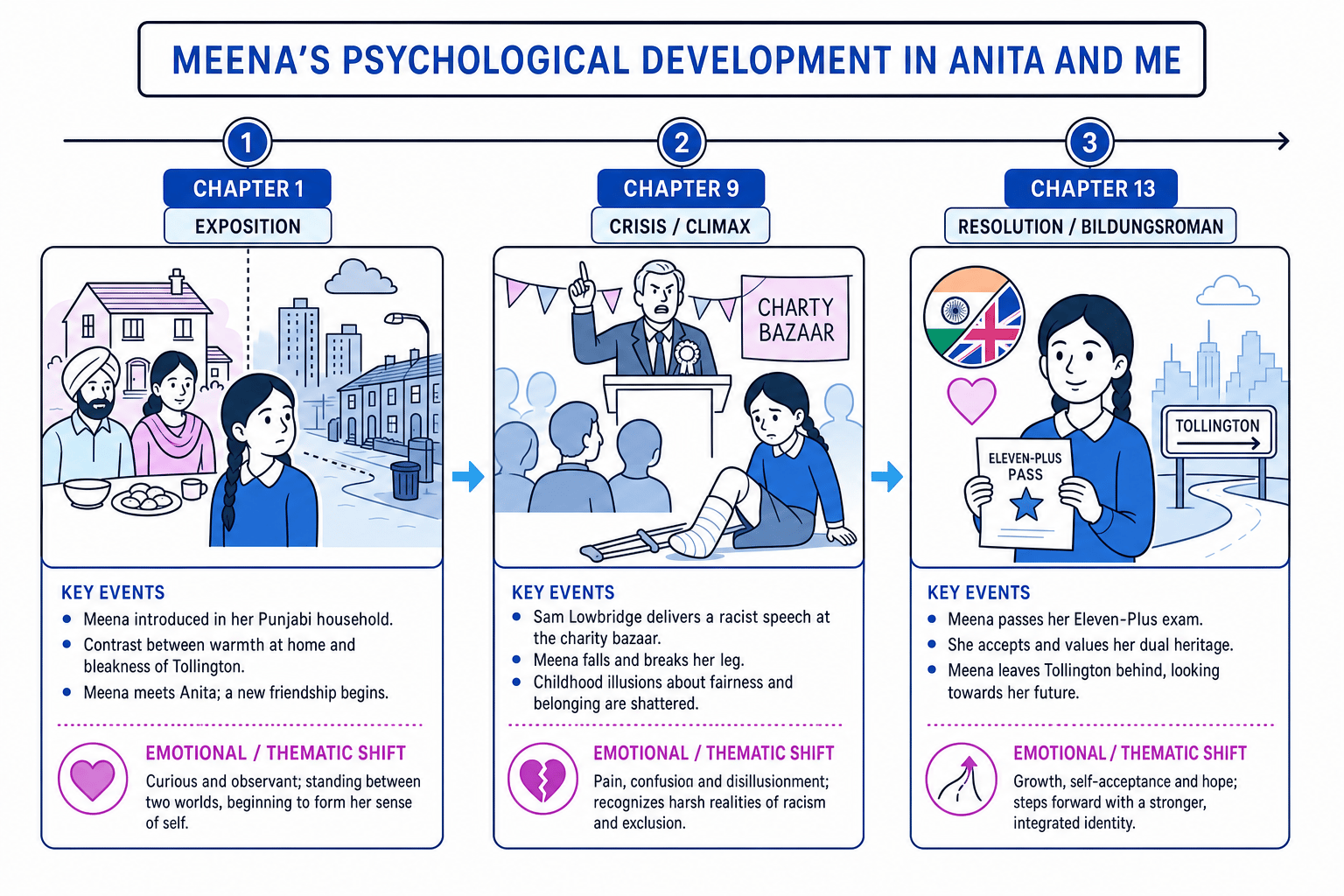
By focusing on three pivotal chapters—Chapter 1, Chapter 9, and Chapter 13—you can map the entire journey of the protagonist, Meena, and gain deep insights into Syal's structural choices.
The Power of Structure
In the exam, structural analysis is highly rewarded. Instead of just analyzing single words, look at how Syal contrasts chapters, positions key turning points, and uses the beginning and ending of the novel to show Meena’s growth.
What you'll learn
- How Syal structures the novel as a "coming-of-age" journey.
- The thematic and structural importance of Chapters 1, 9, and 13.
- How to write an analytical response linking structural developments to character and context.
Understanding Structure: The Bildungsroman
Before diving into specific chapters, we need to understand the overarching genre of the novel. Anita and Me is a classic example of a Bildungsroman.
Bildungsroman
A Bildungsroman is a novel that traces the psychological, moral, and social development of a protagonist from youth to maturity. The journey typically involves a loss of innocence, a clash with society, and a final acceptance of one's place in the world.
For Meena, this journey is complicated by her status as the daughter of Indian immigrants in a white, working-class mining village in the 1970s. Her psychological growth is deeply tied to her struggle with her dual identity.
Dual Identity
A dual identity refers to the experience of navigating and belonging to two distinct cultures at once. In Meena's case, she must balance her warm, traditional Punjabi home life with her desire to fit into the rough, exciting, white British world of Tollington.
Chapter 1: The Foundation of Identity and Conflict
Chapter 1 acts as the exposition of the novel, setting up all the key themes, conflicts, and character relationships.
Exposition
The exposition is the opening section of a narrative where the writer establishes the setting, introduces the main characters, and hints at the primary conflicts.
Setting the Scene
Syal immediately establishes a sharp contrast between the warm, secure, and sensory-rich interior of Meena’s family home and the bleak, grey, industrial landscape of Tollington outside.
- The Punjabi Home: Filled with the smells of "chutney and spices," the sound of laughter, and the security of her parents' unconditional love.
- Tollington: Described as "a dirty beast of a village," filled with coal dust, derelict buildings, and a sense of isolation.
This spatial contrast mirrors Meena's internal conflict. She is physically situated in Tollington but culturally anchored to her parents' homeland.
The Voice of the Narrator
The novel is written in the first person, but with a unique structural twist: it is told by an older, wiser Meena looking back on her nine-year-old self. Syal highlights this maturity right from the famous opening line:
"I was nine years old and a liar with it."
This retrospective narrative perspective allows Syal to inject humour, hindsight, and deep analytical reflections into the childish antics of young Meena.
Introducing Anita Rutter
Anita is introduced not just as a neighbor, but as a symbolic figure. To the young, insecure Meena, Anita represents absolute freedom, local authority, and "coolness":
- Anita is the leader of the "Tollington Wenches."
- She is "the local legend," possessing a confidence that Meena desperately craves.
- Structurally, Anita acts as the catalyst for Meena’s rebellion against her family's values.
Chapter 9: The Climax of Disillusionment
If Chapter 1 is about childhood innocence and the desire to belong, Chapter 9 is the climax of the novel—the ultimate turning point where Meena's illusions are shattered.
Climax
The climax is the point of highest tension or drama in a narrative, representing a major turning point for the characters.
Syal structures Chapter 9 around a devastating juxtaposition: the joy of the village charity bazaar is crashed by the ugly reality of racism.
Juxtaposition
Juxtaposition is the literary technique of placing two contrasting ideas, characters, or settings close together to highlight their differences and create a stronger emotional effect.
The Charity Bazaar and Sam Lowbridge's Outburst
During the bazaar, Sam Lowbridge (a young local man whom Meena previously admired as a harmless rebel) takes the stage. He delivers a venomous, racist speech, shouting:
"We don't want you here... this is our country."
This moment is structurally crucial. It is the first time Meena faces overt, public racism from someone she considered a friend.
- Syal uses the image of a "cold wind" blowing through the crowd to capture the sudden, chilling atmosphere.
- Anita's passive reaction—she does not defend Meena and continues to hang around Sam—proves to Meena that her "goddess" is deeply flawed, complicit, and ultimately weak.
The Broken Leg: A Metaphor for Separation
Directly following this emotional trauma, Meena goes horse riding with Anita—an act of defiance against her parents. She falls and breaks her leg.
This accident is structurally highly symbolic:
- Physical Isolation: The broken leg physically separates Meena from Anita and Tollington. She is sent to a hospital far away.
- Intellectual Growth: In the hospital, Meena meets Robert, a well-mannered, educated boy who introduces her to books and intellectual conversation.
- The Death of Childhood: The physical "fracture" of her bone represents the permanent fracture of her childhood illusions. She can never go back to being the naive girl who worshipped Anita.
Analysing the structural turning point in Chapter 9
Let's walk through how to structure a high-scoring analytical paragraph focused on the events of Chapter 9.
-
Step 1: State your point clearly, focusing on structure and theme.
Example: In Chapter 9, Syal uses a structural turning point to shatter Meena’s childhood innocence, shifting the novel from a light-hearted coming-of-age story into a confrontational exploration of 1970s British racism.
-
Step 2: Introduce precise textual evidence showing juxtaposition.
Example: During the community-focused "charity bazaar," a symbol of village unity, Sam Lowbridge delivers a hateful xenophobic rant, declaring, "we don't want you here."
-
Step 3: Analyze the writer's methods (AO2) and their effect on the reader.
Example: The juxtaposition of the festive village gathering with Sam’s sudden hostile outburst highlights how deeply embedded racism was in the working-class community of Tollington. Syal's use of the metaphor of a "cold wind" blowing through the crowd reflects Meena's sudden emotional numbness and isolation. The community's silence during his speech reveals how passive complicity enables prejudice, forcing Meena to realize that her dream of seamless assimilation into Tollington is impossible.
-
Step 4: Integrate context (AO3) naturally to explain why Syal wrote this.
Example: This scene reflects the rising racial tensions in 1970s Britain, a period marked by Enoch Powell's infamous "Rivers of Blood" speech and the rise of the National Front. By placing this macro-political conflict at the heart of a local village fair, Syal demonstrates how young second-generation immigrants like Meena could not escape the hostile political landscape of their era, marking a crucial step in her journey towards self-awareness and maturity.
Chapter 13: Resolution, Maturity, and Saying Goodbye
The final chapter of the novel serves as the resolution of the Bildungsroman.
Resolution
The resolution is the final part of a narrative where the main conflicts are resolved, loose ends are tied up, and a new state of stability or understanding is reached.
Syal structures the final chapter to show complete closure and a total shift in power dynamics between Meena and Anita.
The Eleven-Plus Exam
Meena passes her Eleven-Plus exam, securing a place at the prestigious grammar school.
- Structurally, this is her golden ticket out of Tollington.
- It creates a sharp contrast with Anita, who fails to progress academically and remains trapped in the cycle of neglect and poverty that defines her household.
- The academic divergence highlights that while Meena’s world is expanding, Anita's is shrinking.
Leaving Tollington
The Kumar family prepares to move to a larger, suburban house. This physical relocation mirrors Meena's psychological departure from her childhood self.
Before she leaves, Meena has one final encounter with Anita. Instead of begging for Anita's attention, Meena looks at her with a mix of pity and understanding. Anita gives Meena a small, silent nod of acknowledgment.
- This silent exchange represents a catharsis (an emotional release).
- Meena no longer needs Anita's validation. She has found her own voice.
Acceptance of Dual Identity
By the end of Chapter 13, Meena no longer feels forced to choose between being "Indian" and being "British." She embraces her dual identity as a strength rather than a weakness, looking forward to her future with confidence and self-possession.
Overlooking Anita's Tragedy
When writing about Chapter 13, do not make the mistake of viewing Meena's departure as a simple "happy ending." While Meena escapes and grows, Anita is left behind in an abusive, unstable environment. Syal wants us to feel sympathy for Anita's tragic, limited circumstances, even as Meena outgrows her.
In the exam
When writing about key chapters in Anita and Me, make sure you do the following:
- Track structural changes: Do not treat the characters as static. Always explain how a character changes from the beginning (Chapter 1), to the middle (Chapter 9), to the end (Chapter 13).
- Use structural terminology: Boost your AO2 marks by using precise terms like exposition, climax, juxtaposition, foreshadowing, and resolution.
- Weave context into structural shifts: Explain how the events of Chapter 9 reflect historical 1970s racial tensions, or how Chapter 13's focus on the Eleven-Plus exam reflects the rigid social mobility and educational system of the era.
Check yourself
- Why does Meera Syal use an older narrator to look back on Meena's childhood in Chapter 1?
- How does Meena's broken leg in Chapter 9 act as a physical and emotional metaphor?
- In what ways does the final chapter (Chapter 13) resolve Meena's internal conflict regarding her dual identity?
