

When you sit down to write your GCSE English Literature essay on Anita and Me, it is easy to feel overwhelmed. You are faced with a blank page and a ticking clock.
However, the secret to a high-scoring, convincing essay is not writing as fast as you can; it is spending five to eight minutes planning. A well-structured essay keeps your writing focused, ensures you meet all the Assessment Objectives, and prevents you from running out of ideas halfway through.
What you'll learn
- How to decode an exam question and construct a powerful thesis statement.
- How to structure your essay chronologically or thematically to track Meena's development.
- How to build a balanced essay plan that integrates quotation analysis (AO1), writer's methods (AO2), and 1970s social context (AO3).
The Foundation of a Great Essay Plan
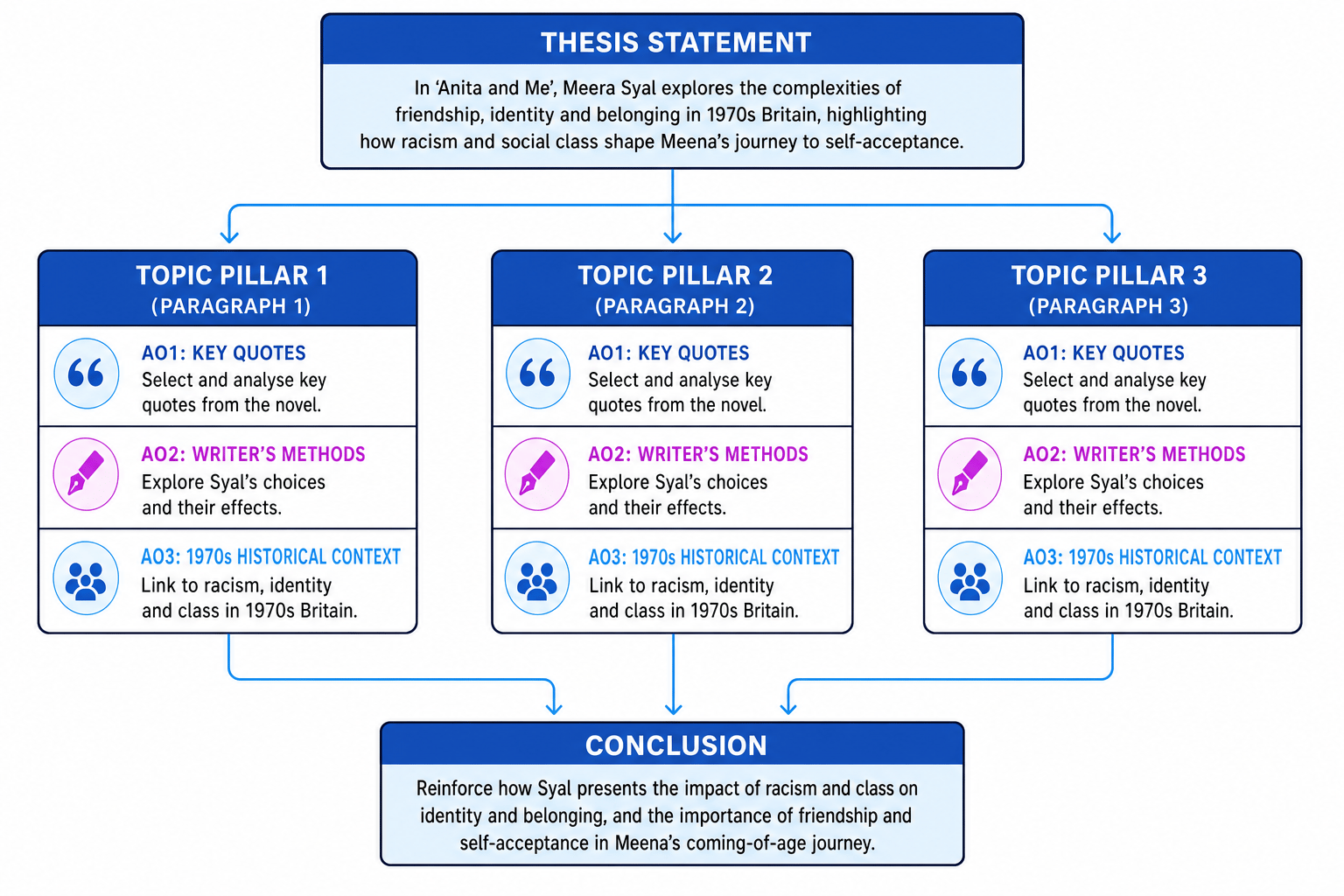
Before you start writing, you need a blueprint. A great essay plan must address the three major Assessment Objectives that examiners look for in your response to Anita and Me.
Assessment Objectives (AOs) in Paper 2
- AO1: Your response to the text, backed up by precise, remembered quotations. This requires a clear, logical line of argument.
- AO2: Your analysis of Meera Syal's language, form, and structural choices, exploring how she creates meaning.
- AO3: Your understanding of the relationship between the novel and its context (1970s Britain, racism, working-class communities, and post-colonial migration).
The structure below illustrates how a successful essay plan routes a single, guiding argument (your thesis) down into three supporting pillars, each balancing these key objectives.
The Thesis Statement: Your North Star
Your essay should never be a random list of thoughts. Instead, it must be thesis-led.
Thesis Statement
A thesis statement is a one- or two-sentence argument, placed at the very start of your essay, that directly answers the question. It acts as an umbrella under which all your subsequent paragraphs sit.
Instead of writing: "In this essay, I will show how Meena struggles with her identity in Tollington," a high-scoring thesis statement takes a stand:
“Syal presents Meena’s search for identity not as a simple choice between two cultures, but as a painful, necessary negotiation. Through Meena’s relationships with the seductive but superficial Anita and her own traditional Punjabi family, Syal suggests that true maturity requires accepting a complex, hyphenated identity.”
A thesis is an argument, not a fact
A great thesis statement cannot be answered with a simple "yes" or "no". It is an interpretation that you must prove using the text.
Structuring Your Essay
Because Anita and Me is a bildungsroman (a coming-of-age novel), the most natural and effective way to structure your essay is chronologically. This allows you to track Meena’s psychological and emotional growth over time.
- Paragraph 1: Early Innocence and Rebellion. Explore Meena's initial rejection of her Punjabi background. She lies, seeks drama, and is seduced by Tollington’s working-class grit, embodied by Anita.
- Paragraph 2: Conflict and Crisis. Look at the middle of the novel where Meena's two worlds collide. This is where she witnesses racism (e.g., Sam Lowbridge at the spring fair) and begins to see the limitations of Anita's world.
- Paragraph 3: Maturity and Resolution. Examine Meena's final transformation. She rejects Anita's superficial path, embraces her family's academic expectations, and accepts her dual heritage as she prepares to leave Tollington.
The Bildungsroman structure
Organising your paragraphs to follow Meena's maturity means your essay's structure mirrors the novel's structure. This automatically helps you pick up marks for AO2 (structure).
Working Through an Essay Plan
Let's look at how to put these principles into practice under timed conditions.
Developing a Thesis and Section Plan
Exam Question: Explore how Syal presents the relationship between Meena and Anita in the novel.
Follow these steps to construct a high-scoring, three-part essay plan.
-
Deconstruct the prompt and draft a thesis statement. Identify the key terms in the prompt: "relationship", "Meena", and "Anita". Instead of just saying they are friends who grow apart, analyze why Syal created this dynamic. Draft Thesis: "Syal uses the volatile relationship between Meena and Anita to represent Meena's internal conflict between British assimilation and her Punjabi heritage. While Anita initially represents independence and working-class 'coolness' to Meena, their eventual drift highlights Meena’s growth from a naive child seeking acceptance to an independent young woman who recognizes the toxic nature of superficial belonging."
-
Plan Paragraph 1: The Attraction of the 'Other' (Early Relationship). Focus on why Meena is drawn to Anita.
- AO1 (Evidence): Meena views Anita as "the leader, the undisputed boss", possessing a "cool, blonde, sassy" demeanor. Anita's family life seems exotic to Meena because it lacks the strict academic expectations of her own home.
- AO2 (Analysis): Syal uses sensory language and colloquialisms to paint Anita as a larger-than-life figure of teenage rebellion. Anita represents the "ultimate commodity"—social status.
- AO3 (Context): This reflects the socio-economic reality of 1970s working-class Tollington, where academic success is rare, and social capital is built on defiance and local street culture.
- Plan Paragraph 2: Cracks in the Facade (The Middle Transition). Examine how the relationship begins to fracture under the pressure of maturity and societal prejudice.
- AO1 (Evidence): The turning point occurs when Meena witnesses the overt racism of Sam Lowbridge, with whom Anita is associated. Anita's silence or participation in casual bigotry makes Meena realize that her ethnic background places an invisible barrier between them.
- AO2 (Analysis): Syal uses dramatic irony and contrasting dialogue. Meena's voice becomes more reflective and standard-English-dominated, while Anita's remains static and colloquial, highlighting their widening intellectual and moral gap.
- AO3 (Context): The rising racial tensions of 1970s Britain (influenced by politicians like Enoch Powell and the National Front) infiltrate the small mining village, forcing Meena to confront the reality of her difference.
- Plan Paragraph 3: Independence and Rejection (The Resolution). Analyze the final breakdown of the friendship and what it symbolizes.
- AO1 (Evidence): By the end of the novel, Meena realizes she has a "family who loved me" and that she "did not belong to Tollington anymore." Anita is left behind, stuck in the cycle of deprivation, while Meena looks toward the future.
- AO2 (Analysis): Syal uses structural contrast. The final chapters move away from the physical streets of Tollington to Meena’s hospital bed and her study space, symbolizing her transition into a mental world of academic progress that Anita cannot access.
- AO3 (Context): Syal highlights the social mobility available to children of immigrants who embraced education (the "immigrant work ethic") compared to the structural decay and lack of opportunity facing working-class white youths in post-industrial Britain.
The 'Good vs. Bad' Trap
Do not write about Anita as simply a "bad friend" or a villain. Syal portrays Anita with immense empathy. She is a victim of parental neglect, poverty, and a lack of social mobility. A top-tier essay explains why Anita is trapped, rather than simply judging her character.
Integrating Context (AO3) Naturally
One of the hardest parts of writing a GCSE English Literature essay is avoiding "context dumping." This happens when you write a paragraph of pure history that has nothing to do with your literary analysis.
Do not 'dump' history
Writing: "In the 1970s, many Indian immigrants moved to the UK because of the partition of India." is a history fact, not literature analysis. It will not get you many marks unless you link it directly to Meena's feelings.
Instead, weave context directly into your language analysis.
- Ineffective integration:
"Syal shows that racism was bad in the 1970s. Sam Lowbridge says bad things at the fair, which shows the National Front was popular."
- Effective integration:
"Through the character of Sam Lowbridge, Syal captures the growing undercurrent of xenophobia that characterized 1970s working-class Britain. When Sam delivers his racist speech at the spring fair, Syal uses Meena’s shock to expose how national political movements, such as the rise of the National Front, easily manipulated disillusioned, working-class youths who sought a scapegoat for their own economic marginalisation."
In the exam
- Spend the first 2 minutes decoding the question: Circle the key terms (e.g., "belonging", "family", "prejudice", "growth") and write down your immediate, instinctive answer.
- Draft your Thesis Statement immediately: Write it out in full at the top of your planning page. It will keep your entire essay on track.
- Select 4–5 short, explosive quotes: Write these down in your plan next to the paragraphs you intend to use them in. Short quotes like "ultimate commodity", "uninvited guest", or "proud mining village" are easy to memorize and highly versatile.
- Plan your chronological route: Ensure your three main body paragraphs follow Meena’s developmental journey from early childhood innocence to mature self-awareness.
- Check your AO balance: Before you start writing the actual essay, glance at your plan and make sure every paragraph has a designated structural or language term (AO2) and a specific piece of historical context (AO3).
Check yourself
- Can you write down a thesis statement for an essay about the presentation of Mama (Shama) in under two minutes?
- How does the structure of Anita and Me as a coming-of-age story (bildungsroman) affect how you should plan your paragraph order?
- What are three short, multi-purpose quotations that you can use to show Meena’s changing feelings toward Tollington?
