

Understanding the context of a novel is not just about memorising historical facts; it is about understanding why the characters act the way they do and what the writer is trying to communicate about the world. For Meera Syal's Anita and Me, context is the very air the characters breathe.
In these study notes, you will learn how the turbulent social and political landscape of 1970s Britain directly influences Meena’s coming-of-age journey.
What you'll learn
- How the socio-historical shifts of 1970s Britain—including immigration, economic decline, and political racism—shape the community of Tollington.
- How Meena navigates her dual cultural heritage (her "hyphenated identity").
- How to seamlessly integrate contextual analysis (AO3) into your essays to meet the highest levels of the AQA mark scheme.
Defining Context (AO3)
Before diving into the history, it is crucial to understand what the exam board is looking for. AQA assesses context under Assessment Objective 3 (AO3).
Context (AO3)
Context is the relationship between the text and the social, historical, cultural, and literary conditions in which it was written and received. It is not "extra information" bolted onto an essay; it is the framework that helps you understand the writer's underlying message and choices.
In Anita and Me, context is represented on multiple levels. It is a story about a specific time (the early 1970s), a specific place (the Black Country in the West Midlands), a specific cultural experience (being British-Punjabi), and a specific literary genre (the Bildungsroman).
Bildungsroman
A Bildungsroman is a literary genre that depicts the psychological, moral, and social growth of a protagonist from youth to adulthood. It is commonly referred to as a "coming-of-age" story.
The Socio-Historical Landscape of 1970s Britain
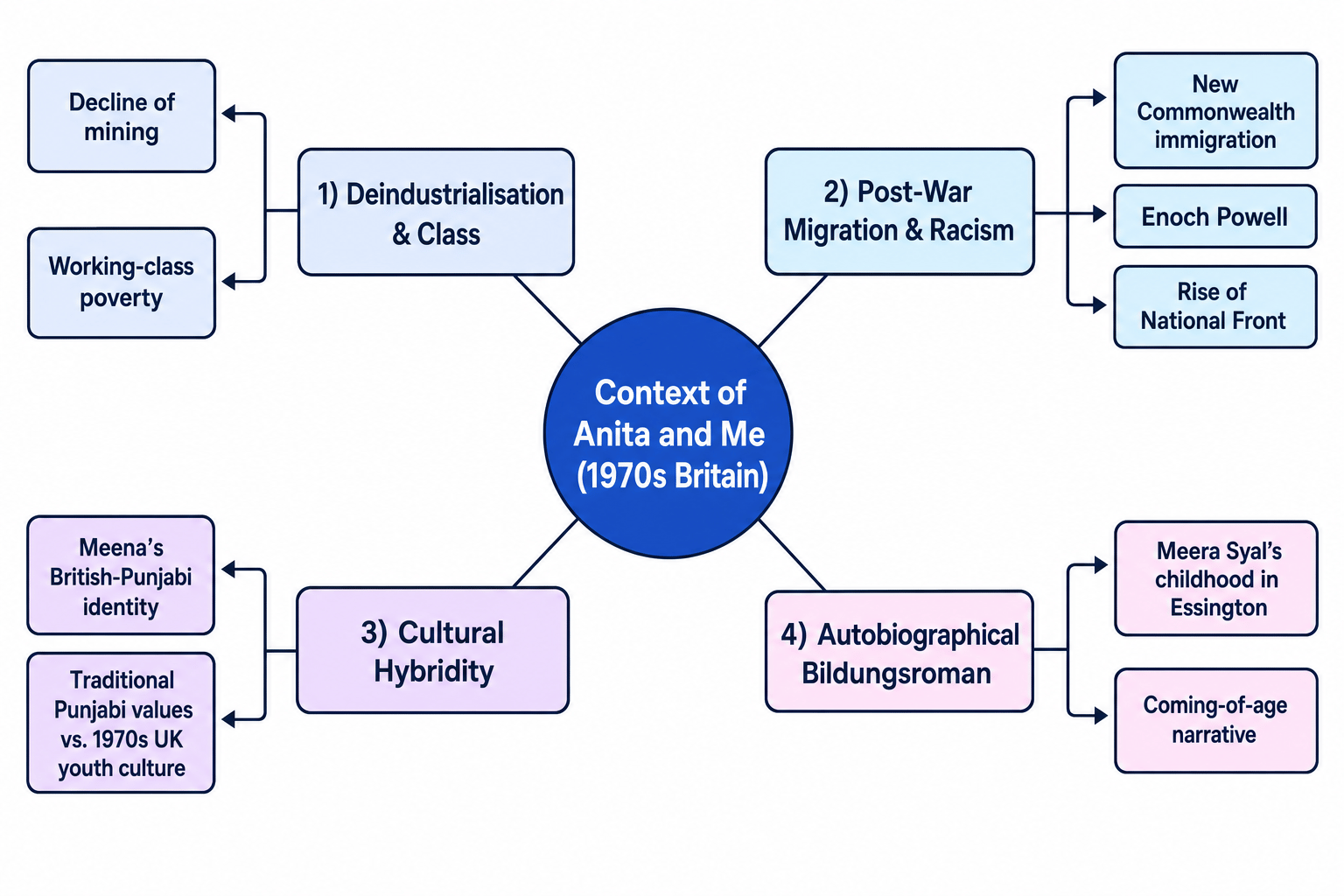
The novel is set in Tollington, a fictionalised version of Essington, a real mining village in Staffordshire, near Wolverhampton. The time is the early 1970s—a period of immense transition and friction in British history.
Post-War Migration and the "New Commonwealth"
Following the Second World War and the breakup of the British Empire, Britain experienced significant waves of migration. The British Nationality Act 1948 gave citizens of the British Empire the right to settle and work in the UK.
Meena’s parents, Shyam and Daljit Kumar, are part of this post-war migration from the Punjab region of India. They represent the educated, professional class of immigrants who came to the UK seeking opportunities, only to find their professional qualifications often undervalued and their presence met with varying degrees of hostility.
The Rise of Racism and Enoch Powell
The late 1960s and 1970s saw a sharp rise in organized racism and xenophobia in the UK.
- Enoch Powell's "Rivers of Blood" Speech (1968): Delivered in nearby Birmingham, this notorious speech warned of apocalyptic violence if immigration from the Commonwealth was not halted. It deeply affected the public consciousness and legitimized casual and systemic racism.
- The National Front: A far-right, fascist political party that gained traction in the 1970s by exploiting economic anxieties and scapegoating immigrant communities.
In the novel, this political undercurrent breaks into Meena’s world. It is seen in the casual use of racial slurs by local children, the verbal abuse targeted at Meena’s father in the local pub, and most dramatically in Sam Lowbridge’s xenophobic speech at the charity bazaar, where he shouts, "This is our country now."
The Paradox of Tollington
Syal depicts Tollington as initially feeling insulated and safe for Meena, a place where her family is liked and accepted. However, this is a fragile illusion. The outside political climate eventually penetrates the village, forcing Meena to realize that her family's acceptance is conditional and fragile.
Deindustrialisation and Class Tension
During the 1970s, Britain’s traditional heavy industries—such as coal mining, steel production, and manufacturing—were in steep decline. This process, known as deindustrialisation, hit working-class communities like the Black Country particularly hard.
- Economic Stagnation: The closure of the mines led to high unemployment, poverty, and a sense of hopelessness among the white working class.
- The Rutter Family vs. The Kumar Family: The Rutters (Anita’s family) represent the devastating impact of this economic decline. They suffer from poverty, domestic instability, and lack of social mobility. In contrast, the Kumars are middle-class, highly educated, and upwardly mobile. This class difference creates a subtle tension: the white working-class villagers are economically trapped, while the immigrant family they look down on is steadily progressing.
Cultural Clash and Hyphenated Identity
Meena exists at the intersection of two distinct cultures. Syal uses her protagonist to explore what it means to grow up with a "hyphenated identity."
Hyphenated Identity
A hyphenated identity refers to the state of living with and balancing two distinct cultural heritages—in Meena's case, being British-Asian (specifically, British-Punjabi).
Punjabi Collectivism vs. Tollington's Individualism
Meena’s household is governed by traditional Punjabi cultural values:
- Collectivism and the "Aunty" network: The family belongs to a tight-knit community of fellow Indian immigrants who refer to each other as "Aunty" and "Uncle." They offer mutual support, share stories of the "Partition of India" (the violent division of India and Pakistan in 1947), and uphold strict moral codes.
- Academic and Moral Aspiration: Shyam and Daljit place immense value on education, respectability, and family loyalty.
Outside her home, Meena is seduced by the rebellious, individualistic youth culture of 1970s Britain:
- Glam Rock and Teen Culture: This era saw the rise of teenage rebellion, glam rock music, and magazines like Jackie.
- Anita Rutter: Anita represents the ultimate freedom to Meena. She is loud, sweary, physically bold, and seemingly answerable to no one. To Meena, Anita’s neglectful home life initially looks like enviable independence.
Ignoring the Nuance of Anita's Character
Do not write Anita off as simply a "bad influence." Syal uses Anita's character to critique the social failures of 1970s Britain. Anita's tough exterior is a coping mechanism for maternal abandonment, poverty, and neglect—issues that the tight-knit, collectivist Punjabi community would never allow a child to suffer.
Autobiographical Elements
It is highly beneficial to acknowledge that Anita and Me is a semi-autobiographical novel.
- Meera Syal was born in 1961 in Essington, Staffordshire. Like Meena, she was the daughter of Punjabi immigrants and was the only non-white child in her mining village.
- Syal used her own lived experience to capture the precise textures of 1970s language, food, music, and the complex psychological toll of being a minority child trying to fit into a white working-class environment.
Syal's Narrative Perspective
Because the novel is written from the perspective of an adult Meena looking back on her childhood, Syal is able to combine a child’s direct, emotional experience of events with an adult's sophisticated, socio-political understanding of the 1970s.
Integrating Context (AO3) into an Essay Paragraph
To get the highest marks (Level 5 and 6) in the AQA exam, you must never write a "history paragraph" where you list facts about the 1970s. Instead, you must weave context directly into your language and thematic analysis.
Use the PEEC structure: Point, Evidence, Effect (including language analysis), and Context (linking the effect to the wider social/historical landscape).
Here is a walk-through of how to construct an analytical paragraph that successfully integrates AO3 context.
Integrating AO3 context into literary analysis
Essay Question: How does Syal present the impact of prejudice in the novel?
-
Step 1: Write a clear thematic point.
Start by identifying how Syal uses a character to reflect prejudice.
Draft: Syal presents prejudice not just as an individual flaw, but as a destructive social force that is fueled by the economic anxieties of 1970s Britain.
-
Step 2: Introduce a precise quotation and analyze its language (AO2).
Select a quotation that shows a character expressing prejudice, and dissect the writer's methods.
Draft: This is most clearly illustrated through Sam Lowbridge’s hostile speech at the charity bazaar, where he boasts to the crowd, "We are the ones... who give this place its heart," while warning against "outsiders." The use of the exclusive pronoun "we" creates a stark binary opposition between the white working-class villagers and immigrant families like the Kumars. By positioning the working class as the sole "heart" of the community, Sam attempts to strip immigrant families of their belonging and humanity.
-
Step 3: Connect the analysis directly to historical and social context (AO3).
Explain the real-world historical forces that Syal is commenting on through this specific scene.
Draft: This moment directly mirrors the real-world political landscape of 1970s Britain, a period marked by deindustrialisation and the decline of traditional mining communities. The closing of industries left the white working class facing severe economic stagnation and poverty. Syal contextually positions Sam’s xenophobia as a response to this displacement; his rhetoric directly echoes the anti-immigration speeches of politicians like Enoch Powell and the rise of the National Front, who scapegoated immigrant populations for local economic decline.
-
Step 4: Conclude by explaining the writer's overarching message.
Synthesise your analysis to show why Syal chose to present this interaction in this way.
Draft: Therefore, Syal uses Sam's outburst to show how macro-level national politics can infiltrate and fracture even the tightest rural communities, revealing that Meena’s sense of safety in Tollington was merely an illusion.
In the exam
- Avoid "history dumping": Never start a paragraph with a historical fact (e.g., "In the 1970s, Enoch Powell gave a speech..."). Always start with a literary point about Syal's characters, themes, or methods, and weave the context in naturally.
- Use precise terminology: Impress the examiner by using terms like Bildungsroman, hyphenated identity, collectivism, deindustrialisation, and semi-autobiographical to structure your thoughts.
- Compare cultural values: When discussing Meena's conflict, directly contrast the traditional Punjabi values of her home with the 1970s British working-class environment of Tollington. This shows a deep, holistic understanding of the novel's dual cultural context.
Check yourself
- How did the decline of the mining industry in 1970s Britain affect characters like the Rutters, and how does this contrast with the Kumars' situation?
- What was the political significance of Enoch Powell’s "Rivers of Blood" speech, and which character’s actions in the novel directly echo this political rhetoric?
- Why is it helpful to analyze Anita and Me as a semi-autobiographical Bildungsroman rather than just a purely fictional story?
