

In Anita and Me, characters are not merely lifelike individuals; they are deliberate tools designed by Meera Syal to explore the complex realities of growing up as the daughter of Punjabi immigrants in a working-class English mining village during the 1970s.
To achieve the highest marks in your GCSE, you must move beyond describing what characters do and instead analyze what they represent and how Syal crafts them.
What you'll learn
- How to analyze Meena and Anita as symbolic foils representing different paths of coming of age.
- How the Kumar family and Nanima act as anchors of cultural identity and security.
- How to decode Syal's language to reveal the deeper thematic purpose of each character.
Concept 1: Characters as Literary Constructs
To succeed in your AQA exam, you must treat characters as constructs. A writer does not create characters by accident; they are engineered to carry specific themes, represent social classes, or highlight cultural tensions.
Construct
A construct is a character created by an author to represent a specific idea, theme, or social group, rather than just existing as a realistic person.
Syal’s novel is a classic Bildungsroman—a coming-of-age novel tracking the psychological and moral growth of its protagonist from youth to maturity.
Bildungsroman
A Bildungsroman is a literary genre that focuses on the psychological and moral growth of the protagonist from youth to adulthood.
Meena Kumar: The Protagonist in Transition
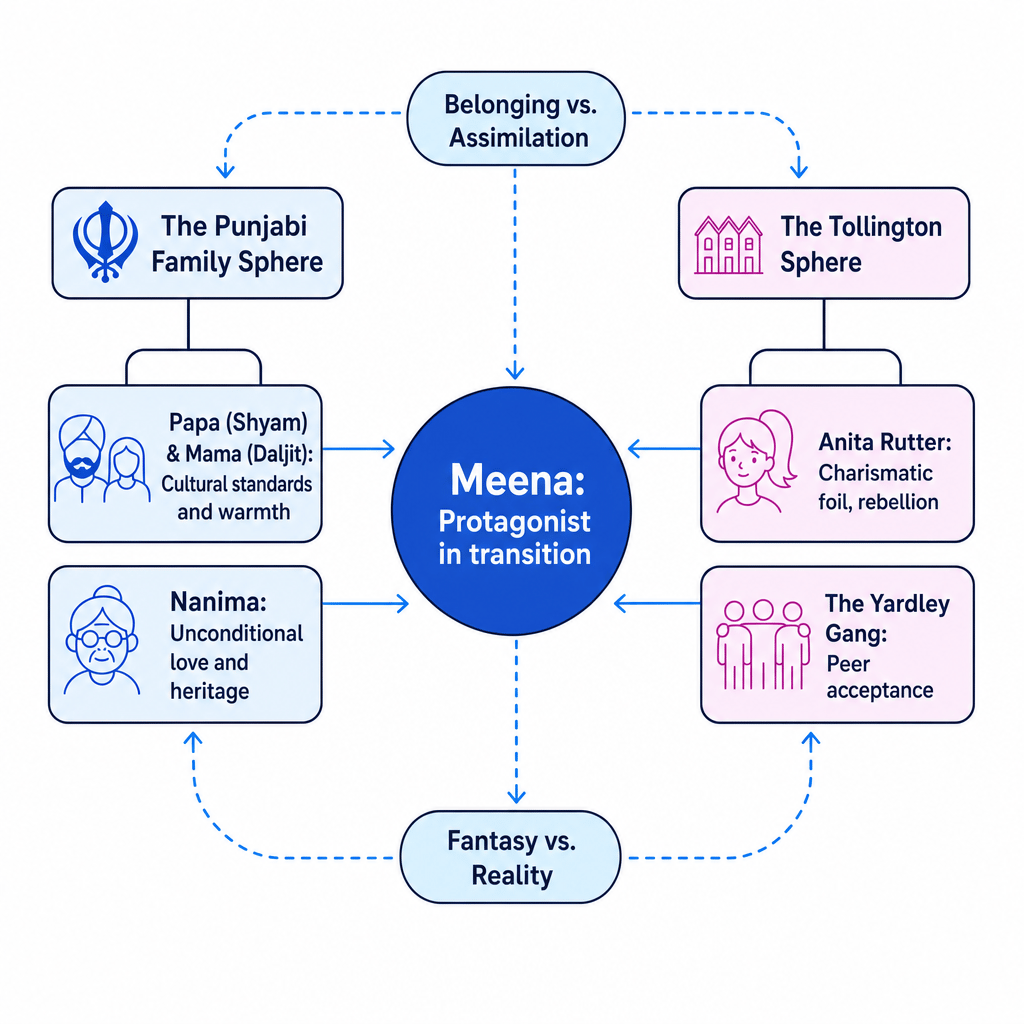
Meena is the novel's narrator and protagonist. Through her dual identity, Syal explores the painful friction between assimilation (trying to fit into British culture) and cultural preservation (honoring her Punjabi heritage).
At the start of the novel, Meena is insecure, prone to telling dramatic lies, and desperate to escape what she views as the dull, restrictive boundaries of her family life. She describes herself as being caught between two worlds:
"I was two people, which was not a bad thing, but it was a bit confusing... a Punjabi daughter... and a Tollington tomboy."
Syal uses Meena’s journey to show that maturing requires accepting your whole self, rather than rejecting one culture to please another.
Treating characters like real people
Do not write about Meena or Anita as if they are your real-life friends. Avoid phrasing like: "Meena was wrong to lie to her mother." Instead, write: "Syal uses Meena's compulsive lying as a literary device to symbolise her internal confusion and her struggle to find an authentic voice."
Concept 2: The Core Contrast – Meena and Anita
The emotional heart of the novel lies in the relationship between Meena and Anita Rutter. Syal structures their relationship as a classic pairing of foils.
Foil
A foil is a character who contrasts sharply with another character (usually the protagonist) to highlight particular qualities, flaws, or struggles in that character.
Anita Rutter: The Allure and Reality of Rebellion
Initially, Meena romanticizes Anita as a symbol of absolute freedom, confidence, and coolness. She is "the leader, the one I had identified as a soul mate." Anita represents everything Meena thinks she wants: she is loud, rebellious, and answers to no one.
However, as Meena grows up, Syal gradually strips away this romantic veneer to reveal Anita’s harsh reality:
- Neglect and Poverty: Anita is emotionally and physically neglected by her mother, Deirdre. Her rebellion is actually a defense mechanism against a bleak, unstable home life.
- Lack of Agency: While Meena has a supportive family pushing her toward higher education, Anita's future is limited by her environment and socio-economic class.
- Cruelty: Anita’s insecurity makes her easily swayed by prejudice, culminating in her passive acceptance of racist behavior from figures like Sam Lowbridge.
The Illusion of Anita
Syal uses Anita to show that the "freedom" Meena envies is actually a form of abandonment. Anita's lack of parental boundaries is not liberation; it is neglect. By contrasting them, Syal highlights how Meena’s seemingly restrictive household is actually a source of privilege and strength.
Concept 3: The Pillars of Identity – The Kumar Family and Nanima
While Tollington represents the messy, changing external world, the Kumar household represents safety, intellect, and culture.
Papa (Shyam) and Mama (Daljit)
Shyam and Daljit Kumar represent the first-generation immigrant experience. They face systemic prejudice with quiet dignity and place an immense value on education and community.
- Papa (Shyam): Charming, musical, and deeply moral. He uses music to connect with his roots, and his warmth makes him popular in the village. Yet, he carries deep trauma from the Partition of India, which Syal hints at to show the unseen depth of the immigrant generation.
- Mama (Daljit): The emotional compass of the home. Though she often clashes with Meena over traditional expectations, her fierce love and protective nature shield Meena from the harsher realities of British racism.
Nanima: The Ultimate Link to Heritage
The arrival of Nanima (Meena's maternal grandmother) is the turning point in Meena’s development.
Nanima is a "warm, solid anchor" who does not speak English but communicates through unconditional love, storytelling, and food. She represents a pure, uncompromised connection to India. Through Nanima, Meena realizes that her Punjabi heritage is not a burden or an embarrassment, but a rich source of pride and identity.
Worked Example: Analyzing Character Foil Dynamics
Let's look at how to construct an analytical paragraph analyzing how Syal uses the foil dynamic between Meena and Anita to show Meena's growing maturity.
Analyzing character foil dynamics
Question: Explore how Syal uses the contrast between Meena and Anita in Chapter 9 to present Meena's growth.
-
Point (Identify the contrast): Syal uses the contrasting reactions of Meena and Anita to Sam Lowbridge’s racist outburst at the charity fair to illustrate Meena's moral awakening and her ultimate detachment from Anita's influence.
-
Evidence & Method (Examine the language): While Meena is devastated by Sam's hate speech, recognizing that she is the target of his vitriol, Anita remains aligned with him, laughing and complicit. Later, Meena looks at Anita and realizes: "Anita did not love me, she did not even like me..." Syal uses the stark, monosyllabic phrasing of Meena's internal monologue to highlight the sudden, painful clarity of this realization. The romanticized illusion of Anita as a "soul mate" is shattered.
-
Effect & Context (Connect to theme and social context): By contrasting Meena's sudden moral clarity with Anita's passive alignment with racism, Syal demonstrates that Meena has outgrown her childhood idol. This foil dynamic highlights that Meena's journey to maturity requires her to reject the superficial allure of Tollington's rebellious youth culture in order to protect her personal integrity and embrace her cultural identity.
Contextual integration (AO3)
When writing about the Kumar family, remember to connect their high expectations for Meena to their context as middle-class, highly educated immigrants in 1970s Britain. Often, immigrant parents had to be twice as qualified as their white British peers to secure stable employment, which explains why they place such a high premium on Meena’s grammar school entrance exams.
In the exam
- Focus on the Writer's Craft: Always use the writer's name (Syal) to remind yourself that the characters are deliberately constructed. Write "Syal constructs Anita to represent..." rather than "Anita is...".
- Anchor Character to Theme: Every time you write about a character, link them to a wider theme (e.g., "Syal uses Nanima to explore the theme of cultural heritage and the pain of displacement").
- Trace the Character Arc: Don't treat a character as static. Show how they change from the exposition (the beginning), through the rising action, to the resolution. Meena starts as an insecure liar and ends as a confident, self-aware young woman ready to leave Tollington.
Check yourself
- Why does Syal use Meena's habit of lying in the early chapters, and how does this change by the end of the novel?
- In what ways does Anita Rutter act as a foil to Meena Kumar? Identify at least two distinct differences in their domestic lives.
- How does the character of Nanima alter the atmosphere of the Kumar household and impact Meena’s sense of cultural identity?
