

In your GCSE English Literature exam, you won't just be asked to retell the story of Animal Farm. Instead, you must show how George Orwell uses his characters and plot to explore deep, real-world ideas. These ideas are the themes of the novella.
By understanding these themes, you will unlock the deeper meaning behind the rebellion on Manor Farm and be able to write high-scoring essays that meet the Assessment Objectives (AOs) for analysis and context.
What you'll learn
- How power corrupts the pigs, turning an idealistic rebellion into a dictatorship.
- How language and propaganda are weaponised to control and deceive the uneducated.
- How the exploitation of the working class exposes the tragic failure of the revolution.
The Landscape of Themes in Animal Farm
Orwell wrote Animal Farm as an allegory—a story with a hidden, deeper moral and political meaning. While the story is on the surface about farm animals, it is actually a satirical attack on the Russian Revolution of 1917 and the rise of Joseph Stalin's totalitarian regime.
To help you visualise how Orwell connects these big ideas, look at how the three central themes of the novella intersect:
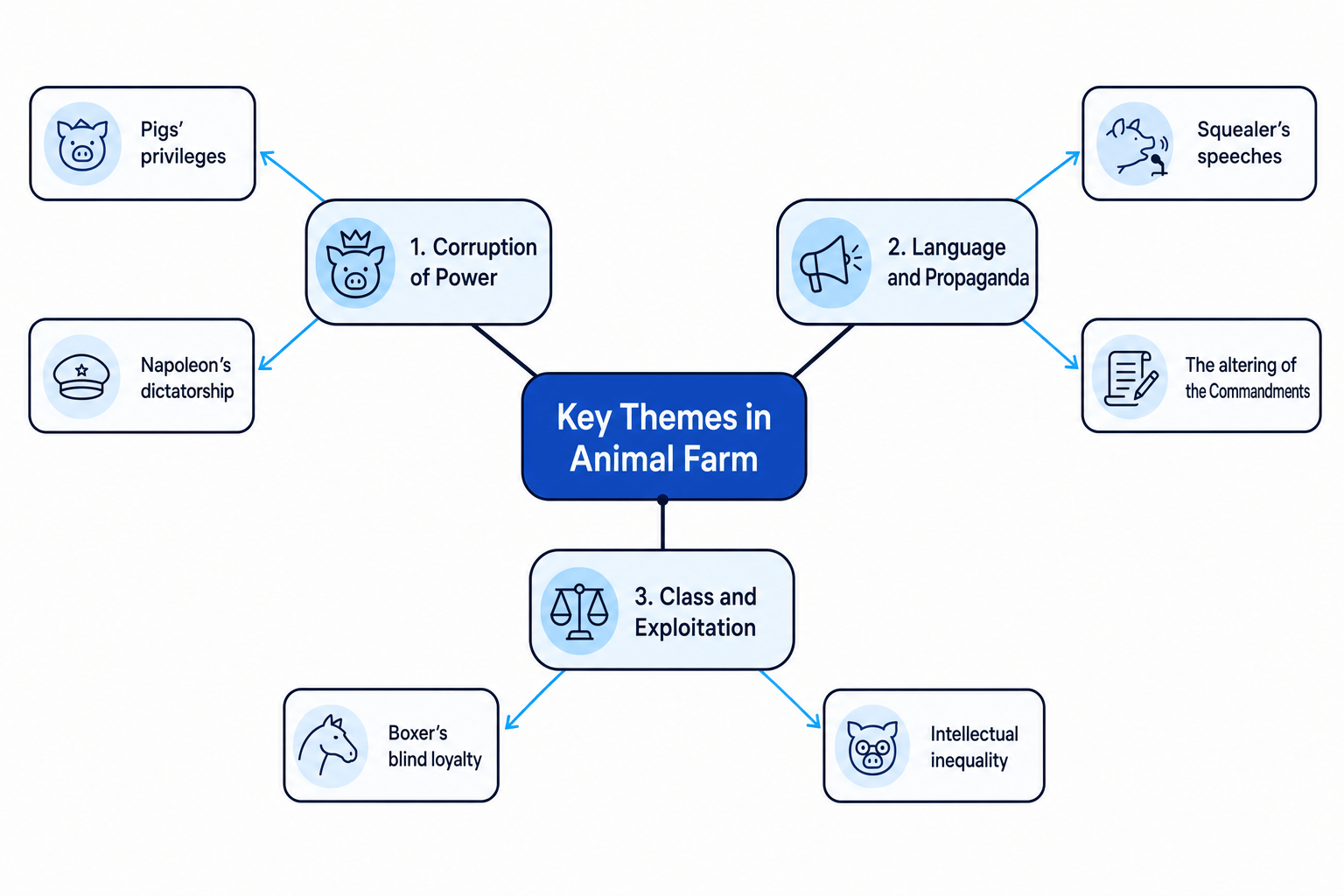
Theme 1: The Corruption of Power and Totalitarianism
At the start of the novella, the animals rebel to escape the tyranny of human rule. They dream of a fair, equal society based on "Animalism". However, Orwell uses the rapid rise of the pigs to show that power inevitably corrupts those who hold it.
Totalitarianism
Totalitarianism is a political system where the state holds total authority over society and controls all aspects of public and private life, usually led by a single dictator.
The descent into totalitarianism begins almost immediately after Mr Jones is expelled:
- The Milk and Apples: In Chapter 3, the pigs take the fresh milk and windfall apples for themselves. Squealer justifies this by claiming the pigs need "brainwork" food to keep Mr Jones away. This is the first step toward inequality.
- Napoleon's Consolidation of Power: Napoleon uses fear and violence—symbolised by his nine fierce dogs (representing Stalin's secret police)—to chase Snowball off the farm in Chapter 5. This eliminates all democratic debate.
- The Cult of Personality: By the end of the novel, Napoleon is referred to in god-like terms, such as "Our Leader, Comrade Napoleon", and is credited with every piece of good fortune on the farm.
The final, chilling image of the book shows the pigs wearing human clothes, drinking alcohol, carrying whips, and standing on two legs. The transformation is complete: the liberators have become the oppressors.
The Cyclical Nature of Tyranny
Orwell’s ultimate message about power is that revolutions often end up replacing one tyrant with another. By the end of Chapter 10, the animals look "from pig to man, and from man to pig... but already it was impossible to say which was which." The structure of the novel is cyclical; the animals end up exactly where they started, under an oppressive regime.
Theme 2: Language, Propaganda, and Education
One of Orwell’s deepest concerns was how political leaders use language to distort the truth. In Animal Farm, the pigs use language as a psychological weapon to control the other animals and maintain their power.
Propaganda
Propaganda is information, especially of a biased, misleading, or outright false nature, used by a political regime to promote a specific point of view and manipulate public opinion.
This theme is developed through several key methods:
Squealer’s Rhetoric
Squealer acts as Napoleon’s propaganda minister. He uses sophisticated language, statistics, and logical fallacies to confuse the animals. When rations are cut, Squealer calls it a "readjustment," never a "reduction."
He also uses rhetorical questions to exploit the animals' deepest fear, repeatedly asking: "Surely, comrades, you do not want Jones back?"
The Rewriting of History and Law
The Seven Commandments, painted on the barn wall, are the constitutional foundation of Animalism. Over time, the pigs secretly alter these commandments to justify their own corrupt, human-like behaviour:
- "No animal shall sleep in a bed" becomes "No animal shall sleep in a bed with sheets" (Chapter 6).
- "No animal shall drink alcohol" becomes "No animal shall drink alcohol to excess" (Chapter 8).
- "No animal shall kill any other animal" becomes "No animal shall kill any other animal without cause" (Chapter 8).
Eventually, all commandments are replaced by a single, self-contradictory paradox: "All animals are equal, but some animals are more equal than others."
Overlooking the Uneducated Animals
Many students write about the pigs' clever propaganda without mentioning the other animals' lack of education. The pigs' manipulation only works because the other animals cannot read or remember the past clearly. Education is a tool of empowerment; without it, the working-class animals are helpless against political lies.
Theme 3: Class Divide and the Exploitation of the Working Class
Orwell was a passionate socialist who believed in the working class, but Animal Farm presents a tragic view of how easily the working class can be betrayed by their leaders.
The animal society quickly splits into two distinct classes:
- The Intelligentsia (The Pigs): The intellectual elite who perform no physical labour but make all the decisions.
- The Proletariat (The Working Animals): The manual labourers, represented by Boxer, Clover, and the sheep, who do all the work but have no political voice.
Boxer as a Symbol of the Working Class
The loyal cart-horse Boxer represents the Russian working class (the Stakhanovite movement). He is strong, self-sacrificing, and deeply decent. His two personal maxims are:
- "I will work harder."
- "Napoleon is always right."
Boxer trusts the pigs blindly, outsourcing his critical thinking to his leaders. Tragically, when Boxer becomes too old and injured to work, Napoleon does not reward his loyalty; instead, he sells him to the knacker (the glue boiler) to buy a crate of whisky for the pigs.
Analysing Boxer's Death
In your essays, highlight the deep dramatic irony of Boxer’s death. The animals are told he died peacefully in a hospital, but the reader knows Squealer is lying. Orwell uses Boxer's fate to show that totalitarian regimes value human beings (and animals) only for their utility; once you are no longer useful to the state, you are discarded.
Analysing the Theme of Language and Power
When writing your exam response, you must explain how Orwell uses specific methods to convey his themes. Here is a step-by-step walkthrough of how to construct a high-level analytical paragraph focusing on the theme of language and political manipulation.
Analysing the theme of language and power
Focus Quote: "All animals are equal, but some animals are more equal than others." (Chapter 10)
-
State your point clearly (AO1): Show how the quote relates to the theme.
Example: "Orwell uses the ultimate corruption of the Seven Commandments to demonstrate how totalitarian regimes manipulate language to justify inequality and maintain an absolute class divide."
-
Analyse Orwell's linguistic methods (AO2): Identify the specific literary techniques in the quote and explain their effect.
Example: "The phrase is a deliberate paradox. The adjective 'equal' is absolute—mathematically, something cannot be 'more equal' than something else. By combining 'equal' with the comparative modifier 'more', Orwell highlights the logical absurdity of the pigs' regime. The pigs use this linguistic distortion to maintain the illusion of democracy while simultaneously cementing their elite status."
-
Link to historical context and the writer's purpose (AO3): Explain why Orwell wrote this and how it relates to his real-world message.
Example: "This reflects Orwell's critique of Soviet Russia under Stalin, where the original Marxist dream of a classless society was betrayed by a ruling elite. Through this linguistic corruption, Orwell warns his audience that when citizens lose the ability to critically question political language, they lose their capacity to resist tyranny."
In the exam
- Avoid simply retelling the plot: The examiner knows what happens to Boxer and Snowball. You must focus on why Orwell chose to write these events and how they develop his key themes.
- Weave context (AO3) into your analysis: Never write a standalone paragraph of history. Instead, connect Stalin, the Soviet secret police, or Pravda directly to the themes of corruption, violence, and propaganda on the farm.
- Trace the development of a theme: A strong essay shows how a theme evolves from Chapter 1 to Chapter 10. For instance, show how the pigs' corruption starts with small privileges (milk and apples) and escalates to murder (the executions in Chapter 7) and total betrayal (selling Boxer).
- Use precise terminology: Don't just say "Orwell uses words"; say "Orwell uses Squealer's deceptive rhetoric, the cynical altering of the commandments, and the symbolic characterisation of Boxer..."
Check yourself
- Why does Orwell use the cyclical structure of the farm reverting to its original state (and name) at the end of the novel?
- How does the character of Benjamin the donkey relate to the theme of education and political apathy?
- What is the thematic significance of the sheep's changing chant, from "Four legs good, two legs bad" to "Four legs good, two legs better"?
