Great Expectations is much more than a story about a young boy growing up; it is Charles Dickens’s fierce critique of Victorian society. By examining Pip's journey, Dickens explores what happens to a person's soul when they value wealth and social status over loyalty, love, and integrity.
Understanding these themes is your key to unlocking top-tier marks in your GCSE English Literature exam (AO1 and AO3).
What you'll learn:
- How Dickens redefines the Victorian concept of a "gentleman" to expose the corruption of high society.
- How the psychological conflict between ambition and moral integrity shapes the novel's structure.
- How the recurring motifs of crime, guilt, and the law serve as a metaphor for societal injustice.
Social Class, Wealth, and the "Gentleman"
To a Victorian reader, a "gentleman" was someone born into wealth, land, and privilege, or someone who did not have to perform manual labour. Dickens uses Pip’s story to thoroughly deconstruct and challenge this definition.
Gentleman
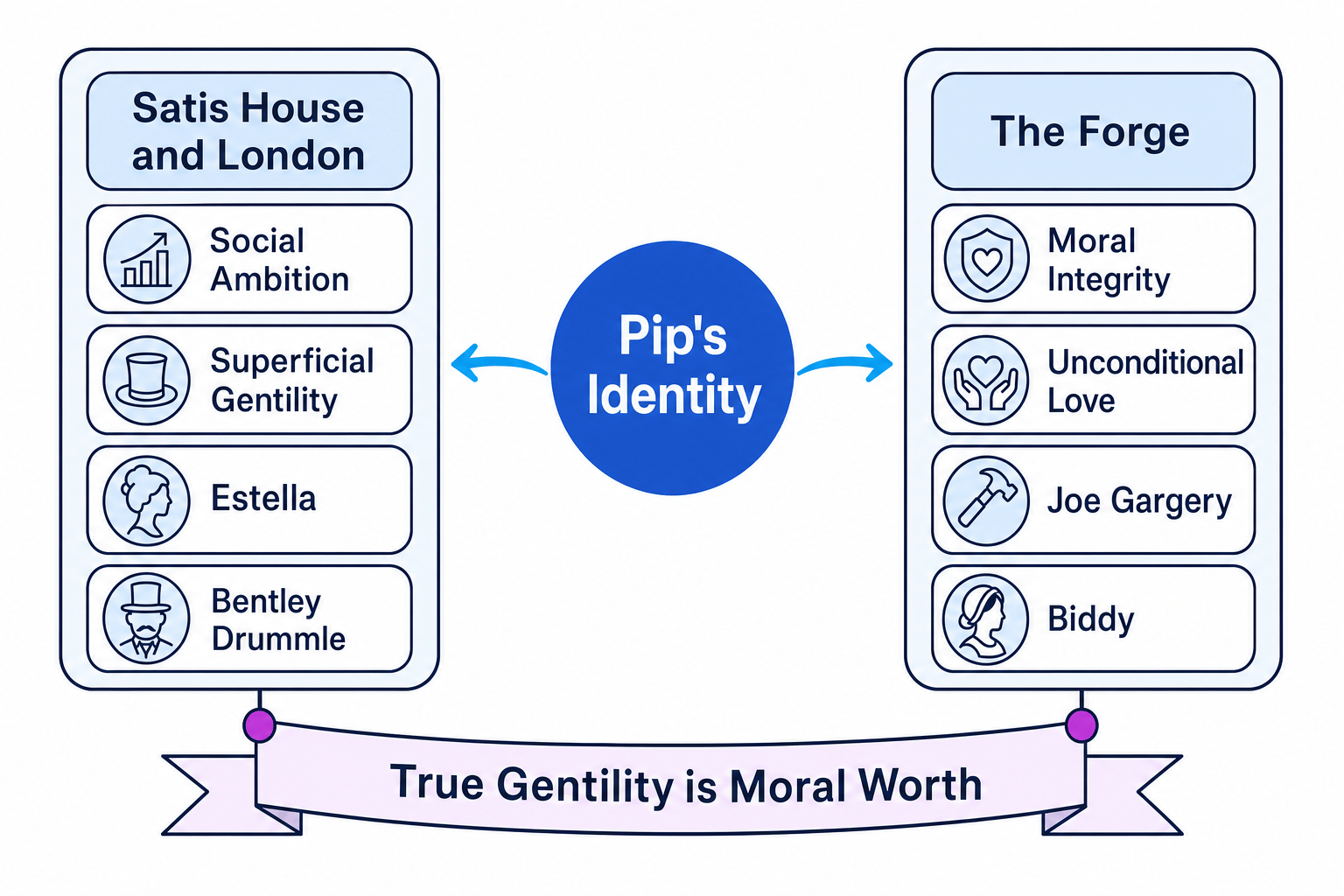
In Victorian society, a gentleman was defined by his high social status, wealthy background, and refined manners. Dickens redefines this term in the novel, suggesting that true "gentility" is a matter of moral character, emotional warmth, and integrity, rather than wealth or birth.
Pip’s desire to change his social class is ignited in Chapter 8 when he visits Satis House and meets Estella. She mocks him for his working-class origins, calling him a "common labouring-boy" and pointing out his "coarse hands" and his "thick boots". From this moment, Pip associates his working-class life at the forge with shame and ignorance.
However, Dickens systematically reveals that the upper classes are often morally bankrupt, cruel, and corrupt:
- Bentley Drummle: An aristocrat by birth, Drummle is wealthy but described as "idle, proud, niggardly, suspicious, and cantankerous". He is physically brutal and ultimately abuses Estella. He represents the failure of the traditional "gentleman".
- Joe Gargery: A poor, illiterate blacksmith who represents pure moral goodness. Joe is loyal, loving, and content with his life. When Pip is ashamed of him, it is Pip who loses his moral compass, not Joe.
- Magwitch: A despised, escaped convict who sacrifices everything to turn Pip into a gentleman. Ironically, Pip’s refined lifestyle is funded by "dirty" money earned by a criminal in the colonies.
The Paradox of Class
In Great Expectations, those of the highest social standing (like Bentley Drummle or Miss Havisham) are often the most corrupt or emotionally damaged, while those at the bottom of the social hierarchy (like Joe or Magwitch) possess the greatest capacity for love, loyalty, and true nobility.
Ambition and Self-Improvement
Great Expectations is a classic Bildungsroman (a novel tracing the spiritual, moral, and social development of a protagonist from youth to adulthood).
Pip's ambition operates on three levels:
- Educational: He wants to learn to read and write (first aided by Biddy) to escape his "ignorance".
- Social: He wants to become a wealthy London gentleman to be worthy of Estella.
- Moral: This is the level Pip initially ignores, but eventually masters by the end of the novel.
Pip’s ambition is deeply flawed because it is rooted in vanity and dissatisfaction. He confesses to Biddy, "I want to be a gentleman on [Estella's] account," showing that his desires are external rather than internal. Once he receives his fortune, he becomes snobbish, idle, and neglectful of those who loved him. He even admits to wanting to "make Joe a gentleman so that he would be worthier of my society"—a line dripping with tragic irony, as Joe is already far superior to Pip in moral worth.
Confusing Dickens's message on ambition
Do not write that Dickens is against self-improvement. He valued education and hard work deeply. What Dickens criticises is superficial ambition—ambition that requires you to sacrifice your integrity, betray your friends, and value appearances over reality.
Guilt, Justice, and the Law
Throughout the novel, Dickens uses a gothic atmosphere and the recurring imagery of handcuffs, leg-irons, and prisons to develop the theme of guilt and justice.
Pip is haunted by guilt from the very opening chapters. This guilt operates on two levels:
1. Personal Conscience
When Pip steals the pork pie and file for Magwitch in Chapter 2, he develops an acute, obsessive sense of guilt. He expects every constable, gate-post, and even the cattle to accuse him. This psychological guilt follows him to London, where he constantly feels "complicit" in criminal acts, particularly through his association with Jaggers and the criminal justice system.
2. Societal Injustice
Dickens uses the legal system to expose how Victorian society treats the poor.
- The "Hulks" (prison ships): These dark, decaying ships loom over the marshes, symbolising a society that locks its problems away rather than solving them.
- Compeyson vs. Magwitch: In court, Compeyson (a gentlemanly fraudster) receives a light sentence, while Magwitch (an uneducated, impoverished orphan) receives a brutal sentence. Dickens uses this to show that the law is biased; it judges people on their social class and appearance rather than their actual guilt.
Jaggers as a symbol of the law
As a criminal lawyer, Jaggers represents the cold, mechanical, and unfeeling nature of the Victorian legal system. He constantly washes his hands with scented soap to symbolically cleanse himself of the filth and guilt of his clients, showing that the law is dirty business.
Love, Rejection, and Companionship
Love in Great Expectations is rarely healthy; instead, it is often destructive, obsessive, and manipulative.
- Miss Havisham and Estella: Miss Havisham's heart was broken when she was jilted on her wedding day. She uses Estella as a weapon of vengeance, teaching her to "steal her heart away and rob her" of men's affections. Estella is raised without the capacity to love, warning Pip directly, "I have no heart... I have no softness there, no sympathy, sentiment, nonsense."
- Pip's Obsession: Pip’s love for Estella is masochistic. He loves her "against reason, against promise, against peace." This love is tied to his social ambition; he desires her because she represents the elite world he wants to enter, even though she brings him constant misery.
- The Healing Power of Unconditional Love: It is only when Pip loses his fortune and falls ill that he experiences true love. Joe travels to London to nurse him back to health, paying off Pip's debts without expecting anything in return. This acts as Pip's moral salvation.
Look for structural contrasts
Always contrast the cold, artificial environment of Satis House (where love is dead and rotting like the wedding cake) with the warm, lively environment of the Wemmick household (The Castle at Walworth) or the Forge. This contrast highlights where genuine human connection resides.
Walkthrough: Analysing Class in an Essay
Here is how you can build a high-scoring paragraph (AO1, AO2, AO3) exploring how Dickens presents the theme of social class.
Analysing Dickens's presentation of social class through Joe Gargery
- Point (AO1): Dickens uses the character of Joe Gargery to challenge Victorian assumptions that social class dictates a person's moral and spiritual value.
- Evidence (AO1): This is evident when Joe visits Pip in London. Feeling out of place in Pip’s fancy apartments, Joe explains his departure by saying, "I am not in a side of country to be right in these clothes... I'm wrong out of the forge."
- Analysis of Method (AO2): The noun "forge" acts as a powerful symbol of honest, productive manual labour and moral purity. Dickens uses Joe's simple, non-standard dialect ("I am not in a side of country") to contrast with Pip's newly acquired, pretentious speech. Through Joe's self-awareness of being "wrong" in gentlemanly attire, Dickens employs situational irony: the illiterate blacksmith possesses the dignity and self-knowledge that Pip, with all his expensive education, has completely lost.
- Context (AO3): In Victorian Britain, the industrial revolution led to a rising middle class obsessed with external markers of gentility. By presenting Joe as "this gentle Christian man" who is spiritually superior to London's elite, Dickens directly attacks class snobbery and urges his readers to value Christian charity and integrity over social mobility.
In the exam
- Avoid "Device Spotting": Do not just list literary terms like "metaphor" or "contrast". Always explain how the writer uses that method to develop the theme (e.g., "Dickens uses the decaying setting of Satis House to symbolise the moral decay of the upper classes...").
- Track the Character Arc: Themes in a Bildungsroman are dynamic, not static. Show how Pip's understanding of "gentility" or "guilt" changes from the beginning (marsh childhood) to the middle (London snobbery) to the end (redemption).
- Integrate Context Seamlessly: Never write a separate "context paragraph" at the end. Instead, weave it into your analysis. For example, explain why Victorian readers would be shocked by Magwitch being Pip's benefactor, linking it directly to class prejudices of the 1860s.
Check yourself
- Why does Pip feel a sense of "criminal complicity" even before he starts receiving his fortune in London?
- In what ways does Bentley Drummle act as a dramatic foil (contrast) to Joe Gargery?
- How does Dickens use the contrast between the atmosphere of the Marshes and the atmosphere of London to explore the theme of ambition?
