

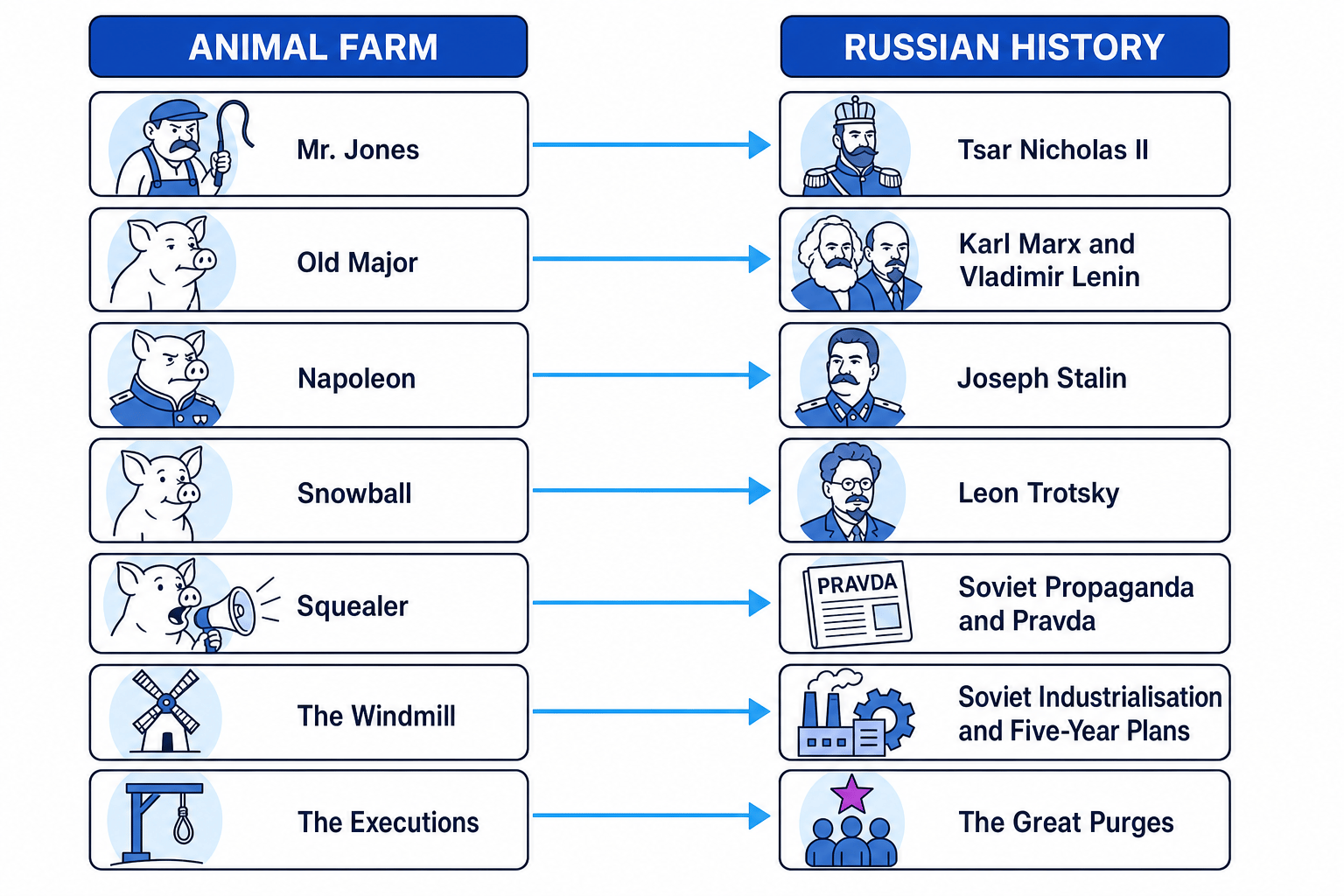
3. George Orwell's Purpose
Many students make the mistake of thinking Orwell wrote Animal Farm because he hated socialism. This is completely false.
Orwell's Political Position
Orwell was a committed democratic socialist. He believed in social equality, worker control of industries, and free education. He did not write Animal Farm to attack socialism, but to show how Stalin's dictatorship had corrupted and betrayed the true ideals of socialism.
Orwell had firsthand experience of this corruption. In 1936, he went to fight in the Spanish Civil War on the side of the anti-fascist Republican government. While there, he witnessed Soviet-backed communists hunting down, arresting, and executing other left-wing groups (socialists and anarchists) who disagreed with Moscow. This deeply shocked him and made him realize how dangerous totalitarianism was, regardless of whether it claimed to be "left-wing" or "right-wing".
When Orwell returned to England, he was frustrated that many British intellectuals and politicians turned a blind eye to Stalin’s atrocities because Russia was Britain’s ally against Nazi Germany in World War II. He wrote Animal Farm to wake Western readers up to the reality of the Soviet regime.
4. Applying Context to the Exam (AO3)
In the exam, you should never write a separate paragraph of pure history. The examiner wants to see you weave context into your analysis of Orwell's methods.
The 'History Dump'
Do not write a paragraph of pure historical facts (e.g., "The Russian Revolution happened in 1917 because Tsar Nicholas II was bad..."). This is a literature exam, not a history exam. You will not get AO3 marks unless you link these facts directly to Orwell's choices of language, structure, and characterisation.
Let's look at how to construct a high-level analytical paragraph that integrates AO3 properly.
Deconstructing propaganda in Squealer's 'milk and apples' speech
Here is a step-by-step method for incorporating context (AO3) with language analysis (AO2) and a clear personal response (AO1).
-
Focus on the writer's method (AO2) and character action (AO1): Identify how Squealer uses manipulative language in Chapter 3 to justify why the pigs took the milk and apples.
Example: Squealer uses pseudo-scientific language ("Science, comrades, has proved") and creates a false sense of selflessness, claiming the pigs consume these things solely to "preserve [their] health" for the sake of the other animals.
-
Embed a direct, short quote and analyze its rhetorical effect (AO2):
Example: Squealer seals his argument with the threatening rhetorical question: "Surely, comrades, you do not want Jones back?" The word "surely" acts as a powerful linguistic trap, making dissent seem foolish or treacherous, while "Jones" is used as a psychological weapon to exploit the animals' fear.
-
Explicitly link this analysis to Orwell's contextual purpose (AO3): Explain how this reflects the real-world history of Soviet propaganda.
Example: Through Squealer's rhetoric, Orwell satirises the historical Soviet propaganda machine, specifically the state newspaper Pravda. Just as Stalin's regime fabricated threats and used the fear of returning to the oppressive Tsarist rule to silence criticism of their own growing privileges, Orwell demonstrates how totalitarian leaders use external threats as a tool of psychological manipulation to maintain hierarchy and suppress democratic debate.
The magic formula for AO3
To keep your context focused on literature, use active phrases that credit Orwell with a conscious choice:
- "Orwell uses the character of Squealer to satirise..."
- "This directly mirrors the real-world..."
- "Orwell's experience in Spain influenced his depiction of..."
- "By choosing the fable form, Orwell exposes..."
In the exam
- Never treat context as an afterthought: Do not just "tack on" historical facts at the end of your paragraph. Keep your focus on Orwell's authorial intent from the start.
- Focus on Orwell's message: Ask yourself why Orwell wanted the reader to notice these parallels. What is his warning to the reader? (e.g. He warns us about the dangers of political apathy, blind obedience, and the corruption of language).
- Remember the literary form: Keep referencing the fact that the text is an allegory and a satire. Use these terms comfortably throughout your essay to show you understand how Orwell is delivering his contextual message.
Check yourself
- Why did Orwell choose to make the ruling class pigs rather than another animal? What does this say about his satirical intent?
- How does the transformation of the Seven Commandments throughout the novel reflect the rewriting of history in Stalinist Russia?
- What was Orwell’s political stance, and why is it incorrect to call Animal Farm a "critique of socialism"?
