

To secure a high grade in your GCSE English Literature exam, you must go beyond simply memorising what happens in Animal Farm. You need to understand how George Orwell structures the narrative to deliver his political message.
In this guide, you will learn:
- The five key stages of the narrative arc in Animal Farm.
- How Orwell uses a cyclical structure to show that the revolution has failed.
- How to write about plot structurally rather than just retiteling events.
Mastering Narrative Structure
Before diving into the chapter-by-chapter events, it is essential to understand the structural framework Orwell uses. Animal Farm is not just a story about farm animals; it is a carefully crafted political allegory.
Allegory
An allegory is a story, poem, or picture that can be interpreted to reveal a hidden political, historical, or moral meaning. In Animal Farm, the characters and events directly parallel the figures and events of the Russian Revolution of 1917 and the subsequent rise of Stalinism.
Fable
A fable is a short narrative making a moral point, traditionally using personified animals as characters. Orwell uses the simplicity of the fable format to make his complex political critique accessible and universally applicable.
To write an effective essay, you must analyze how the plot moves from hope to despair. The narrative follows a traditional tragic arc, which can be mapped onto Freytag's Pyramid.
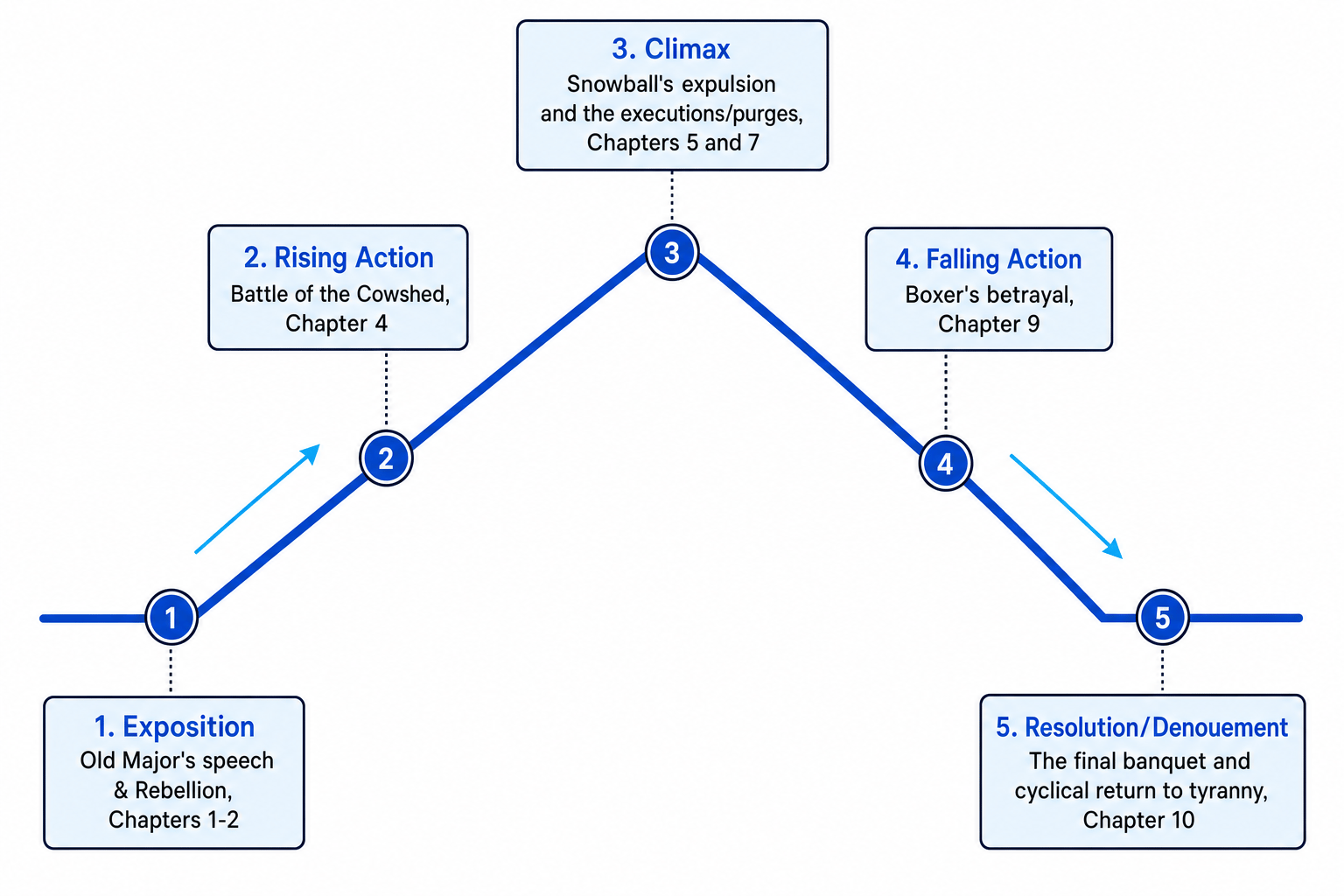
The Five Stages of the Plot
1. Exposition (Chapters 1–2)
The novel opens at Manor Farm, where the human owner, Mr Jones, is introduced as an irresponsible, drunken tyrant. This represents the corrupt rule of Tsar Nicholas II.
The respected prize Middle White boar, Old Major, calls a meeting in the barn. He shares his utopian vision of a world where animals are free from human exploitation, introducing the song Beasts of England.
The Spark of Rebellion
Old Major’s speech serves as the ideological catalyst (representing Marxist theory). When Major dies three days later, three younger pigs—Napoleon, Snowball, and Squealer—codify his teachings into "Animalism". The Rebellion happens unexpectedly when Jones forgets to feed the animals; they revolt, drive him off the land, and rename the property "Animal Farm".
2. Rising Action (Chapters 3–4)
Initially, the revolution is highly successful. The animals experience a golden age of freedom and cooperation:
- The harvest is more abundant than it ever was under Jones.
- Snowball writes the Seven Commandments on the barn wall, summarizing the core principles of Animalism.
- Literacy classes are established, though most animals fail to learn.
- In Chapter 4, the humans attempt to retake the farm. Led by Snowball's brilliant military strategy, the animals successfully defend themselves in the Battle of the Cowshed.
3. Climax (Chapters 5–7)
The climax is the critical turning point of the text where the ideological dream of the revolution is violently shattered.
- Chapter 5 (The Ideological Climax): Snowball and Napoleon clash over the construction of a windmill. When Snowball wins the intellectual argument, Napoleon unleashes nine ferocious dogs he has secretly reared. Snowball is violently chased off the farm. This marks the end of democratic debate; Napoleon abolishes Sunday meetings and establishes an absolute dictatorship.
- Chapter 7 (The Physical Climax): Facing starvation and rebellion from the hens (who smash their own eggs), Napoleon stage-manages a series of brutal show trials. Animals are forced to confess to fabricated crimes of conspiring with Snowball, and the dogs rip their throats out on the spot. This is the ultimate betrayal of the commandment "No animal shall kill any other animal".
Confusing the Climax
Many students think the climax is the final scene where the pigs look like humans. However, structurally, the climax is where the main conflict reaches its highest tension and the protagonist's fate is sealed. In Animal Farm, the climax spans Chapters 5 to 7, when Snowball is exiled and the purges begin. Once terror is established as the primary tool of state control, the tragic ending becomes inevitable.
4. Falling Action (Chapters 8–9)
During the falling action, we watch the gradual decay of the animals' lives and the systematic rewriting of history.
- The pigs slowly alter the Seven Commandments to justify their human-like vices (e.g., "No animal shall sleep in a bed" becomes "No animal shall sleep in a bed with sheets").
- In Chapter 8, the farm is attacked by the neighboring human farmer, Frederick, in the Battle of the Windmill. Though the animals win, the windmill they spent years building is destroyed.
- In Chapter 9, Boxer, the loyal cart-horse who represents the working class, collapses from overwork. Squealer promises he is being sent to a human hospital, but Benjamin the donkey reads the side of the van: Boxer has been sold to a horse slaughterer (knacker) to buy whisky for the pigs.
5. Resolution & Denouement (Chapter 10)
Years pass, and the memory of the Rebellion fades for most animals. The farm has grown richer, but only the pigs and dogs enjoy the wealth.
Cyclical Structure
A cyclical structure is a narrative technique where the ending of a story mirrors its beginning. In Animal Farm, Orwell uses this structure to show that despite the suffering and sacrifice of the revolution, the animals have simply swapped one group of tyrants (humans) for another (pigs).
The final scene of the novel takes place in the farmhouse. The pigs are hosting a dinner party for local human farmers. The Seven Commandments have been erased and replaced with a single, corrupt paradox:
"All animals are equal, but some animals are more equal than others."
As the common animals peer through the window, they watch Napoleon play cards with Mr. Pilkington. They look from pig to man, and from man to pig, and realize they can no longer tell which is which. The transition back to tyranny is complete; the farm is even renamed "Manor Farm".
Analysing the Turning Point
In your GCSE exam, you will be asked to analyse how Orwell presents a theme or character. To gain top marks for structural analysis (AO2), you must be able to write about how a scene acts as a pivot in the plot.
Analysing a structural turning point
Below is a step-by-step breakdown of how to write an analytical paragraph about the expulsion of Snowball in Chapter 5.
- State the structural pivot clearly: Start by identifying how the scene shifts the plot trajectory from hope to oppression.
- Drafting: Orwell uses Chapter 5 as the structural turning point of the novel, marking the abrupt transition from a hopeful democracy to a brutal totalitarian dictatorship.
- Select precise, short evidence: Quote the sudden, violent arrival of the dogs.
- Drafting: This shift is dramatised when Napoleon's secret dogs "bound into the barn" and chase Snowball away, leaving the other animals "silent and terrified."
- Analyse Orwell's methods and word choices: Discuss the immediate consequences of this plot event and how language is manipulated.
- Drafting: The verb "bound" conveys the sudden, aggressive nature of this coup d'état, illustrating that brute force has officially replaced democratic debate. Immediately after this plot event, Napoleon abolishes the Sunday debates. This structural choice is highly significant; it demonstrates how dictators systematically silence opposition to consolidate power. Squealer's subsequent manipulation of the animals’ memories of the Battle of the Cowshed further highlights how control of the narrative follows physical dominance.
- Link to context and Orwell's message (AO3): Explain how this plot turning point mirrors real history.
- Drafting: Through this pivotal plot shift, Orwell allegorises the historical power struggle between Joseph Stalin (Napoleon) and Leon Trotsky (Snowball) in the late 1920s. By structuring the expulsion of Snowball as a violent shock, Orwell warns his contemporary Western readers that totalitarianism does not arrive overnight, but is built through the strategic elimination of free speech and political rivals.
Pitfalls and Exam Tips
Avoid the 'Retelling' Trap
The most common mistake students make on Paper 2 is simply writing down the plot from memory (e.g., "First Old Major gave a speech, then they rebelled, then the pigs took over..."). The examiner already knows the plot! You must always explain why Orwell chose to arrange the events this way. Use analytical phrases like: "Orwell structures the narrative to contrast..." or "The placement of Boxer's death directly after...".
Do Not Treat the Animals as Real Animals
Always refer to the characters as literary constructs. Instead of writing "Boxer was very hard-working but stupid," write "Orwell uses the character of Boxer to represent the exploited, uneducated Soviet working class, whose unquestioning loyalty leads to their own destruction."
In the exam
When writing about the plot of Animal Farm, follow these three structural guidelines:
- Map the trajectory: Always trace how the scene in the extract fits into the wider tragic, cyclical arc of the novel. Does it represent the hope of the early chapters, or the corruption of the later ones?
- Contrast the beginning and the end: To demonstrate a deep understanding of the cyclical structure, contrast the idealistic goals of Old Major's speech in Chapter 1 with the grim reality of Chapter 10.
- Anchor your analysis to Orwell’s intent: Always link plot events to Orwell's political purpose as a democratic socialist writing in 1945. Ask yourself: What warning is Orwell trying to give the reader through this specific event?
Check yourself
Before moving on to the characters and themes, make sure you can answer these questions:
- What is the difference between the "climax" of the plot and the "resolution" of the plot in Animal Farm?
- How does the change in the name of the farm at the start and the end of the novel reflect its cyclical structure?
- Why is Chapter 5 considered the ideological turning point of the narrative?
