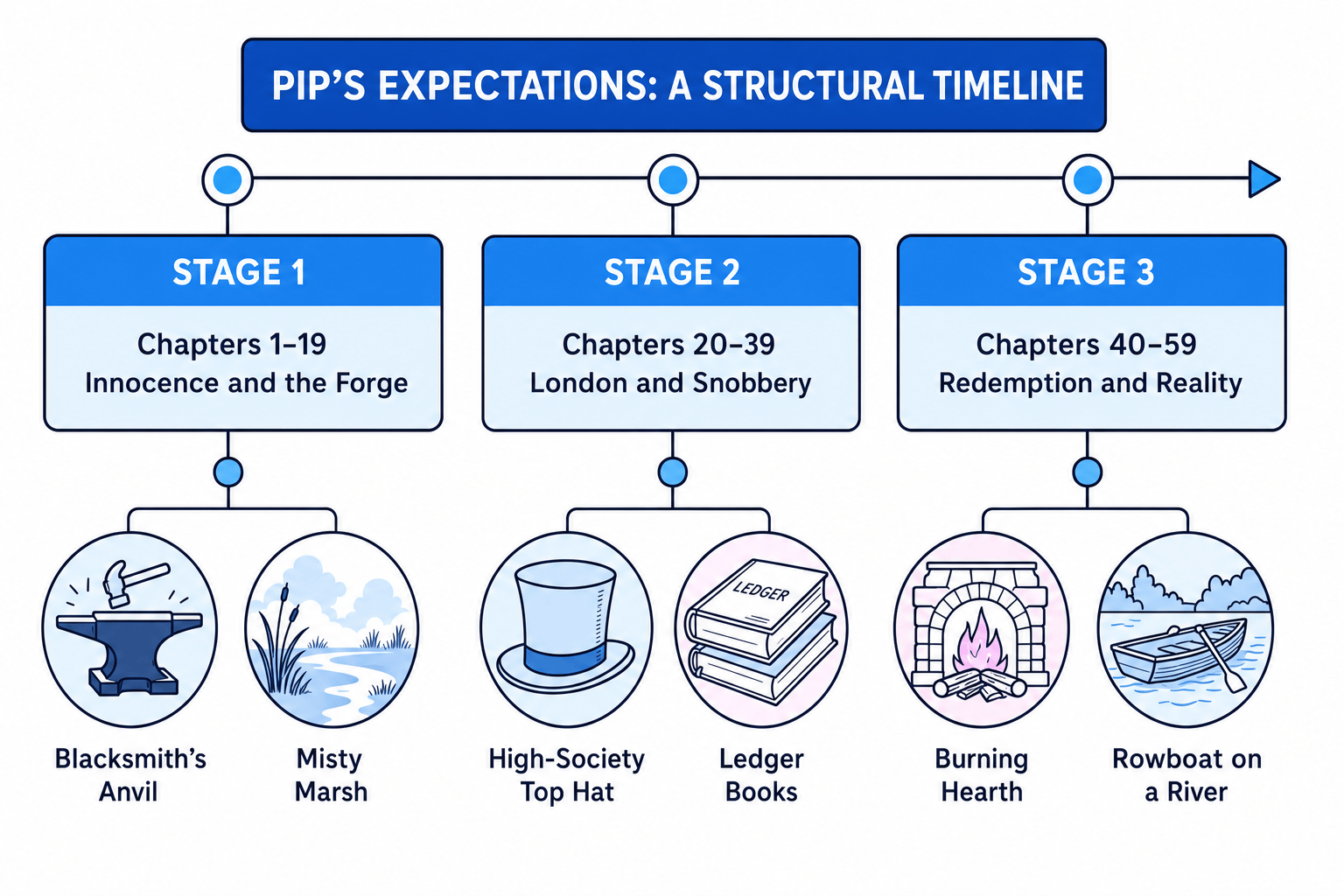
Stage One: Innocent Youth (Chapters 1–19)
The Catalyst on the Marshes
The novel opens on the bleak Kent marshes. This setting uses pathetic fallacy—the cold, damp mist reflects the confusion of Pip's childhood and his vulnerable position as an orphan "brought up by hand" by his abusive sister, Mrs. Joe, and her kind husband, the blacksmith Joe Gargery.
The key plot catalyst occurs in Chapter 1 when Pip encounters the escaped convict, Abel Magwitch. Terrified, Pip steals food (mincemeat and brandy) and a file from Joe's forge to help him. Although Magwitch is soon recaptured, this act of childhood desperation binds Pip’s fate to the criminal underworld forever.
The Corruption of Ambition at Satis House
Pip is summoned to Satis House, the decaying mansion of the wealthy, eccentric Miss Havisham. There, he meets the beautiful but cold Estella.
- The turning point: Before Satis House, Pip was content to become Joe’s apprentice. Estella’s cruel mockery of his "coarse hands" and "common boots" sparks a deep sense of shame in Pip.
- The new desire: Pip develops a desire to transcend his social class, declaring to Biddy: "I want to be a gentleman". He falsely associates wealth and high social status with moral superiority.
The Unexpected Fortune
Just as Pip is resigned to his dull life at the forge, the London lawyer Mr. Jaggers arrives in Chapter 18. He announces that Pip has "great expectations"—a massive fortune from an anonymous benefactor. Pip assumes the benefactor is Miss Havisham, believing she wants to groom him to marry Estella.
Confusing the Benefactor's Identity
A common exam error is forgetting that Pip is completely blind to the reality of his wealth. For nearly half the novel, Pip is convinced Miss Havisham is his benefactor. Dickens uses this dramatic irony to critique Victorian society's obsession with superficial aristocracy; Pip believes his wealth comes from a clean, noble source when it actually comes from a despised convict.
Stage Two: London and Snobbery (Chapters 20–39)
Becoming a "Gentleman"
Pip arrives in London and is shocked by its filth and corruption (specifically Smithfield Market and Newgate Prison). Despite this, he quickly adapts to the superficial lifestyle of a wealthy young man, sharing lodgings with Herbert Pocket and joining an expensive club called "The Finches of the Grove."
- Moral Decline: As Pip’s financial wealth increases, his moral wealth declines. He becomes an insufferable snob. When Joe Gargery visits him in London (Chapter 27), Pip feels acute embarrassment and wishes Joe would not come near him, preferring to preserve his false social image over genuine affection.
- The Pursuit of Estella: Pip continues to pursue Estella, who is being socialised into high society to break men's hearts on behalf of Miss Havisham.
The Climax of Stage Two: The Truth Revealed
In Chapter 39, during a terrifying storm in London, Pip receives a late-night visitor. It is Abel Magwitch, who has returned from Australia under penalty of death to see the "gentleman" he has spent his life making.
The Gothic Storm
The violent storm in Chapter 39 acts as a physical manifestation of Pip's internal world collapsing. Just as the wind and rain tear through London, the revelation of Magwitch’s identity violently rips away Pip's illusions of aristocratic birth and romantic destiny.
Stage Three: Redemption and Truth (Chapters 40–59)
The Path to Maturity
Pip's initial reaction to Magwitch is absolute horror and disgust. However, Stage Three is defined by Pip’s gradual moral awakening:
- Protecting Magwitch: Pip realises that Magwitch risked his life by returning to England just to see him. Pip decides he cannot accept any more of Magwitch's money, but he vows to keep him safe from the police and Compeyson (Magwitch's nemesis).
- Forgiveness and Loss: Pip visits Satis House one last time. Miss Havisham, realising the pain she has caused, begs Pip for forgiveness before her dress catches fire. Pip saves her but is severely burned. Soon after, Estella marries the brutal Bentley Drummle, shattering Pip’s romantic delusions completely.
The Tragic Climax and Resolution
Pip and Herbert attempt to smuggle Magwitch out of the country via the River Thames, but they are betrayed by Compeyson. During the police capture, Compeyson is drowned and Magwitch is fatally injured.
As Magwitch lies dying in prison, Pip’s transformation is complete. He no longer sees a dirty convict; he sees a loyal protector. Pip tenderly holds Magwitch’s hand, telling him before he dies that his long-lost daughter (Estella) is alive and that Pip loves her.
The Moral of the Plot
True nobility is not inherited or bought; it is forged through loyalty, love, and suffering. Pip has to lose his physical fortune to regain his moral compass.
Analysing a Structural Turning Point
When writing about plot in the exam, you must show the examiner how Dickens constructs key scenes to develop his themes (AO2). Let's look at how to unpack a critical moment.
Analysing a structural turning point
Below is a step-by-step method to analyse the structural impact of Magwitch's return in Chapter 39.
- Identify the structural shift and anchor it with a precise quotation.
- Application: Chapter 39 is the literal pivot point of the novel, bridging Stage Two (artificial pride) and Stage Three (painful moral growth). Dickens uses pathetic fallacy to foreshadow the disruption: "The wet wind was blowing, and the piles of shipwright’s work aside the river were quivering".
- Analyse the writer's methods (language, imagery, or structure).
- Application: The Gothic, threatening atmosphere of the storm mimics the breakdown of Pip's high-class identity. When Magwitch enters, he is described as a "substantial", heavy presence. This physical reality contrasts with the fragile, superficial "expectations" Pip has built. The structural use of dramatic irony is resolved in this scene, turning Pip's world upside down.
- Connect this structural shift to Dickens's wider moral or social message (AO3).
- Application: Through this sudden reversal of fortune (peripeteia), Dickens exposes the hypocrisy of the Victorian class system. Pip discovers his high-class lifestyle was funded by a criminal outcast, proving that wealth is often built on the suffering and labour of the marginalised poor.
In the exam
If you are asked a question about a character or theme, you should track their development chronologically across the three stages of the plot to show structural awareness:
- Introduce the trajectory: In your introduction, outline how the character or theme evolves from Stage One through to Stage Three.
- Anchor with structural milestones: Frame your body paragraphs around key turning points (e.g., Pip's shame at Satis House in Stage 1, his rejection of Joe in Stage 2, and his care for Magwitch in Stage 3).
- Use structural terminology: Incorporate terms like catalyst, climax, peripeteia, exposition, and resolution rather than just saying "at the start / middle / end of the book".
Check yourself
Before moving on, make sure you can answer these questions:
- What are the three distinct stages of Pip's expectations, and what locations are they associated with?
- Why is Magwitch's return in Chapter 39 considered the structural climax of the novel?
- How does the ending of the novel (either the original or revised ending) resolve Pip's journey of moral growth?
