

Welcome to your study guide for George Orwell's Animal Farm. Whether you are reading this novella for the first time or revising for your GCSEs, understanding its big picture is the key to unlocking top marks.
Animal Farm is one of the most celebrated political writings in modern history. Although it is short, it is packed with layers of meaning, sharp character studies, and a powerful message about human nature and political power.
What you'll learn
- The literary genre and structure of Animal Farm as a political allegory.
- How the literal farmyard story mirrors the historical events of the Russian Revolution.
- The core theme of corrupted power and how Orwell presents it.
- How to deconstruct an exam question and frame a high-scoring thesis statement.
1. The Literary Form of Animal Farm
Before diving into the plot or characters, you must understand how Orwell chose to write this book. Orwell did not write a standard historical novel; instead, he blended three distinct literary forms.
Novella
A novella is a short, compact novel. Because it is short, every character, event, and word is highly symbolic and serves a direct purpose in conveying the writer's message.
Allegory
An allegory is a story that can be interpreted to reveal a hidden, deeper meaning. On the surface, Animal Farm is about animals rebelling against their human master; on an allegorical level, it represents the 1917 Russian Revolution and the rise of the Soviet Union.
Satire
A satire is a literary work that uses humour, irony, exaggeration, or ridicule to expose and criticise political corruption, hypocrisy, or human vice. Orwell satirises the Soviet regime by portraying its top leaders as greedy, power-hungry pigs.
The Trojan Horse of Literature
Think of Animal Farm as a Trojan Horse. On the outside, it looks like a simple, harmless children's story about talking farm animals (a fable). But once it enters your mind, the real cargo is released: a sharp, devastating attack on totalitarian dictatorship.
By using the form of a beast fable (a traditional story where talking animals teach a moral lesson), Orwell makes his complex political critique incredibly simple to understand. He strips away the confusing political jargon of the mid-20th century to show how easily ordinary people can be manipulated by those in power.
The Power of Simplicity
Orwell deliberately chose a simple, direct vocabulary and a fable-like style so that his message would be universally accessible. By masking real historical tyrants as farmyard pigs, he strips away their grand propaganda and exposes their greed and hypocrisy in its absolute purest form.
2. The Two Levels of the Allegory
To secure a high grade in your AQA exam, you must demonstrate a clear understanding of the relationship between the text and its historical context.
The diagram below shows how the key characters and locations in the literal narrative map directly onto the historical figures and concepts of the Russian Revolution.
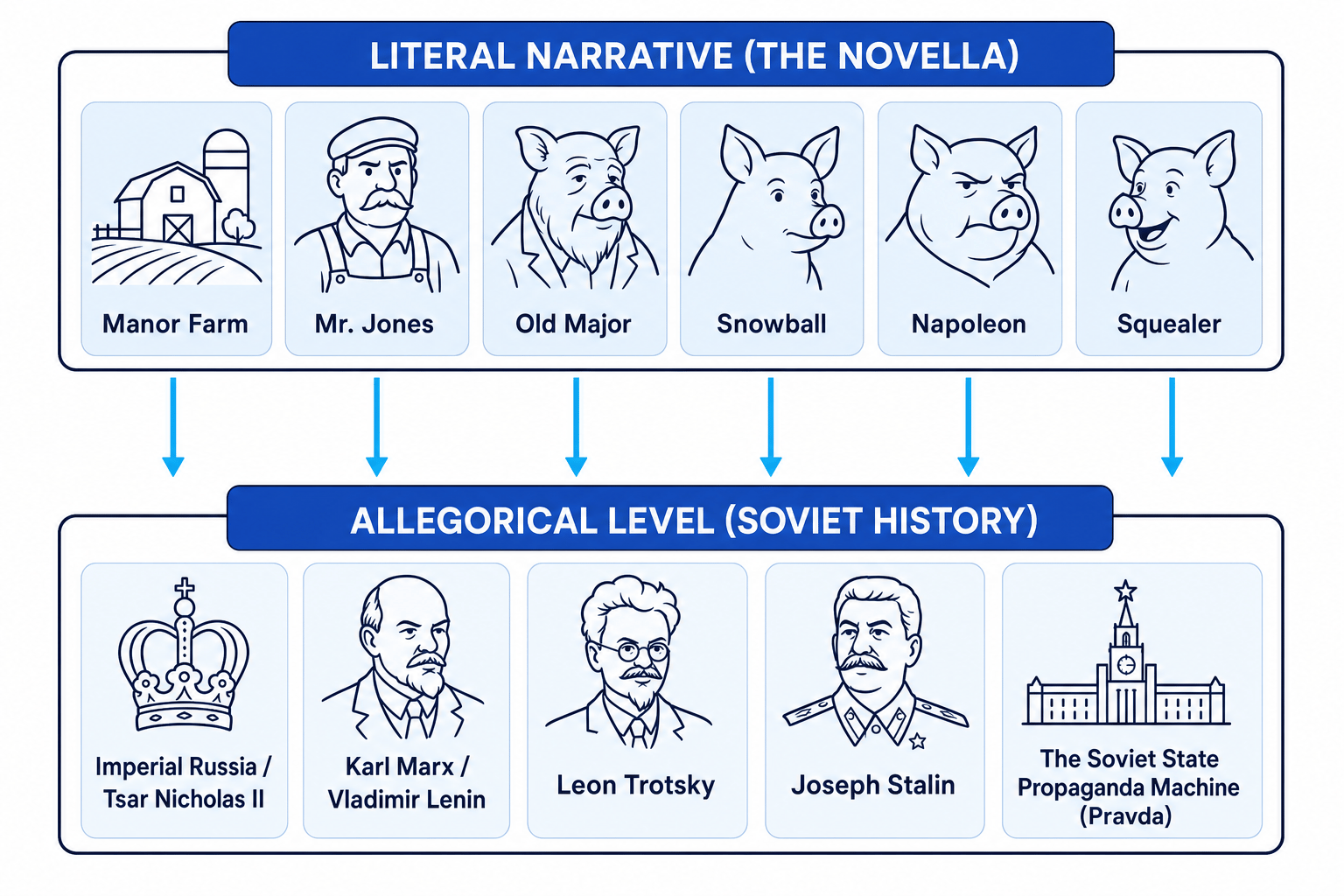
When writing about Animal Farm, you must constantly navigate between these two levels. For example, when analyzing the character of Napoleon, you should discuss his behavior on the farm (e.g., using the dogs to expel Snowball) and link this to how Joseph Stalin used the secret police (NKVD) to exile Leon Trotsky.
Do not write a history essay!
A common trap is writing too much about Trotsky, Stalin, and Russian history without analyzing Orwell’s language and literary methods. Remember: this is an English Literature exam, not a History exam. Always tie the historical context back to Orwell’s language, structure, and choices as a writer.
3. The Central Theme: The Betrayal of Idealism
At its heart, Animal Farm is an exploration of how noble ideals can be corrupted by greed, selfishness, and a thirst for power.
The story begins with Old Major's dream of a world where all animals are free from human oppression, working together in equality and harmony. This ideal is codified into "Animalism" and written on the barn wall as the Seven Commandments.
However, as the pigs take control of the farm, they slowly and secretly alter these rules to justify their own privileges. This process of corruption is structured beautifully across the ten chapters of the novella:
Idealism (Ch. 1-2) ➔ Corruption (Ch. 3-7) ➔ Dictatorship (Ch. 8-10)
The ultimate betrayal of their ideals is captured in the final, paradoxical commandment that replaces all others in Chapter 10:
"All animals are equal, but some animals are more equal than others."
Analyzing the Quote
Orwell uses a paradox (a statement that seems self-contradictory but reveals a deeper truth) to expose the hypocrisy of the ruling class. The phrase "more equal" is linguistically impossible—equality is absolute; you cannot have varying degrees of it.
By twisting the language this way, the pigs have completely rewritten the original meaning of the rebellion to make their own absolute power seem natural and fair.
Feature spotting without effect
Never simply state that Orwell uses a "paradox" or "irony" without explaining why he used it. Identifying a literary device gets you very few marks; analyzing how that device reveals the pigs' manipulative nature and how it affects the reader is what wins the higher grades.
4. Understanding the AQA Exam Structure
For AQA English Literature Paper 2, Section A, you will answer one essay question on Animal Farm.
- Time allowed: You should spend about 45 minutes on this section.
- Marks: The question is worth 30 marks, plus 4 additional marks for SPaG (Spelling, Punctuation, and Grammar).
- Format: This is a closed-book exam, meaning you will not have a copy of the novella in front of you. You must memorize key quotes and structural points before you enter the exam room.
- The Prompts: You will be given a choice of two questions (usually one focusing on a character, and one on a theme). You only answer one.
The Rule of Three
When memorizing quotes for a closed-book exam, aim for short, punchy quotes of three words or fewer (e.g., "four legs good, two legs bad", or "I will work harder"). They are far easier to recall under pressure and can be woven seamlessly into your own analytical sentences.
5. Deconstructing an Essay Prompt
Because you do not get an extract in the exam, your ability to plan and structure an essay quickly is incredibly important. Let's walk through how to deconstruct a typical essay question and build a high-scoring thesis statement.
Formulating an essay thesis on the character of Napoleon
The Question:
How does Orwell present Napoleon to explore ideas about power and control in Animal Farm?
-
Identify the key terms and their literary parameters. Highlight the core elements of the prompt. "Napoleon" is your subject, and "power and control" is your thematic focus. The phrase "How does Orwell present" tells you that you must analyze characterisation, motifs, symbols, and structural changes across the whole novella.
-
Map Napoleon's character trajectory to form structural arguments. Brainstorm three distinct stages of Napoleon’s rise to power to structure your body paragraphs:
- Stage 1 (Beginning): Napoleon's quiet accumulation of influence (stealing the milk, taking the puppies in Chapter 2-3).
- Stage 2 (Middle): The violent seizure of absolute control and the expulsion of Snowball (using terror and dogs in Chapter 5-7).
- Stage 3 (End): The complete corruption and transformation of Napoleon into a human-like tyrant (walking on two legs, wearing clothes in Chapter 10).
-
Integrate context (AO3) with Orwell's structural purpose (AO2). Ask yourself: Why did Orwell portray Napoleon this way? Napoleon is an allegory for Joseph Stalin. Orwell’s purpose is to warn Western readers that totalitarianism can happen anywhere if citizens do not remain vigilant and politically active.
-
Draft a cohesive, conceptual thesis statement. Combine your thoughts into a 2-3 sentence argument for your introduction. Avoid simply saying "Napoleon is a bad pig who takes over." Instead, write a sophisticated, analytical thesis:
- Draft: "Orwell presents Napoleon as a chilling caricature of Joseph Stalin to demonstrate how unchecked ambition can destroy revolutionary ideals. Through Napoleon's gradual transformation from a quiet schemer to a human-like tyrant, Orwell warns the reader that totalitarian regimes inevitably replace one form of oppression with another."
In the exam
- Plan for 5 minutes: Do not start writing immediately. Spend 5 minutes planning your three main arguments and jotting down the quotes you intend to use.
- Anchor your essay with a strong thesis: Your opening paragraph must directly answer the question and outline your main line of argument.
- Embed your context naturally: Do not tack historical facts onto the end of your paragraphs. Instead, integrate them directly into your analysis of Orwell's methods (e.g., "Just as Stalin used the secret police to silence dissent, Orwell uses the terrifying motif of the snarling dogs to represent...").
- Focus on the writer's intent: Always ask yourself why Orwell made a specific choice. What did he want the reader to think, feel, or realize about their own world?
Check yourself
- Can you explain the difference between the literal narrative and the allegorical narrative of Animal Farm?
- What are the three main literary genres that Orwell combines to write this book?
- Why is the final commandment, "All animals are equal, but some animals are more equal than others," considered a paradox?
